
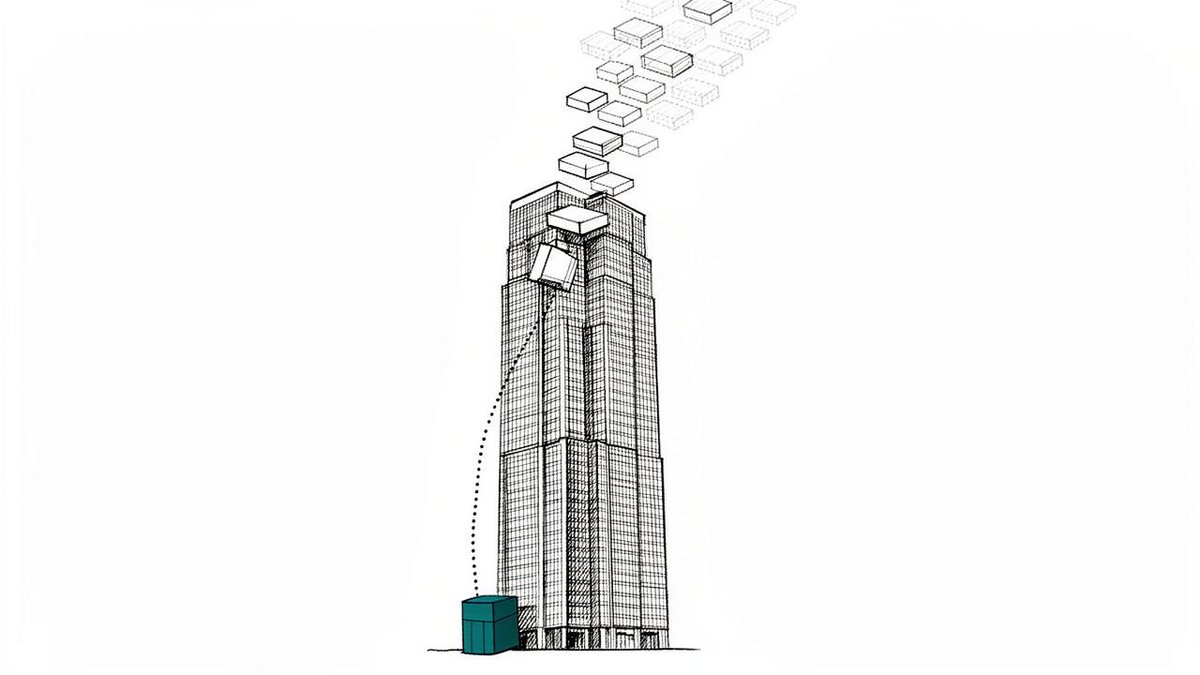
Real estate developers are stepping up their retreat from the shareholder registers of property management companies. Since November, Powerlong Real Estate and the controlling shareholder of Central China New Life have successively disclosed progress on debt workouts — the former’s stake in Powerlong Commercial Management has fallen to about 5.6%, while the latter plans to repay maturing loans with a 20% stake. With China Evergrande Property Services and Jinke Services having already changed hands, a group of property managers once spun off and listed by developers are bidding farewell to their old identity as “developer subsidiaries.”
The ownership change at Central China New Life stems from a guarantee arrangement made at the time of the spin-off. On November 18, the company announced that Chuangyi Limited, wholly owned by controlling shareholder Hu Baosen, had reached a debt restructuring agreement with lenders and a credit fund under Temasek. Chuangyi plans to use about 260 million Central China New Life shares to repay part of its maturing loans, equivalent to 20% of issued shares. After the transaction, Hu’s stake through Chuangyi will fall from 65.28% to 45.28%.
The follow-on arrangement is more noteworthy. In addition to the debt-repayment shares, Chuangyi has granted Temasek an option to purchase a further approximately 429 million shares, or about 33% of total share capital. If the option is fully exercised, Chuangyi’s stake would fall further to about 12.28%, and Hu Baosen could lose control of Central China New Life. The announcement did not disclose the specific amount of the loans being converted or the per-share price.
Powerlong Real Estate’s disposal was completed in two steps. In September this year, the company first sold 160.7 million Powerlong Commercial Management shares, or about 25%, to Prime Capital, held by members of the Hui family, for about HK$361 million (approximately $46.0 million), with proceeds earmarked for cash repayment under its offshore debt restructuring; at the same time, it transferred about 208 million shares directly to creditors. After the offshore debt restructuring took effect in early November, Powerlong Real Estate’s stake in Powerlong Commercial Management fell from about 63% to about 5.6%, and control was lost.
The change of control at China Evergrande Property Services took more than a year. After China Evergrande was ordered into liquidation in January 2024, the liquidators launched a sale process in September 2025, during which they approached more than 160 potential investors. In October this year, China Evergrande signed an agreement with a platform under PAG to sell a combined 51.016% stake in China Evergrande Property Services for about HK$4.026 billion (approximately $513.4 million) in cash; after completion, PAG will become the controlling shareholder and will launch a mandatory unconditional cash offer to other shareholders at HK$0.8359 per share, with a maximum total payable of about HK$9.037 billion (approximately $1.2 billion). Compared with the 2021 plan by Hopson Development to acquire 50.1% for HK$20.04 billion (approximately $2.6 billion), implying a valuation of about HK$40 billion (approximately $5.1 billion), the valuation in this transaction has shrunk by nearly 80%.
The transfer of Jinke Services shares spanned four years. In 2021, to ease liquidity pressure, Jinke Co. transferred about 22.69% of Jinke Services to Boyu Capital for HK$3.734 billion (approximately $476.1 million), then pledged 108 million shares to secure $175 million in financing. As Jinke Co. defaulted, the pledged shares entered judicial auction, Boyu and its concert parties raised their stake to 55.91% and gained control, and in February 2026 completed a privatization, delisting Jinke Services from the Hong Kong Stock Exchange.
The common features of these deals are clear: the sellers are all distressed developers or creditors, while the buyers are without exception financial investors. PAG is a private equity fund, Boyu Capital is a private equity institution, and the Temasek fund is private credit capital. Domestic developers have disappeared from the buyer list.
Peng Yu, deputy research director of the property research department at China Index Academy, said that since 2024 distressed developers have entered a critical period of offshore debt restructuring and liquidation. Listed property companies have clear ownership, are highly liquid and come with their own cash flow, making them the most sellable assets in debtors’ hands. The counterparties have shifted from peer property managers in the previous cycle to financial investors, and the pricing benchmark for industry M&A has switched from “growth expectations” to “discounted cash flow,” the person said.
This change is reflected quite directly in valuations. In 2020-2021, Jinke Services’ IPO price was HK$44.8 per share (approximately $5.7), with its price-to-earnings ratio once exceeding 80 times; what the market was buying was the growth story of continuous new project deliveries from the parent company. Five years later, PAG’s offer for China Evergrande Property Services implies a 2026 forecast P/E of about 8.2 times, while Jinke Services traded at less than 6 times before its privatization suspension. According to CRIC property management statistics, at the end of 2025 the average P/E of listed property companies was about 13.9 times, and 78% of companies had a market value below HK$3 billion (approximately $382.6 million).
The exit of developer shareholders is also changing the operating logic of property managers. In the past, developers routinely handed newly developed projects to affiliated property managers each year, a core guarantee of scale expansion; now, as developers’ development volumes contract and incremental projects keep shrinking, this pipeline has clearly weakened. Before PAG’s involvement, China Evergrande Property Services had largely completed “de-Evergrande-ization” on the business side, with third-party revenue accounting for nearly 100% and related-party revenue at only about 2.65 million yuan (approximately $400,000), down 87% year on year.
Song Hongwei, director of the Tongce Research Institute, said that whether or not control changes hands, developer shareholders’ dual role of “injecting and extracting” cash at property managers is fading — the only difference is whether the exit is fast or slow. The former brings a complete reshuffle of the decision-making layer and faster marketization, while the latter may sink into prolonged decision-making friction. He expects property managers to stop simply pursuing assets under management and instead make profit and cash flow their core goals; the industry will first go through a round of survival-of-the-fittest, with concentration among leading players rising further.
As the real estate industry enters the stock-market era, competition among property managers is shifting to the battle for existing projects. E-House China R&D Institute believes that as new projects introduced by affiliated developers decline, whether property managers can defend market share increasingly depends on whether existing projects can be renewed, while opportunities for other companies arise when clients launch re-tendering. Take Onewo as an example: in the first half of 2026, 63.5% of the annualized saturated revenue from newly signed residential projects came from renewals of existing developments.
Still, changing shareholders does not automatically solve problems. Song Ziqian, a senior researcher at the China Property Management Institute, noted that a large part of related-party transactions consists of property fees generated by developers’ unsold vacant properties, which cannot be eliminated unless the projects are exited; and if developers’ debt settlements in kind, such as parking spaces, are completely rejected, receivables may not be recovered at all. Peng Yu cautioned that financial investors cannot continuously supply management area the way a developer parent can — a structural weakness for foreign-controlled property managers. At the same time, cost cutting will quickly show up in renewal and collection rates and ultimately backfire on the capital itself; the real risk to watch is the deferred risk of cutting preventive maintenance on elevators, fire systems and facades before exit.
In terms of market impact, a group of property managers with related-party risks cleared and relatively ample cash is taking shape. China Index Academy judges that over the next three years the key variable in the competitive landscape will not be who holds the equity, but whether “independence” can be converted into sustainable market-oriented expansion capability. Those that complete the cleanup will be first to repair valuations and gross margins, while those that do not will remain under pressure.