
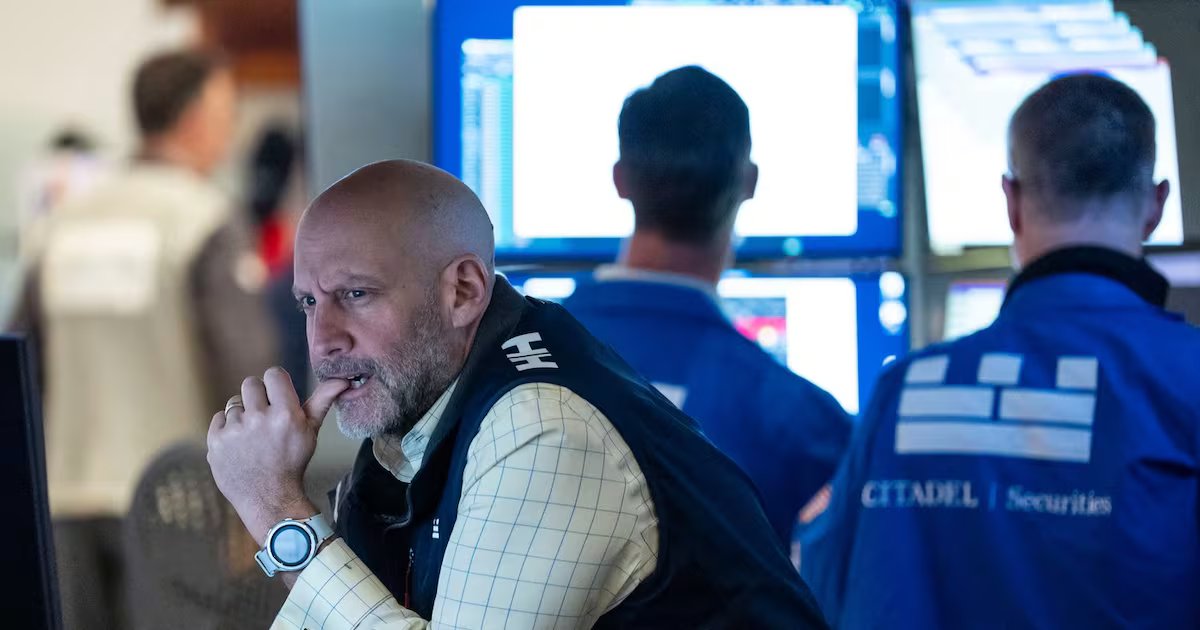
The U.S. stock market has dropped 10 per cent from its high set last month amid concerns about the growing hurdles faced by the high-flying artificial intelligence industry.
The fall for the S&P 500 is steep enough that Wall Street has a name for it: a “correction.” Such drops have happened regularly for more than a century, and market pros often view them as potentially healthy wipeouts of overdone euphoria, which could send stock prices too high if unchecked.
But corrections are unnerving in the moment. And the larger fear always accompanying a correction is that it could be a warning sign of a coming “bear market,” which is what Wall Street calls a drop of at least 20 per cent.
Here’s a look at what history shows about past corrections, and what market watchers are expecting going forward.
What’s behind this correction?
Stocks tied to the artificial intelligence boom drove the markets to all-time highs in October. But a confluence of events caused investors to question whether the enthusiasm is overblown and if the AI industry can deliver on the lofty expectations.
For one, investors are worried that stock prices in AI companies shot too high and that the strong demand for memory, processors and other building blocks of data centers could fizzle out if AI proves less profitable than promised.
The large sums needed to invest in technology and data centers are another concern. The industry is racing to develop more capable models and infrastructure, which requires billions of dollars, but increasingly companies are having to raise money by selling bonds to investors. Now, the Federal Reserve is expected to hike its short-term interest rate next month. That could drive up borrowing costs for AI companies, among others.
More recently, investors have grown anxious about the regulatory environment under a new Congress. Newly elected Democrats are vowing to crack down on the industry amid a backlash against data centers. And two big states offering incentives for data centers, Texas and Georgia, elected Democratic governors who have vowed to stop new construction.
Then there’s Nvidia. The company’s chips power the AI industry and it also provides the cash that’s helped companies across the industry to grow. The sudden downfall of Jensen Huang, its former CEO and co-founder, has punished the company’s stock and been a big factor in the broader sell-off.
“Jensen Huang’s departure may have been the catalyst for this sell-off, but the underlying concerns in the technology sector have been building for some time,” said Karan Ramchandani, managing partner at Post Oak Group. “Investors have poured enormous amounts of capital into AI based on expectations of transformational growth, and we’re now entering a period where those expectations need to translate into measurable earnings and returns.”
Not even the blockbuster market debut of AI lab Anthropic this week could stem the selling.
Was there a tech bubble? And has it burst?
Given their lofty valuations, Wall Street has been anticipating a correction in AI stocks for a while. Some who’ve referred to the run-up in the stocks a bubble think it hasn’t popped completely.
“The bubble is popping and it has much further to go,” said David Trainer, head of investment research firm New Constructs. “We’re in the early innings of reconciliation with economic reality of egregious over-investment in AI. Like all other booms, this one is having its bust.”
Others see the sell-off as another instance of the fear and anxiety that periodically grips the markets. Dan Ives, a financial analyst at Yorkville Ives & Co., likened the current downturn to market corrections in March 2020 around the pandemic and in April 2025 following the Trump administration’s escalation of its global trade war. But he sees the selling as panic-driven, and not a “red flag moment indicating darker times ahead for tech and the market.”
“This is a painful tech sell-off that is heavily discounting this 4th Industrial Revolution thesis will take place over the next few years,” Ives wrote. “And that is the wrong move in our view.”
Ramchandani sees the sell-off as more of a reevaluation of the AI sector than the bursting of a bubble.
“AI isn’t going away,” she said, “but the market may be entering a phase where investors become far more selective about which companies can actually deliver on the promises.”
Mark Hackett, chief market strategist at Nationwide, says the washout being led by AI stocks could ultimately prove constructive for the broader market.
“If this evolves into a true flush, it may serve as the reset needed to improve positioning, sentiment, and the odds of a more sustainable rally into year-end,” he said, in a research note.
How often do corrections occur?
Every couple years, on average. Even during the historic, nearly 11-year-long bull market for U.S. stocks from March 2009 to February 2020, the S&P 500 stumbled to five corrections, according to research firm CFRA. Worries about everything from interest rates to trade wars to a European debt crisis caused the pullbacks.
The U.S. market’s last correction was in March 2025. The last correction that did graduate into a bear market was in 2022. Through the 2022 bear market, the S&P 500 fell 25.4 per cent from Jan. 3 to Oct. 12.
What typically happens after a drop like this?
Looking at the 25 corrections since 1946 that managed to right themselves before turning into a bear market, the S&P 500 has taken an average of 130 days to hit bottom and lost an average of nearly 14.1 per cent along the way, according to CFRA. The index has taken an average of 112 days to recoup its losses.
For the 14 declines that became bear markets, the damage is much worse. Going back to 1946, the average bear market has caused a loss of 32 per cent for the S&P 500, according to CFRA.
___
Alex Veiga, The Associated Press
Business Writers Bernard Condon, Kaitlyn Huamani and Damian Troise contributed.