
Key Takeaways
- Embedded finance integrates financial services like banking, lending, and insurance into nonfinancial apps, enhancing customer convenience and loyalty.
- The growth of embedded finance is driven by technological advances, evolving consumer expectations, and the shift to e-commerce.
- Embedded finance can reduce the number of unbanked individuals and democratize access to financial services.
- Companies use APIs to seamlessly incorporate financial services into their platforms, creating new revenue streams.
- Potential risks include increased complexity and the need for enhanced security and customer support.
Get personalized, AI-powered answers built on 27+ years of trusted expertise.
What Is Embedded Finance?
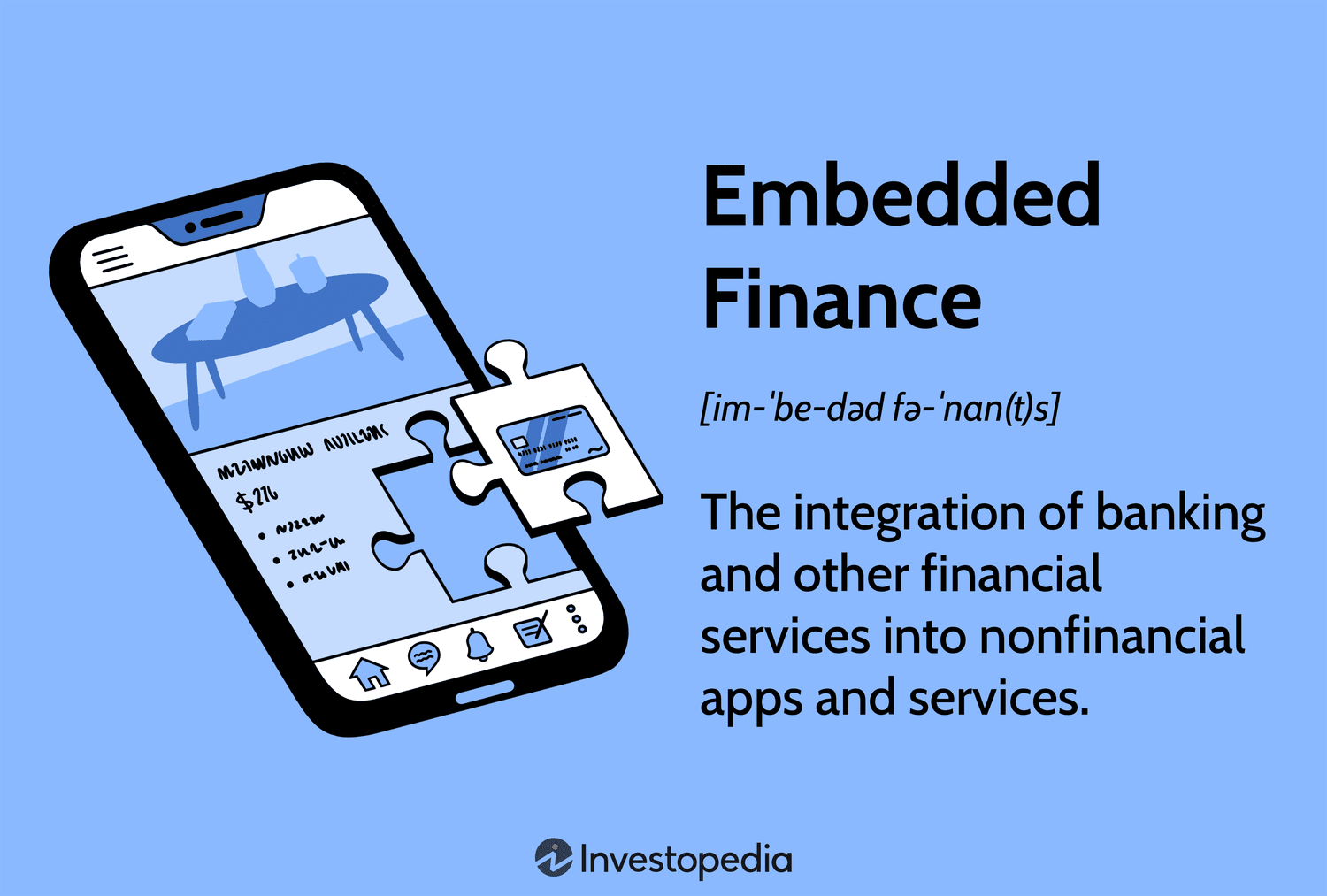
Embedded finance refers to the integration of a host of banking and other financial services into the apps and services of companies outside of the finance industry. Companies are incorporating banking, lending, insurance, and investment services with their customer offerings through application programming interfaces (APIs) that are linked to financial partners.
APIs and smartphones are ubiquitous, so consumers can get their banking services wherever they are. Companies gain greater customer loyalty and more revenue streams in turn.
How Embedded Finance Works
To help us understand the shift marked by embedded finance, we contacted Joris Hensen, founder and co-lead of the API Program, and Brigitte Koetting, Chief Marketing Owner of API Banking, at Deutsche Bank (DB).
They published a paper on their experience with embedding while helping to lead its use at the bank, one of Europe’s largest financial institutions.
“Embedded finance has great potential to empower ‘unbanked,’ target groups,” even though, they told us via email, they note that there still needs to be wide-scale use cases for this.
“Whether it’s offering banking services through mobile wallets or providing microfinance options, e.g., within agricultural supply chains—embedded finance can help … foster economic growth.”
Embedded finance puts checking and savings accounts, loans, insurance, debit cards, savings, and investment tools into the platforms of companies that typically don’t deal in finance.
This results from partnerships with technology partners and traditional financial institutions.
The History of Embedded Finance
Inserting financial products or services into non-financial company transactions isn’t new. For example, many car companies began offering direct-to-consumer auto loans and financing options decades ago.
Store-branded charge cards offered by department stores and other retailers are as old as mass-market credit services.
However, embedded finance has gained prominence, first as a term in the mid- to late-2010s and then due to changes in fintech and retailing apps.
These changes include:
- Competition from innovative players
- Evolving customer expectations
- The unbundling of traditional banking functions for many
- The prominence of APIs and software as a service (SaaS) models
- The pursuit of new market opportunities.
The Groundbreaking Evolution of Embedded Finance
Proponents of embedded finance say that non-financial companies incorporating financial services into their platforms and connecting with fintech and banks through APIs is a significant departure from both the conventional fintech model and traditional banking practices.
This could have profound implications for the future of banking and the fintech industry, and how financial services are delivered and experienced.
To be truly different, evolving embedded finance would need to move beyond conventional practices, such as:
1. An app-based analog to car dealers that offer direct-to-consumer loans or sign up customers for third-party financial institutions.
Companies have long done this so that customers could cover the costs of new autos or other products, many using branded cards.
These transactions help drive purchases and keep customer loyalty. They supplement the primary transactions between a customer and a business.
2. The leveraging of APIs and smartphones by fintech firms to offer more efficient and cost-effective ways for consumers to get credit, transfer money, and invest in the stock market.
The point is captured by thinking of banking and other financial services as offered less by independent entities with separate locations and different apps than as part of one consumer experience.
Let’s turn to how embedded finance works and some examples of its potential new phase.
Tip
Platforms with embedded finance gain access to personal data that they can use to personalize each experience. But that data could be at risk. So when you use these services, be sure to use the enhanced online security that you would use for sensitive transactions with banks and other financial institutions.
Factors Driving Embedded Finance Growth
Four fundamental shifts are driving the emergence of embedded finance:
- Shift to e-commerce: The digitalization of commerce has paved the way for embedded finance, as businesses integrate financial services within their digital platforms for a single customer experience. E-commerce merchants offer BNPL financing, branded credit cards, and rewards programs in their checkout flows to boost sales. On-demand platforms like ride-hailing apps and freelance marketplaces also provide digital wallets, payments, and wealth management tools to attract producers and consumers.
- Advances in technological integration: With the rapid development of fintech and APIs, integrating financial services into non-financial platforms has become more workable and scalable. Digital onboarding, electronic Know Your Client, and real-time data connections make authenticated transactions fast and far easier for the customer. APIs enable SaaS and subscription services to incorporate flexible payment options, in-app invoicing, and lines of credit for business users.
- Changes in consumer expectations: Consumers are increasingly comfortable using nontraditional providers for financial services, driven by a desire for convenience and streamlined experiences. The ubiquity of smartphones, fintech apps, e-commerce, and digital banking has helped bring about these changes in attitude.
- Reaching the underserved: Those not served by traditional banks and other financial institutions have posed a complex problem. Some argue that embedding finance into everyday transactions could democratize finance and expand access to financial products. Others imagine behavioral economic approaches where embedding insurance options right into, say, a ride-sharing transaction and making other choices easier could help those who may not have the time or knowledge to seek out such services separately.
For Hensen and Koetting, “Embedded finance is [to be] understood as a transformation of the bank as such….This is ultimately where the biggest transformation takes place: the customization of banking services to the needs of a partner or the requirements of a product.
In the end, only fundamental flexibilization will support these developments and make it possible to meet upcoming regulatory requirements, such as the EU’s planned Open Finance Framework.”
Examples of Embedded Finance
The rapidly evolving area of embedded finance is reshaping how businesses integrate financial services into their operations.
Here’s an overview of some of the ways that it’s being used.
Exploring Embedded Banking
Embedded banking seamlessly integrates banking services into nonfinancial companies’ platforms. For instance, Shopify’s (SHOP) Shopify Balance provides business banking and card services within its platform, streamlining financial management for ecommerce businesses.
Uber (UBER) has also developed an embedded banking ecosystem, offering its drivers instant earnings deposits and specialized debit cards.
Hensen and Koetting walked us through how Deutsche Bank is implementing these practices throughout its services. “Our embedded finance initiative initially focussed on the account opening processes for Deutsche Bank’s brands,” they said.
Deutsche Bank first standardized its systems across the organization. In its Wealth Management division, it created an investment API that family offices can integrate with their software.
For small and medium-sized business customers, it now offers db Smart Access. “With this product, they can easily integrate their business account into their IT landscape,” Hensen and Koetting said.
“We have received a lot of valuable feedback and suggestions for new functions that we are working on right now. After all, that is also part of embedded finance: taking feedback into account and learning how we can further expand our portfolio.”
Understanding Embedded Payments
Embedded payments integrate the payment process into a platform or app, making transactions more convenient for users.
For example, Uber and Lyft (LYFT) have simplified the payment process by allowing users to complete transactions within the app and integrating apps like PayPal and Venmo.
In addition, Housecall Pro has launched business expense cards for home service professionals, offering financial management from its software platform.
Similarly, the Starbucks (SBUX) app enables customers to order and pay via their phones while earning reward points.
Insights into Branded Payment Systems
Companies use branded cards to simplify payments, such as the PayPal (PYPL) cash card, which provides immediate access to PayPal account balances.
These differ from traditional store-branded charge cards, as they not only earn loyalty rewards but also draw directly from stockpiled balances held via the app.
Conversely, Amazon.com (AMZN) lets customers use the JPMorgan Chase & Co. (JPM) rewards program to pay for purchases on its site.
These cards often carry the branding of the company and can be used just like regular debit or credit cards for transactions at other companies. This offers a more integrated financial experience for users.
An Overview of Embedded Lending
Embedded lending offers immediate loan options at the point of sale, enhancing the customer’s purchasing power.
Popular examples include BNPL services like Klarna and Afterpay, which let consumers split online purchases into smaller monthly payments.
Understanding Embedded Investing
Financial platforms like Robinhood (HOOD), Cash App, and Acorns integrate investment services into their apps so that users can buy, sell, and exchange stocks or crypto without a separate investment account or advisor.
This approach democratizes and clarifies investing for average consumers by including it in platforms that customers already use for other financial services.
The Role of Embedded Insurance
Embedded insurance streamlines the process of purchasing insurance by combining it with the purchase of a product or service.
For instance, Tesla (TSLA) offers an insurance program to customers when they’re buying a vehicle.
Airlines and online travel companies like Expedia (EXPE), Booking Holdings (BKNG), and Hotels.com also provide travel insurance during the booking process, making its purchase more convenient for customers.
Key Players in Embedded Finance
There are three primary categories of companies enabling embedded financial services: technology providers; banking (balance sheet) firms; and embedded finance distributors.
Leading Technology Providers in Embedded Finance
These firms create the digital infrastructure that connects financial institutions and the companies that embed financial services. This involves:
- APIs and cloud platforms that allow for the integration of financial tools into external environments. Examples include Synapse and Unit.
- Middleware firms that help manage integration and place core banking infrastructure on the back end. Railsr, Bond, and GreenDot are examples.
- Turnkey “stack” providers that offer embedded finance capabilities through a ready-made suite. Providers of stacks include DriveWealth, Solaris, and Treasury Prime.
By reducing the complexities of embedded finance through APIs and infrastructure, technology providers make it easier for non-financial companies without the staff or in-house know-how to offer financial services.
Impact of Balance Sheet Firms in Embedded Finance
These regulated, licensed financial institutions originate core banking, credit, and insurance products and provide the underlying balance sheet that enables non-banks to embed customized financial services.
They also offer safekeeping and other banking services on behalf of end users. They include the following:
- Challenger banks that generate assets and liabilities on their balance sheet
- Banking-as-a-service, or open banking providers that rent out regulatory-compliant bank capabilities
- Specialized lenders that originate credit assets for embedding
Balance sheet providers bankroll services and assume the risks for the financial products that technology companies install with customized APIs and other tools for their distribution partners.
Distributors in Embedded Finance
These firms integrate financial services into customer offerings for distribution to the following:
Traditional Retailers
Retailers embed finance to move beyond simple e-commerce transactions. For example, through its partners, Walmart (WMT) offers check cashing, bill pay, credit card, BNPL, and money transfer services in its stores and apps.
Home Depot (HD) provides consumer credit cards for all its customers and professional credit lines for contractors as part of their purchases.
Software Firms
SaaS companies can integrate tailored financial tools for other businesses. Here are some examples:
- Invoicing, tax, and accounting tools are placed within enterprise resource planning and billing software platforms.
- Cash flow forecasting, payment reconciliation, and virtual cards are made part of expense management apps.
- Easy multi-payment functions and flexible billing terms are embedded in project management tools.
Marketplaces and Platforms
Transaction hubs for gig workers and digital matching embed access to wages, lending, wallet, and investing tools like these:
- Payment accounts and debit cards for income settlement, like Uber Money
- Microloans and advances against future earnings data for flexible liquidity
- Automated tax withholdings and holistic earnings data analytics dashboards
Telecom Companies
Telecoms offer customers mobile financial services such as:
- Airtime and data advances through prepaid balance overdrafts
- Micro-loans and nano-insurance bundled with mobile money capabilities
- Fee-based wallet accounts, often with subsidies and discounts
Original Equipment Manufacturers
Product makers incorporate specialized financing programs into their internet-connected devices:
- Auto companies provide lease financing and insurance bundles with vehicles.
- Electronics makers embed warranty coverage and replacement device insurance as add-ons during product purchases that continue their relationships with customers.
Advantages and Disadvantages of Embedded Finance
Pros
-
Behavioral economic advantages
-
One-stop financial shopping
-
Enhanced security
-
Streamlined user experience
-
Greater trust and brand loyalty
-
Increased financial access
-
Expanding portfolio of services
Cons
-
Behavioral economic pitfalls
-
Complexity
-
Customer overload
-
Increased need for customer support
-
Loss of focus
-
Security and privacy pitfalls
-
Regulatory compliance
-
Reliance on third parties
-
Reputational risk
-
Trust erosion
Advantages of Embedded Finance
In addition to providing new revenue streams and profit possibilities, embedded finance has features that can benefit both the provider and the consumer:
- Behavioral economic advantages: Nudge-like practices championed by behavioral economists aim to push customers toward beneficial financial decisions. Embedding ways to make better, more informed, or easier choices (like adding insurance for a car) could improve financial decision-making for many.
- Covering more customer needs: Companies that offer financing, risk coverage, bank accounts, and money transfers are a one-stop shop that meet many customer financial needs customized to particular services and products.
- Enhancing security: Vetted financial technology partners specializing in payments, lending, and asset management already meet strict regulatory security requirements. They can reduce the risks resulting from managing everything in-house.
- Improving the user experience: Customers enjoy greater convenience and save time when they can make a purchase in one ecosystem that streamlines identity checks, makes payments faster, and completes a transaction.
- Increasing loyalty and engagement: Providing financial services to customers in addition to the essential commercial transactions can cultivate trust and brand affinity, and increase engagement. Businesses also can benefit from discounts from financial partners on bulk processing, which they can pass on to loyal customers.
- Increasing financial access: Financial services could become more efficient and cost-effective while reaching more people.
- More products to offer: Embedded finance allows retailers, platforms, SaaS firms, and other businesses to expand their portfolio of products to serve customers better in one place. Providing loans, insurance, and payments builds a “stickier” relationship beyond one-off transactions.
Challenges of Embedded Finance
For businesses and consumers, embedded finance involves risks. These include overextending reach, integration complexities, changes to the relevant laws and regulations, and liability for partners’ actions.
Furthermore, there are data privacy concerns, increasing security vulnerabilities, and the potential to annoy customers by monetizing every possible interaction. Checkout times can grow longer if a growing number of checkboxes and opt-outs are not managed right.
Here are some further potential drawbacks:
- Behavioral economic pitfalls: As a seamless service, customers could make major financial decisions without even considering the ramifications—or realizing there are any.
- Complexity: Integrating with one or several financial services partners through APIs and ensuring reliable connections and data sharing across different systems open up additional technology and operational risks. Integration expands the attack surface for hackers and could increase the potential for system outages, performance lags, and cyber breaches.
- Customer overload: Building an all-encompassing financial experience across too many domains too fast can overwhelm customers and erode trust. That can be especially true if promises of seamlessness and convenience are not fulfilled. Or if consumers perceive that the company they trust is trying to get at their wallet in other ways through opt-outs, checkboxes, and the like when they simply want to make a purchase.
- Increased need for customer support: Financial services often require a high level of customer support. Companies new to this space may struggle to provide this, and potentially damage customer relationships.
- Loss of focus: Perhaps the biggest potential downside of embedded finance is simply losing focus. A company that expands its value proposition with embedded finance and ancillary services risks diluting its competitive advantages. It can distract customers from what they found valuable about their offerings in the first place.
- Security and privacy pitfalls: Collecting your users’ financial data for personalized services poses threats if sensitive personal information is compromised through a platform breach. Rigorous safeguards must be maintained across partners. Even so, companies can find themselves the targets of sophisticated hacking operations. There are also emerging privacy regulations restricting the data that is shared among companies.
- Regulatory compliance: By embedding regulated financial activities like lending, payments, and investments, platforms inherit compliance rules for customer identification, data usage, privacy protection, transparency disclosures, equity access, and fair lending, even as a service distributor.
- Reliance on third parties: A company could put major contact points with customers largely in the hands of others. Relying on third-party fintechs or banks to provide embedded financial services involves the risk that they could fail to deliver them to customers’ satisfaction.
- Reputation risk: If a company’s embedded financial service fails or has a security breach, it could damage its reputation, even if the financial service is a small part of its overall business.
- Trust erosion: Customers might decide that these new services, with their promise of greater financial access or ease of use, are less a benefit and more a hassle.
What Is the Difference Between Open Banking and Embedded Finance?
Open banking refers specifically to banks that provide third-party financial services/companies access to customer data and account functions through APIs. It enables external fintech companies to build applications and services around banking data to deliver more value, convenience, and personalized offerings to account holders. Open banking (also known as banking-as-a-service), therefore, deals with banks opening up regulatory-compliant services and data flows.
Embedded finance focuses on non-banks integrating financial services using open APIs and infrastructure. So, open banking provides the foundations for embedded finance by enabling regulated back-end financial institutions to distribute capabilities, while embedded finance is about extending financial tools into new distribution channels.
What Is the Difference Between DeFi and Embedded Finance?
Decentralized finance, often shortened to DeFi, aims to use blockchains, smart contracts, and cryptocurrency to make financial systems more open, global, and accessible without the need for central authorities through automated processes. DeFi, therefore, seeks to build alternative financial rails using decentralized technologies, which some proponents think removes intermediaries between a customer and someone else providing services.
Rather than taking away middle parties, embedded finance seeks to embed financial services into nonfinancial contexts via centralized or proprietary technologies like APIs. It essentially enables nonfinancial companies to offer white-labeled financial products from licensed, traditional financial institutions.
How Big Is the Embedded Finance Market?
According to Global Market Insights, the market was valued at $104.8 billion in 2024 with an estimated compound annual growth rate (CAGR) of over 23.3% from 2025 to 2034. Potentially, it could reach $834.1 billion by 2034. Grand View Research estimated a CAGR of 32.8% from 2024 to 2030.
The Bottom Line
Embedded finance integrates banking, lending, insurance, and investing services into apps and platforms used by companies outside of the finance sector.
It can open new revenue streams for businesses and enhance customer convenience.
The evolution of embedded finance represents a significant shift in the financial services landscape away from traditional banking and fintech models toward a major change in the delivery of financial services.