
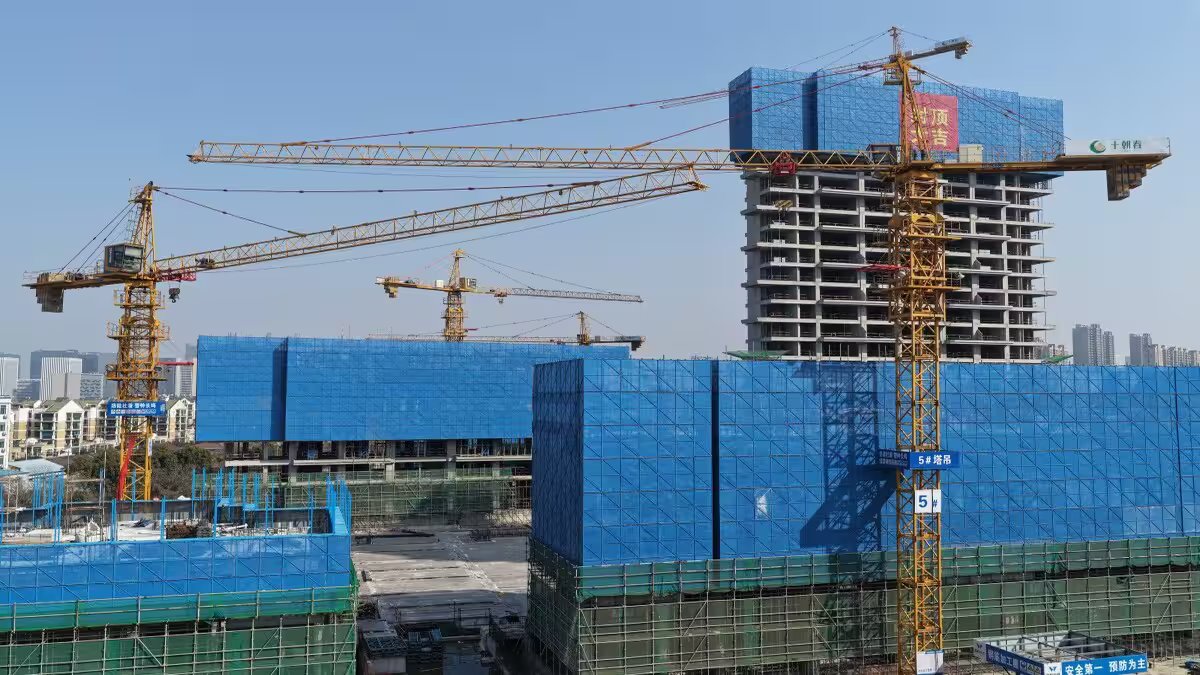
China’s long-running property downturn is beginning to show faint signs of stabilisation in its biggest cities, but the recovery narrative remains fragile, uneven and overshadowed by a staggering structural overhang: an estimated 90 million empty or unfinished apartments that continue to weigh on prices, sentiment and household wealth.
After nearly four years of decline that wiped out trillions of dollars in household savings and shook the world’s second-largest economy, new data and market indicators suggest that the worst of the price collapse may be easing in select urban centres. But analysts caution that this is far from a broad-based recovery and may, at best, represent another pause in a deeper structural correction.
According to data compiled by UBS and Centaline Property, average prices of existing homes in China’s Tier-1 cities — Beijing, Shanghai, Shenzhen and Guangzhou — rose about 2 per cent between February and April 2026, following a cumulative 38 per cent fall since the 2021 peak, as reported by The New York Times.
Shanghai, in particular, has emerged as a key focal point of optimism, with analysts pointing to easier credit conditions and municipal mortgage support schemes as partial stabilisers.
A stabilisation that is narrow, not national
While Tier-1 cities are showing tentative price gains, smaller cities — which account for the bulk of China’s housing stock and population — continue to struggle with falling prices, weak demand and high unsold inventory. Reuters, citing National Bureau of Statistics data, reported that new home prices fell 0.1 per cent month-on-month in April 2026, though this marked the slowest decline in a year and was seen as a possible early sign of stabilisation.
However, analysts remain divided over whether this signals a genuine bottom.
“The property market has not yet bottomed out,” Morningstar analyst Jeff Zhang told Reuters, warning that oversupply conditions could keep the sector weak for another one to two years. Similarly, ING’s Greater China economist Lynn Song noted that while April data suggests proximity to a bottom, previous “false bottoms” mean caution is warranted.
This divergence underscores a key feature of China’s housing crisis: it is no longer a uniform national cycle, but a fragmented market where recovery in Shanghai can coexist with stagnation — or outright decline — in inland and lower-tier cities.
The 90 million-unit overhang
At the heart of the concern is the massive stockpile of unsold and unfinished housing units. Analysts estimate that around 90 million apartments remain vacant or incomplete, according to The New York Times report.
This oversupply is not just a statistical problem; it is a structural drag on prices and sentiment. In many smaller cities, developers are still struggling to clear inventory built during the boom years, while in some regions, entire housing clusters remain under-occupied or abandoned.
Even as prices show early stabilisation in Shanghai and Shenzhen, analysts argue that this inventory overhang limits any meaningful recovery in national pricing power.
Wealth destruction and a consumption drag
The consequences of the property slump have extended well beyond real estate. Chinese households, which traditionally park a large share of savings in property, have seen a sharp erosion in wealth.
Urban household net worth fell from about $163,000 to $130,000 within two years, according to the China Household Finance Survey conducted by Southwestern University of Finance and Economics.
As property values fall, consumption has weakened. Chinese consumers have reduced spending on discretionary goods such as automobiles and cosmetics, adding further pressure on an already slowing economy. The property downturn has thus become a key transmission channel from asset prices to real economic activity.
Unlike the US housing crash of 2008, China’s downturn has not primarily been driven by excessive household leverage. Chinese banks have traditionally required large down payments, and households save nearly two-fifths of their income.
This has prevented a systemic banking collapse. However, it has also shifted the burden of adjustment onto households, rather than financial institutions — amplifying the wealth effect of falling prices.
The crisis was triggered in part by Beijing’s 2020 “three red lines” policy aimed at curbing developer leverage. The move led to defaults across major firms, including China Evergrande Group, and set off a prolonged contraction in construction and sales activity.
While the policy achieved financial de-risking, it also exposed deep structural imbalances: overdependence on property for growth, local government reliance on land sales, and an economy where housing had become the primary savings vehicle for millions.
Stabilisation or stagnation?
The current phase of the market is defined less by collapse and more by uncertainty. Optimists see stabilisation in Tier-1 cities as the first step toward recovery, supported by policy easing and improved credit access. Bank of America’s Karl Choi expects major-city prices to stabilise in the second half of 2026, with recovery potentially spreading to smaller cities by 2027.
But sceptics argue that China may instead be entering a prolonged adjustment phase rather than a cyclical rebound. The scale of unsold inventory, weak migration trends in smaller cities, and persistent income uncertainty all point to a slow grind rather than a V-shaped recovery.
First Published:
May 22, 2026, 08:54 IST
End of Article