
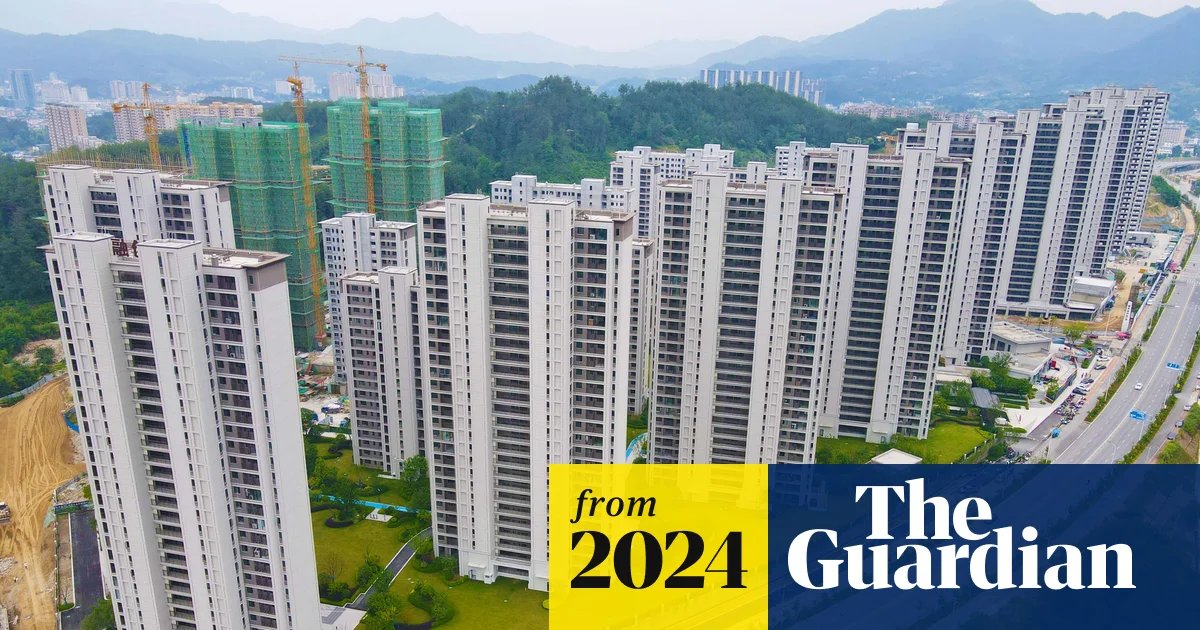
All across China, from Beijing in the north, to Shenzhen in the south, millions of newly built homes stand empty and unwanted. There were nearly 391m sq metres of unsold residential property in China as of April, according to the National Bureau of Statistics. That is the equivalent of Manchester and Birmingham combined – and then some – sitting as vacant, unwanted property.
This glut of idle property has caused a headache for the government, shaken the world’s second largest economy and raised tensions over the purpose of housebuilding in a nation where property investment had been viewed as a safe bet.
Since the real estate sector was sent into a tailspin in 2020, caused by the pandemic and a sudden regulatory crackdown, the industry that has traditionally powered about one-quarter of GDP has been in a downward spiral that policymakers have struggled to halt.
The crux of the problem is that, with shaky faith in the economy and big property developers failing to deliver on paid-for apartments, potential homebuyers are keeping their money out of the market.
In one recent Weibo post, a user wrote: “In this magical country, investment = gambling. No matter what you invest in, whether it’s buying a house or opening a small shop, if you lose money or go bankrupt, it has nothing to do with the country. It’s all your own fault for wanting to gamble.” The post has since been censored.
Local authorities have tried various tactics to encourage people to roll the dice on the property market once more. Shenyang in north-east China is offering 100 yuan (£11) a sqmetre subsidies for some homebuyers. Kaifeng in central Henan province is offering an income tax refund to anyone who buys a new property within a year of selling their old one. Changhsa, the capital of Hunan province, is encouraging developers to offer no-questions-asked refunds of housing deposits if a buyer changes their mind within seven days.
None of them have worked. Between January and April, sales of newly built residential properties were down more than 30% on last year.
That is a big problem, especially for the already overleveraged property developers whose cash is now tied up in unsold housing stock, pushing the developers to the brink of bankruptcies.
The government was forced to step in. Last month, the state-owned People’s Bank of China (PBOC) unveiled a 300bn yuan relending fund to support local governments and state-owned enterprises to buy up unsold stock and turn it into affordable housing. The central bank also lowered the minimum downpayment required for prospective buyers. Tao Ling, an official with the PBOC, said that local state-owned enterprises would be encouraged to use the funds to buy “reasonably priced” homes and turn them into affordable accommodation.
But analysts say that the stimulus – Beijing’s most aggressive yet – will be a drop in the ocean compared with the real estate sector’s woes. And local governments, which are already saddled by $13tn (£10tn) of debt, are unlikely saviours when they are also under pressure to balance their books.
“The scale of this policy is really way too small to really provide more affordable housing to the people who need it,” says Dan Wang, the chief economist of Hang Seng Bank. The policy is “more about containing the risk” for property developers than boosting the housing market, argues Wang.
Andrew Collier, the managing director at Orient Capital Research, a financial research company, says that previous attempts to redevelop slum housing in China’s sprawling cities have encountered difficulties because of corruption and the lack of financial viability for local authorities.
“Although the will may be there in the central government, local governments, which actually disbursed the funds in the previous programme, are in a weaker fiscal position,” Collier says. “While these local players are desperate to prove they can continue to deliver growth, they will be struggling with other priorities and unwilling to add to their debt obligations for investments that won’t provide any long-term profits.”
Last year, a pilot scheme involving eight cities received little interest. Local authorities often do not see affordable housing initiatives as being commercially viable. State media reports indicated that only a fraction of the 100bn yuan made available in the voluntary scheme was used. Analysts expect the nationwide scheme to be similarly lacklustre
Even if local governments did want to hoover up all, or most of, the vacant housing, the newly available lending would not be sufficient. Based on the average price a sq metre for newly built homes in China, the value of the unsold stock is more than 4.3tn yuan, far outstripping the 300bn yuan stimulus.
The authorities “know there isn’t really market demand” for the acres of unsold property, says Alicia García-Herrero, the chief economist for Asia Pacific at Natixis, an investment bank. The relending facility is just a way of “avoiding additional problems”. García-Herrero expects that there will be more fiscal reform to boost the impact of the policy, likely at the long delayed meeting of the Chinese Communist party’s central committee in July.
As part of the efforts to cool what was once an overheated housing market, the government has stressed the mantra that “houses are for living in, not for speculation”.
By that metric, the government has had some success. The average time it takes to sell a new home in China’s wealthiest cities is now over two years, up from less than 10 months in 2017. In the capital, the average time it takes to sell is around four years.
But now the market has cooled too much. And “the central government does not have a lot of options to turn around the property market,” Collier says. “It’s a giant hole that sucks in money.”