
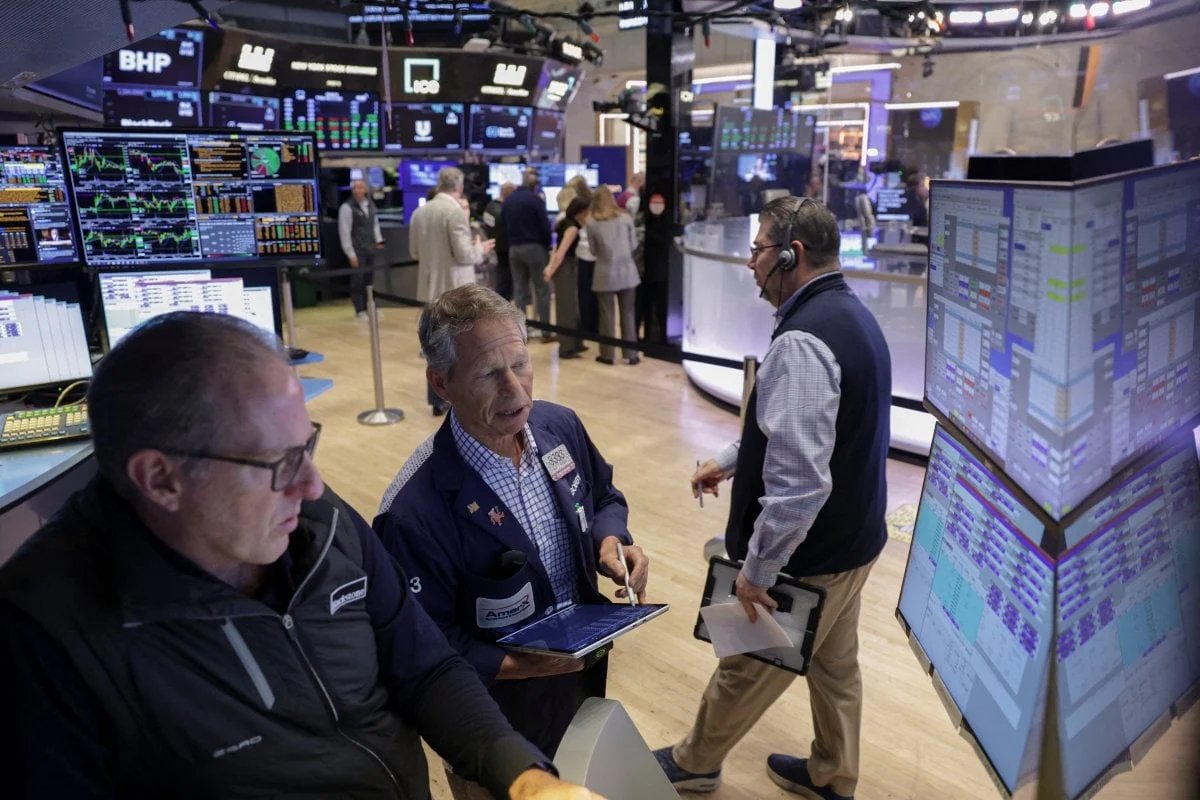
Investing.com — Wall Street on Tuesday recovered from a mixed showing in the previous session to end higher, helped by a rebound in technology stocks and a fall in oil prices and Treasury yields. Market participants appeared to refrain from major moves a day ahead of key inflation data and artificial intelligence poster child ’s quarterly results.
Traders kept an eye on escalating trade tensions between the Washington and Ottawa after Canada unveiled up to 50% retaliatory tariffs on nearly $28 billion worth of U.S. goods.
The benchmark S&P 500 added 0.3% to close at 7,675.54 points, the tech-heavy rose 0.7% to settle at 26,151.30 points, and the blue-chip advanced 0.3% to conclude at 53,577.17 points. Get fresh stock market insights with InvestingPro – now 55% off
Nvidia halts longest daily losing streak since September 2022
The S&P 500 technology sector kicked off the week on a negative note on Monday, pressured by memory and semiconductor stocks. ’ announcement of a softer-than-expected target range for its 2026 shareholder return program also clouded the mood, sending the company’s Korea-listed stock down nearly 9%. Shares rebounded on Tuesday, ending flat.
“After selling off sharply in early Asia trading, and Samsung stabilized and rallied to settle flat. That fueled an early memory and semiconductor rally here in the United States. Nvidia is leading that rally now as it bounces ahead of earnings after 8 straight days of declines. The defensive sectors that rallied yesterday are experiencing profit taking today,” Michael O’Rourke, chief market strategist at Jones Trading, told Investing.com.
Nvidia stock finished more than 2% higher, snapping a seven-day losing streak, its longest such slide in nearly four years. The world’s largest firm is expected to deliver quarterly results on Wednesday, in what will be a major test of the high flying artificial intelligence trade that lifted Wall Street earlier in the year but has recently been under pressure.
The AI trade’s roller coaster year saw a stellar rally over April, May, and June that helped the broader market shake off the Middle East conflict and return to record levels. However, concerns about uncertain returns on the billions of dollars being spent by mega-cap companies on AI infrastructure brought the monthly winning streak to a halt, with the crashing more than 20% in July.
Against this backdrop, expectations for Nvidia are at stratospheric levels as investors look to see whether enterprise demand for AI hardware justifies the massive spending on the technology. While the chipmaker’s quarterly revenue is anticipated to nearly double Y/Y to around $92 billion, anything short of a blowout performance could be seen as disappointing.
Bond market extends rally ahead of PCE, Jackson Hole
Away from tech, U.S. Treasury yields slid for a second straight day as the fixed-income market continued to bounce back from last week’s sell-off. A key driver was a CNBC report from Monday which said Washington could use its near $1 trillion Treasury General Account (TGA) to help fund the increased buybacks of longer-term bonds announced last week. That move was seen as a surprise intervention action to cap rising yields, especially in longer-end maturities.
Economists and analysts have largely viewed the U.S. Treasury’s intervention as an unsustainable short-term solution to a bigger problem fueled by jitters about Washington’s ballooning fiscal debt. Last week, U.S. debt crossed $40 trillion.
“No official announcement was made yesterday by Treasury regarding U.S. debt management, so these stories – at this point – amount to ’verbal intervention,’ i.e. they’re an attempt to scare markets from driving long-term yields up,” Robin Brooks, senior fellow in economic studies at the Brookings Institution, said.
“In my opinion, this is almost always counterproductive because it showcases a vulnerability. Once you start drawing lines in the sand with markets, they’re invariably going to test you. So this all but guarantees that long-term yields will resume their rise,” he said.
“The TGA is finite, so it’ll only go so far. The ever-expanding deficit means debt issuance is continually growing…so using the TGA is confronting a ’flow’ problem with a ’stock’ measure. That never works. Flows always win that fight,” Brooks added.
Interest rate watchers are now looking ahead to Wednesday’s data on the July core price index, widely seen as the Federal Reserve’s preferred measure of inflation. Attention will then shift to Fed Chair Kevin Warsh’s keynote address at the on Friday.
Consumer confidence drops to seven-month low
Ahead of the inflation data, Tuesday’s economic calendar was highlighted by the Conference Board’s gauge on U.S. consumer confidence, which ticked down to a softer-than-anticipated 89.4 in August from 90.2 in July. This was the lowest monthly reading since January.
“Consumers are optimistic about today but increasingly nervous about tomorrow. Assessments of current conditions improved materially, while future expectations fell to their lowest level since January as Middle East tensions and income concerns weighed on sentiment,” Jeffrey Roach, chief economist at LPL Financial, said.
“Although employment conditions remain solid, fading expectations for income growth may act as a headwind to spending. For now, we expect the economy will grow 2.1% in Q3,” Roach added.
The Conference Board data comes at a time when quarterly results from major U.S. retailers last week painted a mixed picture on the U.S. consumer. Those were preceded by an unexpectedly weak July retail sales report. in particular saw its worst U.S. comparable sales growth in six years.
On Tuesday, shares of DICK’S Sporting Goods cratered almost 31%, after the sporting goods retailer missed quarterly top- and bottom-line expectations and slashed some full year guidance metrics due to challenging conditions in the athletic footwear and apparel marketplace.
Jones Trading’s O’Rourke told Investing.com that the earnings were the “latest sign that pressure on the U.S. consumer” was “growing and taking a toll.”
Canada hits back
Elsewhere, trade ructions between the U.S. and Canada escalated. Discussions between the two North American nations to reach a deal collapsed over the weekend, and new 50% U.S. tariffs on $27.6 billion of Canadian imports came into effect on Saturday. Ottawa pledged “dollar for dollar” retaliatory levies.
On Tuesday, Canada said effective September 8, it would “impose counter-tariffs of 15, 25 and 50 per cent on products drawn from those targeted by U.S. Section 338 and Section 232 tariffs, with the rate for each product matching the corresponding U.S. rate.”
According to the Canadian government statement, the tariffs would apply to products covering $27.6 billion in U.S. imports across sectors such as steel, dairy, appliances, agricultural equipment, pulp and paper, and electronics.
President Donald Trump earlier in the morning posted some more harsh rhetoric against Canada, saying the country had been charging American farmers “400%” tariffs and had “driven many wonderful U.S. companies out of business.”
“For 10 years they wouldn’t certify Gulfstream Jets, until I got involved. They wanted 100% of the market for Gulfstream’s Canadian competitor. I deal with many countries, and Canada is easily the most difficult and unreasonable,” Trump said on his Truth Social service.
Bessent says Iranian leadership ’panicking’ after U.S. ramps up economic warfare
Turning to the Middle East, Treasury Secretary Scott Bessent said Iran’s leadership was “admitting” that U.S. economic pressure was “working.” On Monday, he had unveiled what he called “Operation Economic Outcast” under which he launched new sanctions on Iran and warned other countries to cease all economic operations with Tehran.
Bessent described the move as an “economic onslaught against Iran’s financial connections” around the world that would disrupt the ability of Tehran’s “enablers” to keep it afloat. While he did not specifically mention China, one of Iran’s biggest trading partners, Bessent said no country would be “above the reach” of U.S. sanctions.
Iran, for its part, played down Bessent’s comments, saying that it has been expecting such plans and is prepared to deal with them. Iran on Tuesday also published a joint statement with Oman which said the countries had “held constructive consultations” over safe resumption of navigation through the Strait of Hormuz.
Against this backdrop, oil prices slipped. They took a further leg lower later in the day after Russia’s RIA Novosti reported that the U.S. and Iran had reportedly reached a ceasefire agreement, citing Pakistani and Iranian military sources.
, the global benchmark, were last down 5.8% to $85.31 a barrel.
Ayushman Ojha and Scott Kanowsky contributed to this article