
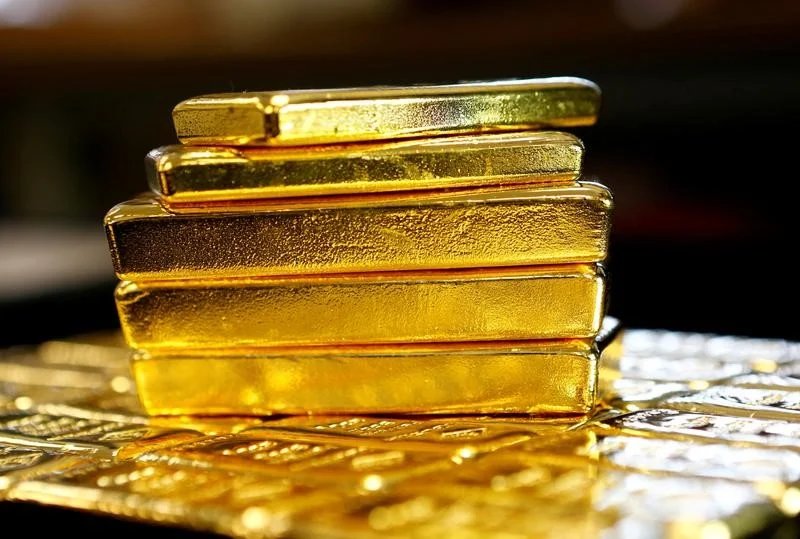
Investing.com — Gold prices on Monday extended a big advance from the previous week that was driven by soft U.S. jobs data. Precious metal market participants are now looking ahead to key inflation data in the days ahead for further cues on monetary policy.
Gains were capped by a jump in oil prices amid mounting uncertainty over a Middle East deal to reopen the critical Strait of Hormuz.
At 16:49 ET (20:49 GMT), added 1.1% to $4,389.17/oz, while climbed 1.1% to $4,448.55/oz. The former had surged 7.5% last week, while the latter had jumped 7.1%. Get premium commodity market insights with InvestingPro — now 55% off
Soft jobs data eases rate hike expectations
Bullion rose more than 2% alone on Friday, after data showed the first monthly decline in U.S. nonfarm payrolls since February, primarily due to a fall in local government education jobs. Additionally, payrolls for May and June were collectively revised lower by a 103k.
The jobs report complicated the picture for the Fed. On the one hand, despite the negative print, the overall labor market remains solid. On the other hand, inflationary risks are much higher amid ongoing volatility in oil prices due to the Iran war, with some policymakers showing a clear bias towards raising rates at the Fed’s last monetary policy meeting in July.
Traders reacted to the data by paring their expectations for Fed rate hikes in September. Higher rate environments tend to weigh on a non-yielding asset like gold. They also strengthen the dollar, which in turn puts pressure on the yellow metal by making it more expensive for foreign buyers.
“For the last several months, the major moving force behind gold prices has been the Fed’s policy. So any news changing the chance that it will move interest rates is also moving the metal’s price. This is what happened now, as negative news on the US job market made it much harder for the Fed to conduct stricter monetary policy. The market now expects much less that the rates will be increased, and so gold moved forward,” John Murillo, chief business officer at B2BROKER, said.
All eyes are now on key inflation indicators this week for further cues on monetary policy outlook. The economic calendar will be highlighted by the July consumer price index (CPI) and producer price index (PPI) readings on Wednesday and Thursday, respectively. Those will be followed by the July retail sales report on Friday.
“It would be fair to say that everything now depends on the core inflation results. If the growth is relatively small, there would be almost no arguments left for tighter policy and rate hikes. Should this happen, I see gold trading closer to $4,400, since jumps to $4,500 would demand brighter news on the job market, while a fall to $4,200 and lower needs much higher,” Murillo added.
Notably, UBS maintained a $5,000/oz price target for gold, underpinned by three structural pillars: falling real yields as the Fed eventually eases, dollar softness tied to U.S. fiscal and external deficits, and steady central bank buying acting as a price floor — factors the brokerage sees driving gold higher through 2027.
Oil marches higher as Trump demands compensation from Iran
Turning to the Middle East, oil prices rose nearly 5% on Monday after Iran ruled out direct talks with the U.S. and said a full reopening of the Strait of Hormuz would only be possible after Washington met certain conditions. Concerns over regional oil flows were also exacerbated by Iran-backed Houthi attacks on Saudi Arabian energy infrastructure. Traders moved into the safe haven nature of the dollar against this backdrop.
had slumped last week, largely due to assertions from U.S. officials including President Donald Trump that talks with Iran were ongoing. But the losses were tempered towards the end of the week amid Tehran’s continuous rejection of Washington’s negotiation claims and reports that the Strait of Hormuz’s management framework would prohibit passage of U.S, Israeli, and other hostile vessels through the vital waterway.
Iran’s state media said a parliamentary commission had approved the framework with the inclusion of the ban on the vessels. Foreign ministry spokesperson Esmaeil Baqaei on Monday said that Iran and Oman had yet to finalize a joint statement on the management of the strait, adding that the plan would include mechanisms to monitor vessel passage, for which compensation should be received.
Iran also ruled out direct talks with the U.S. for now, citing alleged violations of the interim peace agreement reached in June. Tehran reiterated conditions for a full reopening of Hormuz, including an end to the U.S. naval blockade, the removal of sanctions, and compensation for war damage.
Trump on Monday said Iran was asking for compensation for damages since the start of the U.S.-Israeli joint assault on Tehran towards the end of February. The president said he in turn would also be “demanding compensation from Iran” and that he had instructed his representatives “to put this firmly into any, and all, future negotiations.”
Ayushman Ojha, Scott Kanowsky, and Jaiveer Shekhawat contributed to this article