
Compass Group (LSE:CPG) could be the latest FTSE 100 name to move to the US stock market. The transfer makes sense, but is it a buying opportunity?
I own the stock and I rate the business highly. So I’ve been thinking about the possibilities available to the company if it can access a more powerful investor base.
The direction of travel
Compass Group had been rumoured to be moving its primary listing to the US for some time. But on Thursday (24 November) it confirmed plans to consult shareholders.
Wise announced a move last year. And growth names stand out more and more in an index that’s becoming heavily skewed towards cyclicals and dividend stocks.
Compass is headquartered in Surrey, but 75% of its operating profits come from North America. It already reports and trades in dollars, so the move does make some sense.
I own the stock, and I’d hate to see it leave as I think it’s one of the FTSE 100’s top growth stocks. But with the share price grinding higher, should I buy more before the move?
Is the S&P 500 worth the trip?
The main attraction of a move across the Atlantic is a deeper and more active investor base. At 0.1% of the S&P 500, Compass might attract more capital than it does at 1.5% of the FTSE 100.
That’s a risky calculation. Since joining the Nasdaq, Wise has gone from $15.96 to $11.22.
It’s far too soon to judge what the outcome will be. But Wise was never in the FTSE 100, so it didn’t have the same clout Compass has with UK passive funds.
Index inclusion does generate buying pressure, but the boost tends to fade. It’s a quick gain at best and with a listing in 2028, the potential outcome’s a long way off.
A top-quality business
The risks with contract catering are real. Costs keep rising and a relatively undifferentiated product makes it hard for the likes of Compass to offset this through price increases.
That means there’s constant pressure on margins. But its scale means the FTSE 100 company is in a better position to deal with this threat than most of its competitors.
A couple of key features reinforce this strength. One is the strategy of growing via acquisitions and another is its Foodbuy purchasing arm, which turns buying power into high-margin revenue.
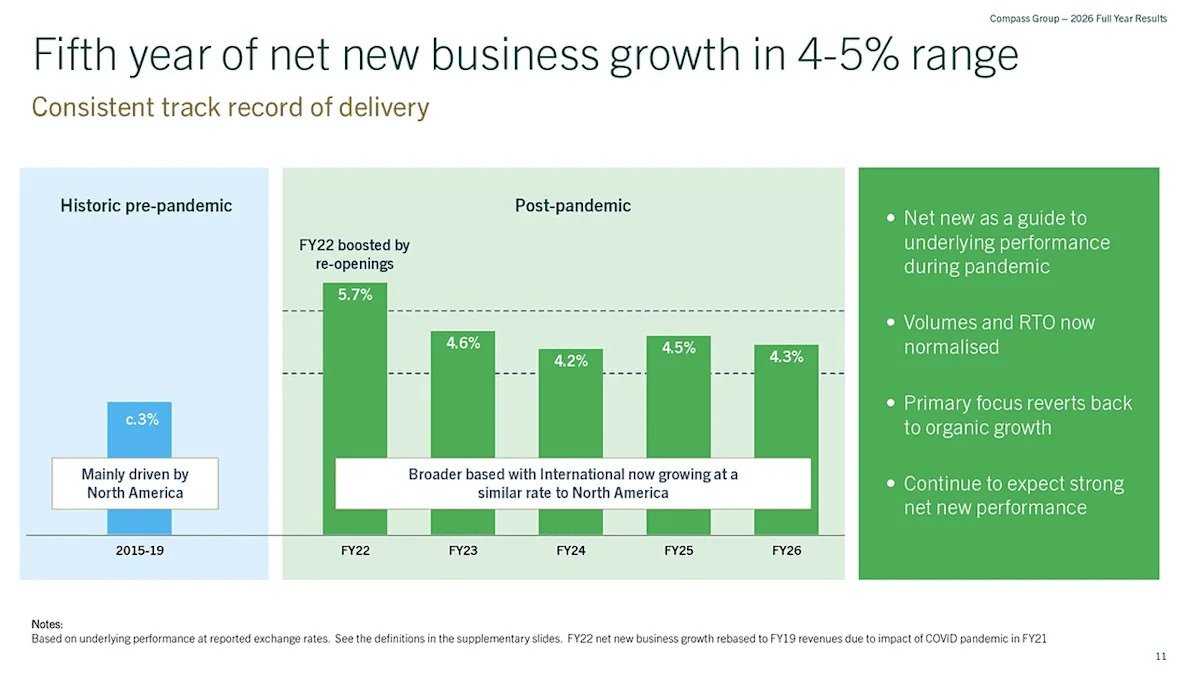
The latest results back that up. New business growth 4.3% net of 96% client retention shows a company that’s gaining new clients faster than it’s losing them.

Source: Compass Group FY 2026 Results Presentation Slides
Free cash flow faltered in 2026, but acquisition spending’s set to ease next year. And the extra cash should support a share buyback programme.