
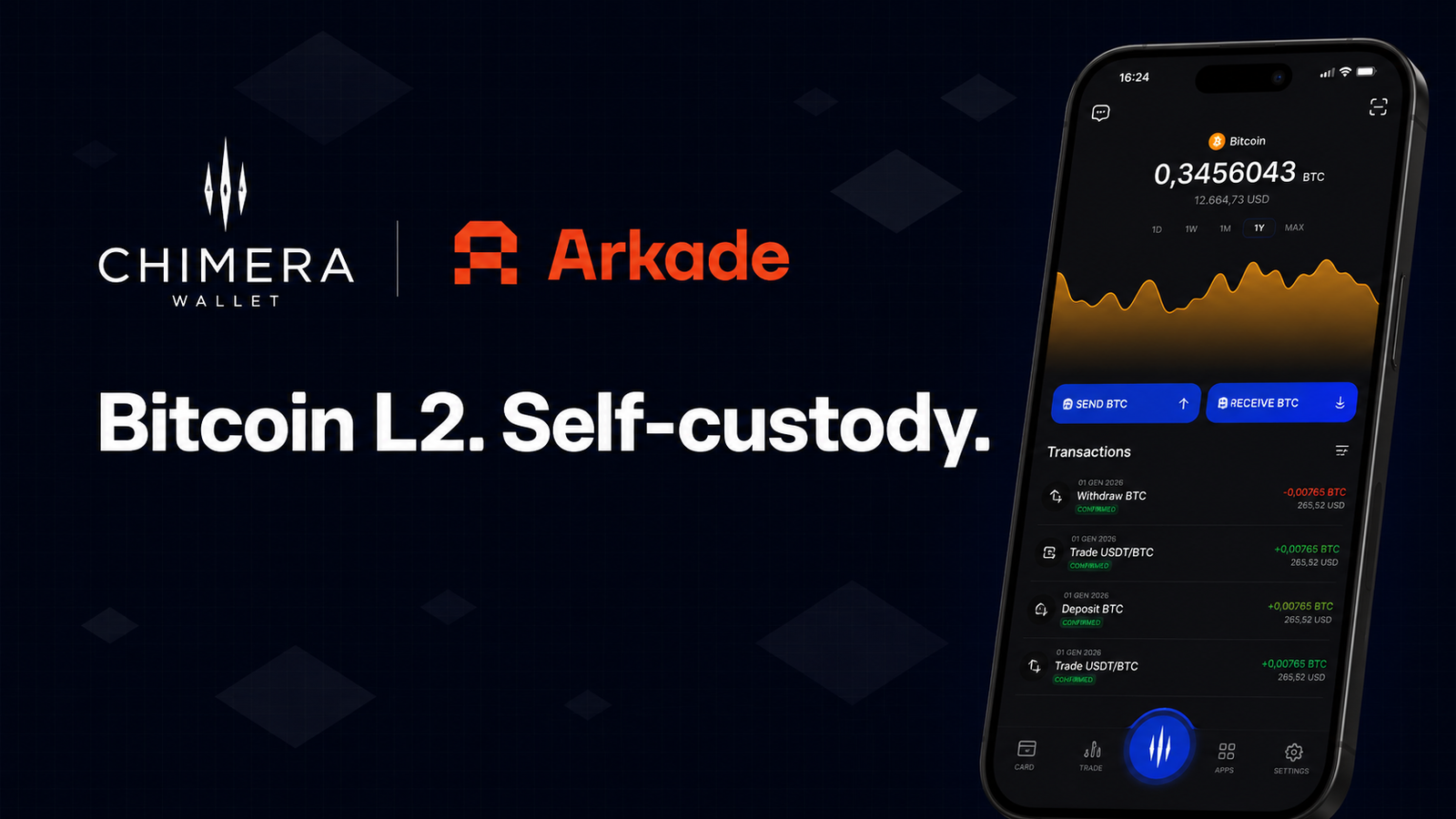
On May 27, 2026, Chimera Wallet reaches its token generation event.
It is the first Bitcoin super-app to integrate Arkade Protocol as its primary payment layer — a Bitcoin Layer 2 that went live on mainnet just six months ago, backed by Tether, Tim Draper, Anchorage Digital, and Ego Death Capital.
The period between now and mid-May is the last window before the wallet, the token, and the referral economy all open to the public.
The $15M committed to the broader Chimera ecosystem and token launch by Nimbus Capital ahead of TGE is context for what that infrastructure represents — but the architecture is the story, not the cheque.
This article covers what Arkade Protocol Bitcoin L2 actually is, why Chimera’s architecture matters for Bitcoin self custody, and what the three entry mechanics before the TGE look like.
Quick Summary
- Arkade Protocol mainnet: live since October 2025
- Arkade backers: Tether, Tim Draper, Anchorage Digital, Ego Death Capital; $7.7M raised
- Ecosystem funding: $15M from Nimbus Capital into the Chimera ecosystem and token launch
- Structure: Non-profit association; no profit-extraction incentive
- Token distribution: 90% of CEXT tokens allocated to market
- TGE date: May 27, 2026
- Referral program: 20% base share of platform fees, up to 60% with CEXT tier multipliers, no cap, no expiry
What is Arkade Protocol?
Arkade Protocol is a Bitcoin Layer 2 that uses VTXOs — virtual UTXOs — to give users near-instant, low-cost Bitcoin transactions without channel management or custodial trust.
Mainnet went live in October 2025, and the backer list explains the institutional attention: Tether, Tim Draper, Anchorage Digital, and Ego Death Capital are among the investors that have backed the protocol, with $7.7M raised to date.
That list matters:
- Tether has a direct economic interest in Bitcoin settlement layers.
- Tim Draper has backed Bitcoin infrastructure for over a decade.
- Anchorage Digital is the only federally chartered crypto custodian in the United States.
- Ego Death Capital writes exclusively into Bitcoin-native companies.

These are not generalist crypto funds adding exposure.
They are the investors who have spent years deciding what counts as real Bitcoin infrastructure.
It is not Chimera asserting Arkade is credible — it is Tether and Tim Draper asserting it. Marketing claims are cheap; capital deployment at this level is not.
The VTXO model is worth a plain-English definition. A virtual UTXO is a Bitcoin output that exists off-chain under the security guarantees of a shared on-chain transaction. What that gives users:
- Receive, send, and swap VTXOs in seconds
- Settle to mainchain whenever they want
- No channels to open, no liquidity to rebalance
- No counterparty to trust with custody
The simplest way to frame it: Lightning made Bitcoin fast if you were willing to run infrastructure. Arkade makes Bitcoin fast without asking you to run anything at all.
Why Chimera Wallet is built on Arkade
Chimera Wallet is the first consumer Arkade wallet — built natively on Arkade Protocol — and it operates as a non-profit association, an unusual legal structure in crypto that removes the incentive to extract value from users. In practice, this means:
- The wallet does not hold funds
- It does not take a spread
- It does not sell order flow
- There is no treasury optimising against the user
That structural choice is reinforced by Nimbus Capital’s $15M commitment to the broader Chimera ecosystem and token launch ahead of the May 2026 TGE.
Whether Arkade becomes the dominant Bitcoin L2 for consumer payments is a separate question — but a non-profit wallet entity sitting alongside an institutionally-backed token ecosystem is an unusual structural pairing, and one that suggests the architecture is not optimised for short-term extraction.
Chimera Wallet is a non-custodial Bitcoin wallet built natively on Arkade Protocol, operating as a non-profit association.
The broader Chimera ecosystem is backed by a $15M commitment from Nimbus Capital ahead of the May 2026 TGE.
Bitcoin L2 Self-Custody — what changes with Arkade
Bitcoin L2 self-custody means holding your own keys for Bitcoin that settles on a Layer 2, not just on mainchain.
Arkade extends the self-custody guarantee — your keys, your coins — to transactions that would previously have required either slow on-chain settlement or Lightning channel management.
Before Arkade, a self-custodial Bitcoin user had three practical options, each with a trade-off:

The honest read: Lightning solved speed but pushed complexity onto the user. Custodial Lightning wallets solved complexity by giving away custody.
Arkade is the first option that holds all four properties simultaneously — self-custody, speed, low cost, and low complexity.
This is the architectural point that explains why a Bitcoin-native wallet can credibly target mainstream adoption without betraying the self-custody thesis.
The reason most Bitcoin payment apps are custodial is not ideology. It is that Lightning was hard. Arkade removes that excuse.
Cold wallet vs hot wallet — and the third category
Cold wallets store private keys offline, hot wallets store them on a connected device, and Chimera Wallet introduces a third category: a hot wallet with real-world spending rails and full self-custody.
The traditional cold-versus-hot framing forces a choice between security and usability. The third category collapses that trade-off.
Cold wallets — hardware devices like Ledger and Trezor — give the strongest security but are operationally awkward. You don’t walk into a coffee shop with a Trezor.
You don’t pay for groceries from an air-gapped device. Cold storage is for holding, not spending.
Hot wallets — browser extensions, mobile apps, and software wallets — are fast enough to transact but historically split into two failure modes.
Either they are self-custodial and limited to on-chain or Lightning payments (meaning no merchants accept them directly), or they are custodial and marketed as “user-friendly” while holding the keys for you.
For a direct comparison, see chimera wallet vs metamask across custody, fees, and spending rails.
The third category is what Chimera Wallet, built on Arkade, actually is.
Keys stay on the user’s device. Transactions settle on Arkade with the security guarantees of the Arkade Protocol itself, not those of a custodial intermediary.
And the planned Chimera Card, issued via Wirex, will eventually connect spending to 80 million+ merchants while the wallet itself remains non-custodial.
(The card launches in June 2026 — not live at this article’s publication, and flagged here only as roadmap context.)
For a Bitcoin self-custody user, this is the split that actually matters:
- Cold storage: for coins you are not going to move
- Chimera + Arkade: for coins you are going to use
The two are complementary, not competitive. A serious Bitcoin holder runs both.
Is Chimera Wallet really non-custodial?
Yes — Chimera Wallet is non-custodial at the key level, meaning the private keys are generated and stored on the user’s device and never transmitted to Chimera’s servers or any third party.
The wallet software signs transactions locally. Chimera cannot freeze funds, reverse transfers, or access balances.
The non-profit structure reinforces this: there is no entity with a financial incentive to insert a custody layer later.
Fiat on/off-ramp services — the parts where users convert between currencies — are provided by third-party partners, each operating under its own regulatory supervision.
Verification is required only when mandated by those partners and applicable regulation; the model is designed to minimise friction and apply identity checks only where necessary for compliance.
This is a controlled limitation worth naming plainly rather than glossing over: regulated fiat rails require compliance infrastructure, and Chimera’s architecture routes those specific interactions to licensed providers while keeping the wallet itself outside custody.
If you are reviewing this for safety, the honest summary: the wallet holds no funds, the keys never leave the device, and the fiat services are compliant third-party rails.
For anyone researching the best non-custodial wallet options on the market, that is a stricter architecture than most wallets positioned as “self-custody” in marketing materials.
For a full breakdown of the security model, see deeper review on whether is chimera wallet safe in detail.
“No install, no nemory, no risk” — the PWA decision
Chimera Wallet runs as a Progressive Web App — a PWA — meaning it installs directly from a browser to the home screen without passing through the App Store or Google Play.
A PWA is a web application that behaves like a native app: it gets an icon, runs full-screen, works offline, and sends push notifications, but its code lives on the web and updates in real time.
The decision to skip native app distribution is strategic, not technical. In October 2025, Google introduced new Play Store policies requiring custodial crypto wallets to hold active licences in every jurisdiction where they distribute — or face removal.
Apple has a history of quietly restricting wallet apps in specific regions and has pulled wallets from the App Store with little notice.
Every native crypto wallet operates at the discretion of two American corporations.
Chimera’s PWA sits entirely outside that dependency.
There is no store review, no regional gatekeeping, no risk of being delisted between one version and the next.
The wallet is reachable from any browser on any device — iPhone, Android, desktop, tablet — and the install is a two-tap operation from a shared link.
At version 0.2 (live now), the PWA includes:
- Bitcoin self-custody across mainchain, Lightning, and Arkade — functioning as a full Bitcoin Lightning wallet plus L2 interface
- Chimera token support inside the wallet
- Referral program activation
- Buy/sell Bitcoin via licensed third-party providers
That is the surface area available to users before the May 27 TGE. Multi-chain support (ETH, USDT, Tron, Polygon) and the Chimera Card are on the roadmap, not in the current version.
Chimera Wallet referral program before the TGE
The Chimera Wallet referral program pays 20% of platform fees generated by every user you refer, scaling up to 60% for CEXT token holders in higher tiers, with no cap on referrals and no expiry on earnings.
The referral window closes at the TGE on May 27 — after that, the program continues, but the pre-TGE activation window is what this section is about.
The mechanics are straightforward:
- Base rate: 20% of platform fees from referred users
- CEXT tier multiplier (after TGE): up to 3x, lifting the effective rate to 60% at top tier
- Cap: none
- Expiry: none — payouts continue as long as the referred user transacts
- Referral count limit: none
Two details matter for anyone evaluating this seriously. First, the 60% figure is not a one-time promotional rate.
It is a persistent referral commission tied to holding CEXT at tier thresholds, and it applies to the full lifetime of the referred account.
Second, there is no conversion — the share is paid out of the same platform fees the wallet collects. This is a referral payout structure, not a points program.
The pre-TGE window matters not because the program changes shape afterwards, but because the pool of available referrals expands sharply at TGE.
Setting up a referral footprint before that expansion — when the audience is smaller and acquisition is easier — is the structural advantage of acting now rather than after May 27.
This is not a feature that rewards speculation. It rewards distribution — bringing users into a wallet whose fee revenue has not yet been captured by anyone.
Chimera Wallet rewards program
The Chimera Wallet rewards program — the mechanism through which the Chimera Wallet token (CEXT) flows to users — runs on a single principle: rewards come through the referral system, not through tracking individual user activity.
The wallet itself is privacy-first by design — there is no on-chain monitoring of balances or transactions, no “points for usage,” no engagement metrics, no airdrop snapshot of wallet contents.
What gets rewarded is the verified financial activity of users you refer.
When a referred user funds their wallet or redeems back to fiat through licensed third-party providers, a share of the platform fee on that conversion flows to the referrer.
Hold CEXT at higher tiers, and the multiplier raises that share up to 60%.
Three things this program is not:
- Not a snapshot airdrop. Wallet balances are never monitored or sampled. There is no balance threshold to hit.
- Not a social-task program. No Discord activity, no retweets, no “engagement” requirements.
- Not a usage-tracking system. The wallet does not log your transactions, holding patterns, or behaviour.
What it is, in plain terms: a referral payout drawn from platform fees that referred users’ verified fiat conversions actually generate.
The model is structurally rigorous because the underlying activity — fiat conversion through licensed partners — is verifiable and substantive, rather than gameable like wallet-snapshot airdrops or social-task farming.
The contrast with a typical Bitcoin airdrop matters here. Most airdrops reward wallet addresses for holding a snapshot balance or completing social tasks — both of which can be farmed cheaply and at scale.
The Chimera program inverts that: there is no snapshot, no social layer, and no surveillance of the wallet.
Rewards are tied to the only activity the platform can verify — fiat conversions handled by regulated partners — and they flow through the referral structure, not through any monitoring of the user’s own wallet.
Why before the May TGE?
The window before the May 27 TGE is the period in which readers can establish position in the Chimera ecosystem before the public token market exists.
That is not a promotional frame — it is the structural distinction between a pre-launch and post-launch environment, and it matters for three reasons.
- The token is not yet publicly tradeable. CEXT lists at TGE on May 27. Until then, an open market for the token does not exist, and any consideration of CEXT exposure is made against the published tokenomics rather than a live price chart. Anyone who wants to think about CEXT positioning without the noise of a live market does that thinking pre-TGE — by definition.
- 90% of CEXT tokens are allocated to market — not insiders. This is unusual. Most token launches reserve 30-50% of supply for teams, advisors, private rounds, and treasury. A 90% market allocation means the community-facing distribution represents the majority of supply, not a sliver of it — a first-order variable for anyone weighing insider overhang risk before public trading begins.
- Operational setup time is non-trivial. Funding a non-custodial wallet, getting comfortable with Arkade’s transaction model, generating a referral link, and identifying the people you would actually refer — none of that happens in five minutes. Doing the setup before the launch window, rather than during it, means starting the post-TGE period operationally ready instead of catching up under launch-day attention.
The honest caveat: Arkade Protocol’s mainnet launched in October 2025, which is recent.
The infrastructure is real and the backers are credible, but the operational track record is six months, not six years.
That is a genuine risk to weigh, not a disclaimer to skip.
Users comfortable with early-stage Bitcoin infrastructure will find the pre-TGE window legitimately distinct. Users who prefer battle-tested systems should wait.
Three entry mechanics, one decision window
The pre-TGE window before May 27 has three distinct entry paths into the Chimera Wallet ecosystem, and they are not mutually exclusive — a user can activate all three simultaneously.
| Entry mechanic | What it does | Pre-TGE advantage |
|---|---|---|
| Fund the wallet | Self-custody Bitcoin on Arkade, Lightning, and mainchain | Operationally set up before the public launch window |
| Activate referrals | 20% base revenue share, up to 60% with CEXT tier | Build a referral footprint before public attention concentrates at TGE |
| Earn rewards | 90% market allocation, fixed supply, May 27 launch | Rewards scale with smart usage |
The wallet is accessible now at v0.2. The non-custodial bitcoin wallet runs as a PWA — no App Store, no install, no waiting. A Bitcoin deposit funds the wallet in seconds, with no custody handoff at any step.
A few practical notes for anyone starting this week:
- Install: open the Chimera site in any mobile browser and tap “Add to Home Screen.” That is the entire onboarding.
- Fund: Bitcoin deposit, or fiat on-ramp via licensed partners (verification only when required by compliance).
- Refer: the referral link is generated from inside the wallet once verified; revenue share accrues immediately on referred users’ activity.
For users already deep in Bitcoin self-custody — running cold storage, familiar with VTXO concepts — Chimera adds a non-custodial active-use wallet for transactions and spending, distinct from cold storage and complementary to it, not a replacement.
For users earlier in the journey, it is a single tool that covers self-custody and the referral program in one place.
Conclusion
The read on all of this is straightforward. Arkade is real infrastructure backed by investors who have spent careers identifying real Bitcoin infrastructure.
Chimera Wallet is the first Bitcoin super-app to integrate Arkade as its primary payment layer, funded by a $15M institutional round, structured as a non-profit, and live now in its v0.2 PWA.
The pre-TGE window closes May 27. The three entry mechanics — funding, referrals, rewards — are open now.

Fund your Chimera Wallet and activate your referral bonus — open the PWA.