
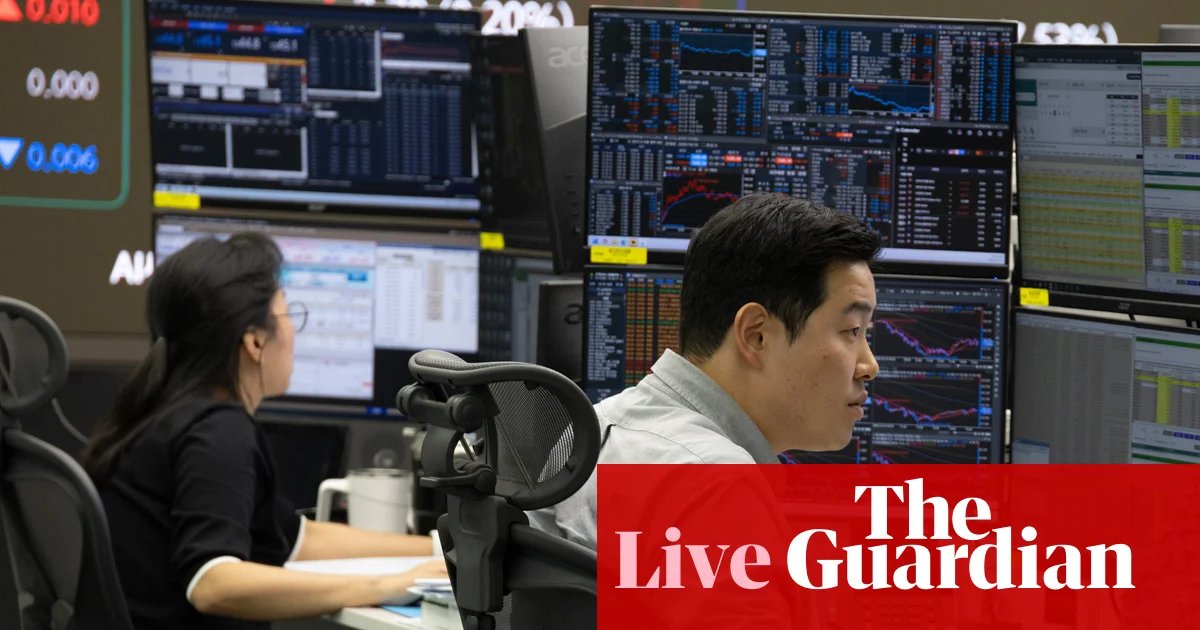
Introduction: Chip stock sell-off deepens ahead of UK GDP report
Good morning, and welcome to our rolling coverage of business, the financial markets and the world economy.
The sell-off in chip stocks is deepening today, worrying investors as market await the latest UK GDP report.
Signs of rising inflation in the US are driving concerns about the risk of interest rate hikes, and AI-linked stocks are bearing the brunt.
In South Korea today, the KOSPI share index has plunged by over 8%, extending its recent losses. Chip giants Samsung Electronics (-9%) and SK Hynix (-10.5%) are leading the rout.
Japan’s Nikkei 225 is sliding too – it’s down by 4.5% in late trading.
This follows a drop on Wall Street on Wednesday, where the S&P 500 index fell by 1.1% and the Nasdaq Composite lost 1.9%.
That includes an 11% plunge in Dell’s shares, which CNBC blames on mounting concerns that enterprise spending on artificial intelligence won’t justify the AI buildout.
The news yesterday that US inflation has jumped to 3.7% has alarmed traders, as it makes it more likely that the US Federal Reserve will raise interest rates soon – possibly even at the end of this month.
Chris Weston, analyst at brokerage Pepperstone, says signs that US inflation pressures are spreading worries investors:
Further evidence of right-tail inflation risk in the US has reinforced the higher-for-longer rates narrative, with sellers emerging across risk assets and interest rate-sensitive equities coming under renewed pressure.
The breadth of price pressures across the CPI basket has been particularly concerning, challenging a market desperately in need of evidence of disinflation.
These inflation pressures will also worry policymakers at the IMF’s Annual Meeting in Bangkok, which continues today (of which more shortly…)
We’ll soon learn how the UK economy performed in August, too. The latest GDP data, due at 7am, is expected to show a fall of 0.1% in the month, as growth fizzled out after a strong July.
The agenda
-
7am BST: UK GDP report for August
-
10am BST: Eurozone industrial production report for August
-
1.30pm BST: US initial jobless claims data
-
1.30pm BST: US PPI index of producer price inflation in September
Key events
UK bond yields fall amid semiconductor sell-off
The slump in tech stocks is helping to push down Britain’s borrowing costs.
The yield, or interest rate, on UK debt has dropped today as investors buy up these gilts.
This has pushed the yield on UK 10-year bonds down by 10 basis points (0.1 of a percentage point) to 5.33% today.
Thirty-year gilt yields are down 10bps too, to 5.8%.
Neil Wilson, investor strategist at Saxo UK, explains what’s occuring:
The sell-off across semiconductor stocks has sent bond yields lower, which if it sticks could ultimately support risk sentiment and support valuations.
This is two-fold; one a flight to relative safety with the risk-free rate generating 5%, and two, because a breakdown in the AI capex narrative and pullback in spend will shrink the supply of debt, the huge increase of which has been a powerful driver of bond yields moving out to multi-year highs.
Chip sell-off drags South Korea’s Kospi index to six-month low
Oof! South Korea’s benchmark Kospi share index has closed at a six-month low, as inflation fears and worries about the IT boom triggered a sell-off.
The Kospi ended the day down 7.5% at its lowest closing level since April, after a day of wild trading that briefly caused circuit breakers to be triggered. At its worst point, the Kospi was down over 9%.
Chipmakers drove the selloff – Samsung Electronics fell 9.5% and SK Hynix plunged by 11.1%.
It’s been a staggering year for South Korean traders. In the first half of 2026 the Kospi roughly doubled in value, as investors flocked to buy shares in chipmakers whose products were in hot demand with AI companies.
But that boom began to fade as we entered July. And now, the Kospi is ‘only’ up 30% for 2026.
The South Korean stock market boom was driven by a surge of interest from retail investors, many of whom bought shares on margin (with borrowed money), and could have lost their stakes as the market turned sour.
As covered earlier, today’s tech rout is partly due to worries over US inflation, which may trigger interest rate rises.
There’s also concern about the high amount of borrowing which AI firms are taking on as they roll out data centres and train new AI models.
Lee Hardman of Japanese bank MUFG told clients this morning:
Bloomberg has reported that investor confidence in AI-related confidence has been undermined in part funding concerns.
CoreWeave, the world’s biggest and most established neocloud, a relatively new term for companies that rent out computing power to AI model developers and teach leaders, saw its shares plunge in value by as much as 17% yesterday, and its debt due in 2032 traded at less than 78 cents on the dollar.
According to Bloomberg, credit default swaps on the company are pricing in more than a 50% chance of default within the next five years.
European stock markets pulled down by tech slump
Although Britain’s FTSE 100 share index is holding up well this morning, other European markets are in the red in early trading.
Germany’s DAX index dropped by 0.5% at the start of trading, a few minutes ago, while France’s CAC is down 0.2% and Spain’s IBEX lost 0.17%,
Mining shares slide in London
The London stock market is open, and shares in mining companies are dropping sharply.
Copper produder Antofagasta (-6.5%) is leading the fallers on the FTSE 100 share index, with Rio Tinto (-4.2%) and Anglo American (-4%) close behind. That may reflect concerns that a rise in US interest rates to fight inflation will dampen growth, and demand for commodities.
However, the wider FTSE 100 index is only down 0.1%. As it doesn’t include many tech shares, it is insulated from the rout in chip stocks today. Instead, ‘defensive shares’ such as tobacco firms, consumer goods maker Haleon (+2.6%) and hotel chain Whitbread (+2.4%) are in demand.
Update: Antofagasta also released its latest production report this morning – this showed a 7% rise in third-quarter copper production, with the company maintaining its annual guidance.
Deutsche Bank: The UK’s resilience story continues
The UK economy “surprised yet again” by growing by 0.1% in August, says Sanjay Raja, chief UK economist at Deutsche Bank:
Raja explains that the UK’s resilience story continues:
Undoubtedly, there may be some hiccups to come in the run up to year end, especially as energy prices continue to bite household incomes, and higher rates continue to drag on spending and investment.
The good news? The UK’s resilience story continues. It’s hard to overstate how strong the UK performance has been all year. The UK economy remains the fastest growing G7 economy.
What’s more impressive? If you believe the HMRC jobs data, UK GDP growth has hit 1.8% this year in the first eight months of the year, with 95k FEWER jobs. Who said productivity growth was dead in the UK?”
November interest rate rise ‘highly likely’ after UK growth surprise
Today’s better-than-forecast UK growth report is good news for chancellor John Healey as he hobnobs with other finance ministers at the IMF meeting in Bangkok.
But it may encourage the Bank of England to raise interest rates as soon as its next meeting in November….
Suren Thiru, chief economist at chartered accountants group ICAEW, explains:
“While August’s unexpected uptick all but confirms that the OBR will raise its growth forecast for this year from 1.1% to 1.4%, the Chancellor still faces a major Budget headache, as elevated borrowing costs eat into fiscal headroom and increase pressure for tax rises.
“These unexpectedly upbeat figures will further embolden hawkish sentiment among policymakers by reinforcing the view that the economy is strong enough to withstand a rate rise, making a November hike look highly likely.”
The money markets indicate there’s a nearly 93% chance tht the Bank raises rates at its November meeting….
PwC: UK on track to be second-fastest-growing G7 economy this year
August’s growth means the UK economy continues to perform well against international rivals.
Britain had already grown faster than fellow-G7 members France, Germany, Italy, Japan and Canada in the first half of 2026, and roughly as fast as the US.
Jake Finney, senior economist at PwC, says:
“The latest GDP figures are encouraging, with the economy growing by 0.7% in the three months to August, its strongest growth rate since May. On its current trajectory, the UK is likely to record growth comfortably above 1% this year, which would probably be enough to make it the second-fastest-growing economy in the G7.
“The UK’s growth performance has been a bright spot amid a less impressive run of economic news following events in the Middle East. Business investment has been an important driver, particularly spending on ICT hardware, likely linked to the build-out of AI infrastructure. The UK still lags the US in both the scale of that investment and the boost it provides to growth, but it is making progress and remains ahead of many of its European peers.
UK economy ‘lost momentum’ despite keeping growing in August
Emeritus professor Joe Nellis, head of economic research at accountancy and advisory firm MHA, points out that the underlying pace of growth in the UK economy remains weak.
Responding to this morning’s UK GDP report, he says:
The loss of momentum in August reflects the impact of continued inflationary pressures that have negatively impacted consumer confidence and spending.
Businesses also continue to face tough trading conditions resulting from rising employment costs and taxation which have squeezed profitability, particularly among small and medium-sized enterprises, discouraging investment spending and recruitment activity.
Computer programming drove growth in the last quarter
Over the last quarter, the UK economy grew by 0.7%, today’s GDP report shows.
That’s the fastest quarterly growth since the three months to May.
Growth over the quarter was driven by the IT sector – perhaps a sign that AI technology is starting to boost growth?
ONS director of economic statistics Liz McKeown explains:
“GDP growth showed further strength in the latest three months, led by the services sector, while both production and construction fell. Upward revisions to already strong services growth in June and July helped drive robust growth across the three months, despite services showing no growth in August.
“Computer programming was once again the largest contributor to growth in the three months to August. Looking at a longer-term picture, compared with the same three-month period a year ago, the increased strength now seen in services is evident not just in computer programming but across a range of business-facing industries, including legal services, research and development and advertising.”
UK growth driven by manufacturing
Britain’s manufacturers drove the economy forwards in August.
Today’s GDP report shows that the growth in August was driven by a 0.8% growth in production – including a 1.2% jump in manufacturing output.
The Office for National Statistics says this was due to growth of 5.1% in manufacture of basic pharmaceutical products and pharmaceutical preparations, and growth of 1.8% in manufacture of transport equipment.
Services (which makes up around three-quarters of the economy) showed no growth, and construction output fell by 0.2% in the month.
UK GDP REPORT: economy kept growing in August!
Newsflash: the UK economy posted modest growth in August, beating expectations!
The Office for National Statistics reports that monthly GDP grew by 0.1% in August, beating expectations of a fall of 0.1%.
That follows unrevised growth of 0.4% in July.
June’s growth rate has been revised up too – to +0.4%, up from +0.3% previously.
“Markets have just had an incredibly tumultuous 24 hours, as a strong US CPI print was then followed up with mounting fears around the AI trade”, reports Jim Reid, strategist at Deutsche Bank.
He adds:
Moreover, there’s been a huge selloff in Asia overnight, with the KOSPI (-7.04%) and the Nikkei (-5.08%) both slumping, and the KOSPI even saw a circuit breaker triggered earlier given the scale of the declines.
Reid points out that the cost of insuring the debt of some AI companies, such as CoreWeave, has been rising – a sign that investors are nervous about leverage and borrowing levels.
Chancellor Healey pledges to ‘stay the path’ at IMF meeting

Heather Stewart
The chancellor, John Healey, has arrived in Bangkok for the IMF/World Bank meetings and spoke briefly as he entered the conference centre this morning.
He welcomed the IMF’s endorsement of the UK’s fiscal policy -the Fund’s managing director Kristalina Georgieva urged the government to “stay the course” on Wednesday.
Healey said:
“I’m pleased the IMF here in Bangkok have backed our economic plans in London. They say the UK stands out on growth despite the deep economic shocks that are affecting worldwide at present.
They say Britain stands out on our plans to get to grips with the big borrowing costs by previous governments. They also say it’s important to stay the path, and I will follow that as I prepare my budget in two weeks’ time.”
He said he would be urging fellow G7 member-countries to continue backing Ukraine; and announced £20m of UK support – alongside France and the US – for critical repairs in Chernobyl.
Healey attended a meeting of G20 central bankers and finance ministers today, and was also due to hold discussions with Georgieva, and have bilateral meetings with the Australian, Qatari and Saudi finance ministers, and the South Korean deputy prime minister.
[NB John, it’s STAY THE COURSE not STAY THE PATH that’s not a thing]
Protests against the IMF and World Bank
Heather Stewart
Heather Stewart is the Guardian’s economic editor, attending the annual meeting of the International Monetary Fund and the Wold Bank in Thailand this week.
Good morning from Bangkok, where the route from my hotel to the vast Queen Sikirit conference centre where the IMF/World Bank meetings are being held was blocked by this small but noisy protest by the People’s Network Against World Bank-IMF, with their friendly-looking World Bank pig.
They’re apparently a coalition of environmental and civil society groups who oppose IMF/Bank-backed development projects as costly and opaque.
Local media have reported scuffles, but at the time I saw them, the numerous police lined up appeared bored, rather than tense.
Introduction: Chip stock sell-off deepens ahead of UK GDP report
Good morning, and welcome to our rolling coverage of business, the financial markets and the world economy.
The sell-off in chip stocks is deepening today, worrying investors as market await the latest UK GDP report.
Signs of rising inflation in the US are driving concerns about the risk of interest rate hikes, and AI-linked stocks are bearing the brunt.
In South Korea today, the KOSPI share index has plunged by over 8%, extending its recent losses. Chip giants Samsung Electronics (-9%) and SK Hynix (-10.5%) are leading the rout.
Japan’s Nikkei 225 is sliding too – it’s down by 4.5% in late trading.
This follows a drop on Wall Street on Wednesday, where the S&P 500 index fell by 1.1% and the Nasdaq Composite lost 1.9%.
That includes an 11% plunge in Dell’s shares, which CNBC blames on mounting concerns that enterprise spending on artificial intelligence won’t justify the AI buildout.
The news yesterday that US inflation has jumped to 3.7% has alarmed traders, as it makes it more likely that the US Federal Reserve will raise interest rates soon – possibly even at the end of this month.
Chris Weston, analyst at brokerage Pepperstone, says signs that US inflation pressures are spreading worries investors:
Further evidence of right-tail inflation risk in the US has reinforced the higher-for-longer rates narrative, with sellers emerging across risk assets and interest rate-sensitive equities coming under renewed pressure.
The breadth of price pressures across the CPI basket has been particularly concerning, challenging a market desperately in need of evidence of disinflation.
These inflation pressures will also worry policymakers at the IMF’s Annual Meeting in Bangkok, which continues today (of which more shortly…)
We’ll soon learn how the UK economy performed in August, too. The latest GDP data, due at 7am, is expected to show a fall of 0.1% in the month, as growth fizzled out after a strong July.
The agenda
-
7am BST: UK GDP report for August
-
10am BST: Eurozone industrial production report for August
-
1.30pm BST: US initial jobless claims data
-
1.30pm BST: US PPI index of producer price inflation in September