
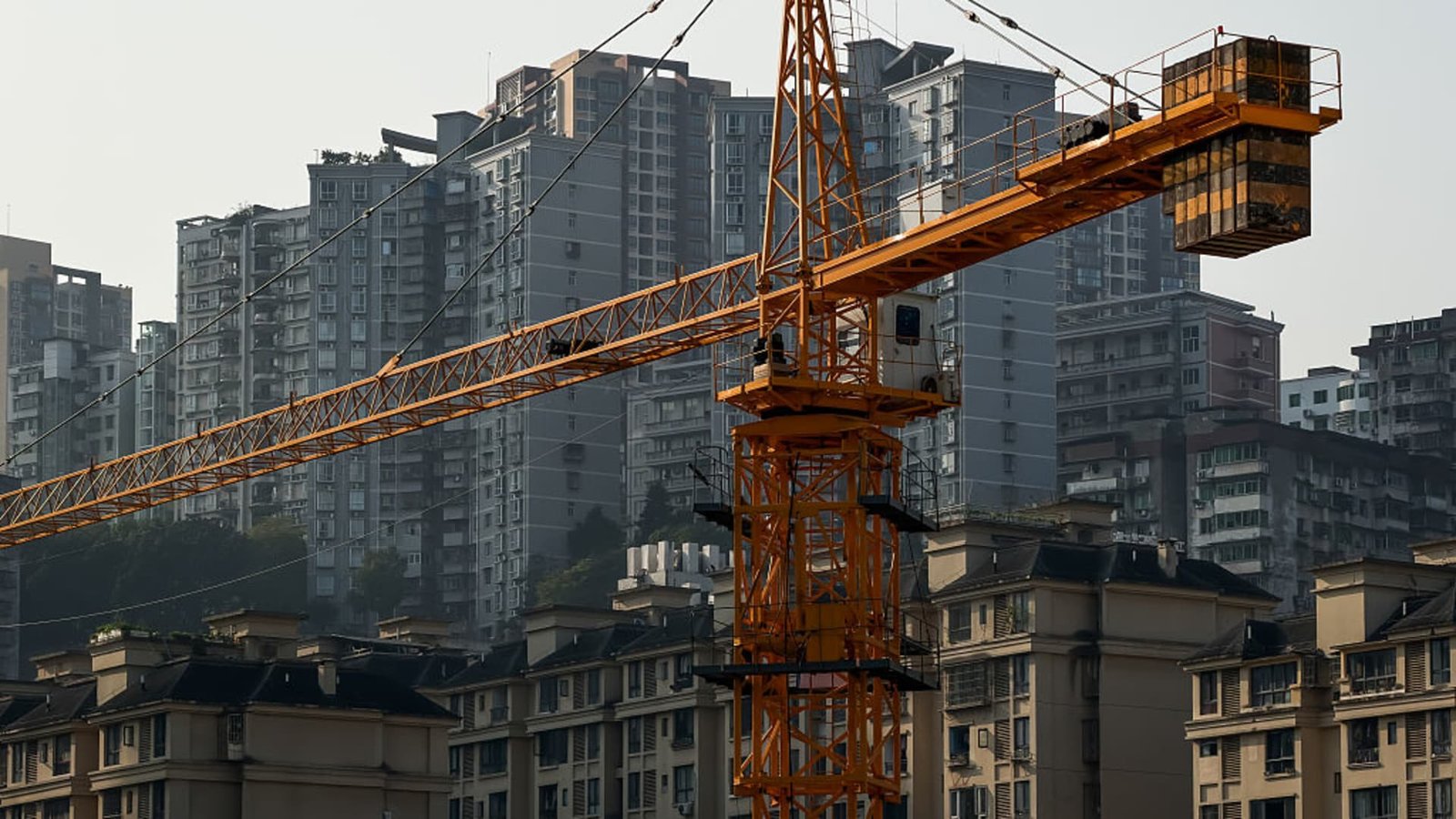
A tower crane stands above residential buildings in an urban district in the afternoon light, on January 9, 2026, in Chongqing, China.
Cheng Xin | Getty Images News | Getty Images
BEIJING — China’s push into high-tech industries isn’t large enough to offset the country’s property slump, leaving the economy more exposed to trade tensions, U.S.-based research firm Rhodium Group said in a report Monday.
From 2023 to 2025, new industries such as artificial intelligence, robotics and electric cars added just 0.8 percentage points to economic output, while real estate and other traditional sectors saw a combined 6 percentage point decline, the report said. The analysis drew on official Chinese data and industry-specific sources.
The findings come as China seeks to boost technological self-reliance in response to U.S. restrictions. Under a five-year development plan set to kick off in earnest in March, Beijing is doubling down on advanced technologies with state investment and favorable policies.
“China’s growth strategy isn’t going to work,” Logan Wright, partner at Rhodium and a co-author of the report, told CNBC. “They’re not going to achieve their targeted rates of GDP growth based on the policies they have outlined so far.”

Beijing has targeted annual GDP growth of around 5% in recent years. For China to sustain that pace, new industries would need to expand sevenfold over the next five years to generate the roughly 2 percentage points of annual investment growth required, Rhodium estimated.
That translates to an additional 2.8 trillion yuan in new investment required this year — or 120% more than in 2025. While investment in artificial intelligence or robotics could increase in the next year or two, other emerging industries are unlikely to sustain such rapid growth, the analysts said.
“Electric vehicles have likely already reached their fastest rates of growth, and output in the industry may be slowing in the years ahead,” the Rhodium report said.
Property drag deepens
While Beijing has prioritized high-tech development, it has taken fewer steps to address a yearslong slump in real estate. The sector once accounted for more than a quarter of the economy. New home sales by floor area last year fell to levels not seen since 2009, according to a report last week by the China Real Estate Information Corp.
Only in recent weeks have sighs appeared that some policymakers are considering more forceful property support. China’s top leaders are due to formalize economic targets for the year at an annual parliamentary meeting in March.
A macro outlook published by global investment firm KKR estimated that property weakness will shave 1.2 percentage points off China’s GDP growth this year. Even with a projected 2.6 percentage point contribution from digital technologies, the estimated total growth was still on the low end at 4.6%.
“Despite a potential 5% growth target for 2026, headwinds from real estate and a weak job market cast doubt on achievability,” the report said. KKR predicts the property drag could halve in 2027, but sees limited improvement in digital industries or consumer demand.
From jobs to trade tensions
An overemphasis on tech could have broader economic consequences.
New industrial sectors may offer higher wages, but they employ far fewer people than traditional industries, the Rhodium analysis found.
Increased factory automation, coupled with China’s already high 30% share of global manufacturing output, could lead to the loss of up to 100 million jobs over the next decade — a displacement that would exceed the total workforce of most developed economies, KKR said.
China’s urban unemployment rate remained above 5% for much of last year, while youth unemployment has been about three times higher.
Since it’s unlikely that domestic investment, even in newer industries, will produce sufficient demand, “Beijing will become even more dependent upon gaining market share in export markets,” the Rhodium report said.
“China will remain even more reliant upon exports in the future, leaving the economy vulnerable to new trade restrictions,” the report said.
As lower-priced Chinese goods, including electric vehicles, have expanded overseas, Mexico and the European Union have joined the U.S. in raising tariffs on imports from China.

Subscribe now
China’s economic imbalance mirrors a similar divergence in the U.S., where AI-linked companies have led stock market gains, while other parts of the economy have struggled.
But many in Beijing argue that the country has longer-term interests at stake.
Zhang Jianping, a deputy director at China’s Commerce Ministry, told CNBC last week that the country’s policies are designed to support innovation over multiple years. Traditional industries such as steel and real estate, he added, must integrate new technologies to remain competitive.