
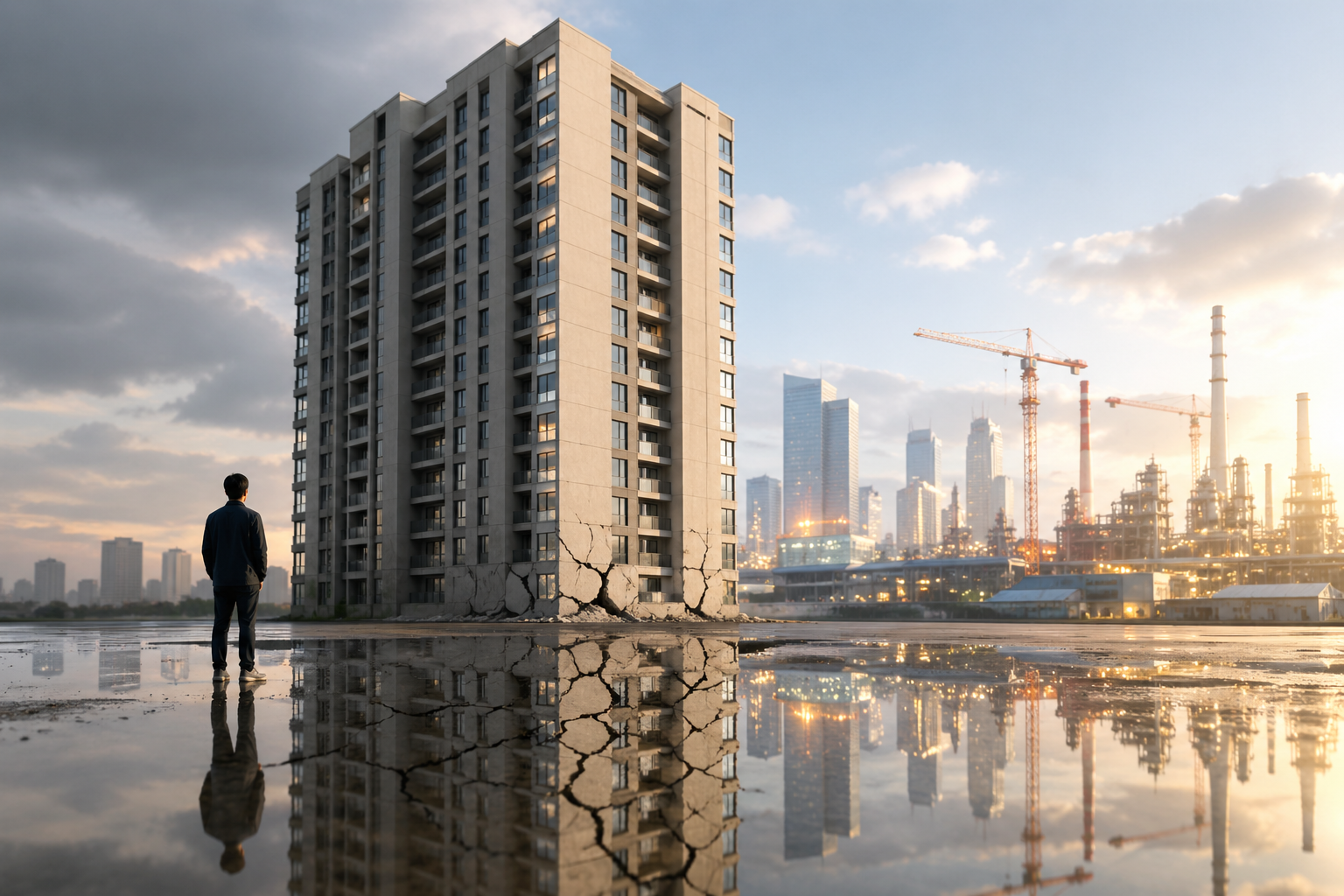
China’s real residential property price index just hit a record low with 17 consecutive quarters of decline.
In real, inflation-adjusted terms, home values are now below where they were in 2010, wiping out fifteen years of appreciation for the country’s urban middle class.
Meanwhile, official GDP grew at 5% in Q1 2026, beating forecasts. So perhaps one headline is more significant than the other.
What the headline number is hiding
The 5% growth figure is not fabricated. But it is being manufactured in a very specific way.
State-owned enterprises are leading a surge in infrastructure and advanced manufacturing investment.
Fiscal spending was front-loaded into Q1 2026. Exports of EVs, batteries, and semiconductors are genuinely booming.
Strip all of that out, and what remains, the organic private-sector-driven activity that reflects how actual Chinese households and businesses are doing, is tracking closer to 3% by several independent estimates.
The property sector, which as recently as 2021 accounted for roughly 24% of GDP, has seen its contribution cut in half.
Property investment collapsed 17.2% in 2025 alone. New home prices in March 2026 marked their 23rd consecutive month of year-on-year decline, including falls of 8% to 12% from peak in cities like Shanghai and Beijing, once considered untouchable.
The BIS real residential property price index closed Q4 2025 at 86.79 on a 2010 base of 100. Prices are not just falling. They have erased the entire decade-and-a-half of real gains.
Property was never just a sector
To understand why this matters so profoundly, you have to understand what property actually was in China. It was the savings account, the pension plan, and the primary store of national wealth, all in one.
Residential real estate represents 70% of urban household assets. Land sales funded roughly 20% of local government fiscal revenue, which in turn paid for hospitals, schools, roads, and public services across hundreds of cities and provinces.
At its peak, the property complex was consuming 60% of global cement output and 50% of global steel. It absorbed 25% of all bank loans in China.
This was not a sector running alongside the economy. It was the economy’s skeleton.
Local government land revenues have fallen 44% from their 2021 peak.
Banks are carrying non-performing exposure that official figures almost certainly understate.
An estimated $18 trillion in household wealth has been destroyed since the peak, a number larger than the entire US GDP.
The doom loop nobody in Beijing wants to name
There is a specific economic concept that fits China’s situation precisely, which is a balance sheet recession. The term was developed by economist Richard Koo to describe Japan after 1991.
When the primary asset of a nation’s households collapses in value, those households rationally respond by saving more and spending less, even when interest rates are near zero.
The correct individual response becomes collectively catastrophic.
Chinese household bank deposits have nearly doubled over the past five years.
Consumer confidence remains depressed. Retail sales growth repeatedly misses forecasts.
The People’s Bank of China can cut rates, and it has, but it cannot manufacture the confidence needed to make people spend.
Monetary policy, in this environment, is a lever disconnected from the machine it is supposed to operate.
The second-order effect is the one poisoning the global trading system. Factories that lose domestic demand do not close. They cut prices and export.
China’s industrial overcapacity is now flooding global markets with cheap steel, chemicals, solar panels, and EVs at prices that competitors in Europe, the US, and Southeast Asia simply cannot match.
This looks like Chinese industrial strength. It is, in significant part, Chinese domestic weakness finding an exit valve, and it is the primary driver of the trade tensions escalating around it.
What investors are actually buying when they buy China
The green industrial complex is real. Output in AI-adjacent sectors, including integrated circuits, grew nearly 50% year-on-year in Q1 2026.
EV exports surged 77.5%.
Lithium battery production rose over 40%.
China is winning the green technology race decisively, and these are not manufactured numbers. For investors with long horizons and tolerance for policy risk, there is genuine value in the sectors Beijing has chosen to champion.
The problem is that these industries do not employ enough people, at sufficient wages, to replace the economic mass of what property used to generate.
A semiconductor fab is not a jobs engine. An EV export line does not rebuild the confidence of a household sitting on a mortgage worth more than the apartment securing it.
Goldman Sachs estimates the property downturn dragged approximately 2 percentage points off annual GDP growth in both 2024 and 2025.
The generation that bought the dream
The sharpest way to understand what is happening in China is not through GDP tables or BIS indices. It is through the young professionals who stretched their savings and their parents’ savings to buy an apartment in 2019 or 2020.
That person is now servicing a mortgage on an asset worth 23% less in real terms than when they bought it, in a job market where youth unemployment runs at approximately 20% officially and significantly higher by independent estimates.
They are not consuming. They are not investing. They are doing what every rational actor does in this situation: waiting, saving, and hoping the floor arrives before the ceiling closes in.
Multiply that across tens of millions of households, and you have the actual state of the Chinese economy in 2026.
The GDP number tells you what the state is building.
The property price chart tells you what people are living.
Beijing can paper over the second story with the first one for a while longer, but the BIS data doesn’t take instructions from anyone.