
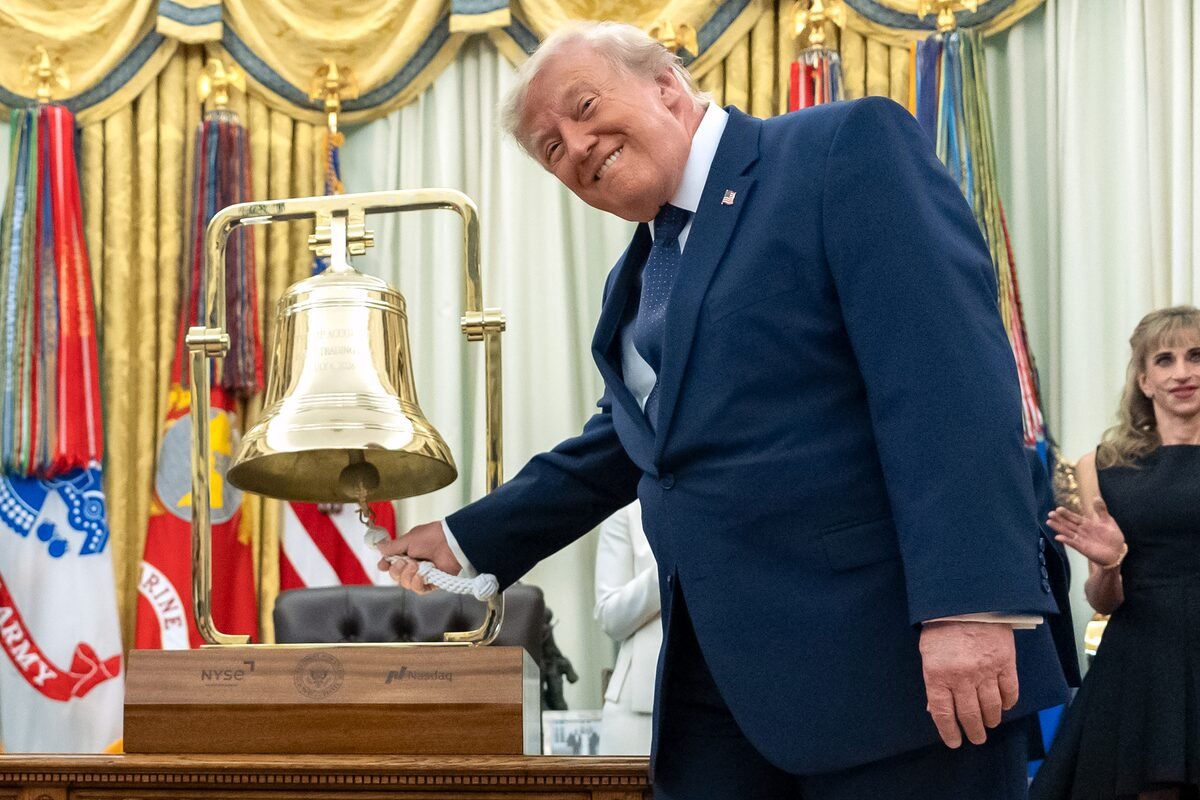
A screen displays U.S. President Donald Trump during an opening bell at the White House, at the New York Stock Exchange (NYSE) in New York City, U.S., July 6.Jeenah Moon/Reuters
U.S. President Donald Trump began this week with an Oval Office first: ringing the stock market’s opening bell.
The moment captured a defining feature of his second term. Trump has increasingly cast Wall Street’s gains as a measure of his presidency, treating record stock prices as proof that his policies are working even as many Americans remain squeezed by high living costs and millions own no stock at all.
It is a political and economic calculus that some economists say risks conflating the fortunes of financial markets with the broader experience of U.S. households, roughly four in 10 of which do not have money in the markets.
Trump has pointed to rising equities as validation for policies ranging from his war with Iran to sweeping global tariffs and signature domestic legislation, while seeking to steer more Americans toward stock ownership and embedding the federal government directly into the balance sheets of some of the country’s corporate titans.
Administration officials say Trump’s focus is part of a broader legacy project to increase household participation in capital markets, an effort that has earned praise from investors who say the White House has a finger on the pulse of the economy.
Trump routinely cites a rising stock market as a signal of a thriving country, raising the theme during meetings with global leaders, at rallies, even at military ceremonies.
In June, before awarding three servicemembers the Medal of Honor, the highest U.S. military recognition, Trump told his audience, “The stock market just hit a new all-time high, the 401(k)s are at a new all-time high, and oil is dropping like a rock.”
Republicans’ US$4.1-trillion “One Big Beautiful Bill” created government-seeded investment accounts for newborns known as “Trump accounts.”
In February, Trump also unveiled plans to match up to US$1,000 in 401(k) contributions for workers who enrolled in so-called “Trump IRA” accounts.
His economic agenda has focused almost exclusively on the growth of businesses as a proxy for household financial health. The administration also has cut deals with major companies, including taking an equity stake in Intel and a “golden share” in U.S. Steel, and inking revenue-sharing agreements with Nvidia and AMD. Trump points
to those firms’ successes as signs of a growing economy rather than the effects of nearly unprecedented federal market intervention.
But some economists say that focus neglects a large share of Americans. Roughly 40 per cent of the country owns no stock at all, according to Gallup polling, and the wealthiest 1 per cent own more than half of U.S. capital market investments.
The division underscores what economists have described as a “K-shaped” economy where spending by wealthy households props up the market while middle- and low-income households cut back. The U.S. stock market has gained US$15-trillion since Trump returned to office, about a 25 per cent increase, and stocks account for roughly a third of household wealth.
But those gains are heavily consolidated among the wealthiest Americans, whose assets are dominated by equities. For the bottom half of households, wealth is more likely tied to real estate and durable goods, leaving their short-term personal finances largely unaffected by stock market growth.
The U.S. economy is largely on steady footing with healthy growth and low unemployment, but recent inflation – in part caused by the Iran war – has led some consumers to sour on their economic outlook.
White House spokesman Kush Desai in a statement said Trump was “simultaneously focused on ensuring every American has a stake in the successes of America’s next golden age with their own piece of the pie.”
Trump himself is heavily exposed to the market. In the first three months of 2026, his investment accounts completed 3,600 stock trades worth between US$212-million and US$695-million, according to his financial disclosures.
“You know why I’m profiting? Because the stock market’s going up, everybody’s profiting,” he said last week.
Some of Trump’s most ardent backers acknowledge that the metric the president relies on may not always reflect the health of the overall economy. “It’s not a perfect correlation. There are other measures of how businesses are doing,” said Stephen Moore, a conservative economist who periodically advises Trump and White House officials. “But a valuation of their stock is an important indication.”
Critics accuse Trump of reversing major policy decisions after market declines, including rolling back parts of his trade war after stocks plunged following its announcement. He’s also weighed the market when discussing the Iran war, wary of gaining a reputation similar to President Herbert Hoover, who presided over the 1929 stock market crash.
At June’s Group of Seven summit, Trump said he noticed that “every time we talked about the possibility of peace, the stock market shot up like a rocket ship.”
“This is the way that people can get his attention or society can get his attention,” said Alex Jacquez, chief of policy and advocacy at the liberal think tank Groundwork Collaborative. “Where it’s dangerous is that it only seems to assert itself when corporate or financial interests are at stake.”
Measuring economic success through the stock market leaves out young people without much equity exposure, as well as women and minority groups who are underrepresented in capital markets, Jacquez said.
It also does not measure the health of small businesses – the backbone of the U.S. labor market – and privately held firms. Many economists prefer to look at the country’s annual total economic output, or gross domestic product, and wage growth to gauge the health of the economy.
U.S. GDP grew by a reasonable 2.1 per cent in 2025, and average hourly wages increased by 3.5 per cent, giving workers a raise but not enough to outpace recent inflation.
Happy investors say the president’s attention will prevent “black swan events,” or surprise, large-scale financial shocks, from rattling markets. Trump administration officials have echoed the sentiment, but some on Wall Street are skeptical the president can permanently shield markets from downturns.
“Having President Trump always focused on the market helps investors sleep well at night,” said Dan Ives, global head of tech research at Wedbush Securities. “It almost creates some natural guardrails.”