
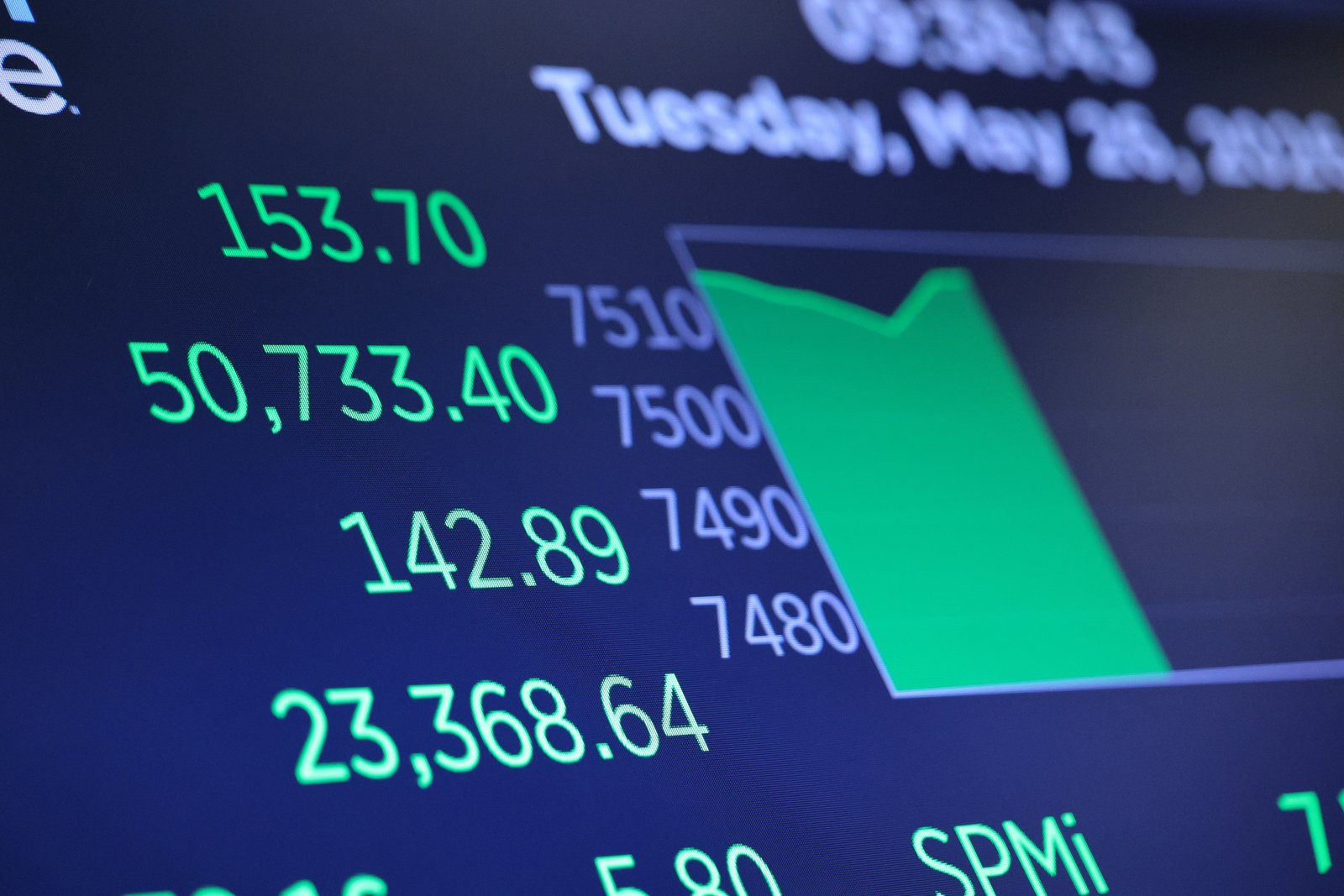
The U.S. stock market continues to post strong gains in 2026 even as the broader economy expands at a far more modest pace, highlighting a growing disconnect that economists say is being driven largely by the artificial intelligence boom.
The contrast has left many Americans wondering why Wall Street appears to be thriving while economic indicators are down. According to economists, the answer lies in the fundamental differences between what the stock market measures and what drives the broader U.S. economy.
“I think there’s this widespread perception the two should be in sync,” Joe Seydl, senior markets economist at J.P. Morgan Private Bank, told CNBC. “But, from a purely analytical perspective, they’re two very different phenomena. We’re talking about apples and oranges in many ways.”
The S&P 500 has gained nearly 10% during the first half of 2026, while the Dow Jones Industrial Average is up almost 9%, marking its strongest first-half performance since 2021. Those gains build on an extraordinary run in recent years, with the S&P 500 advancing 24% in 2023, 23% in 2024 and another 16% in 2025.
President Donald Trump recently pointed to the stock market’s continued strength as a factor behind the growth of his personal wealth after returning to office for a second term. However, the economy has followed a much slower trajectory.
Real gross domestic product, which measures inflation-adjusted economic output, has slowed from roughly 3.3% growth in 2023 to about 1.9% so far this year, according to Seydl. While that does not signal a recession, economists say it reflects an economy that is expanding without much momentum.
“We’re growing. We’re not in recession,” Moody’s Analytics Chief Economist Mark Zandi told CNBC. “But we’re not going anywhere quickly.” Federal Reserve officials projected in June that the U.S. economy would grow about 2.2% in 2026, while most economists expect growth to remain close to 2% for the year. At the same time, several economic indicators have softened.
Employers are hiring at the slowest pace in more than a decade outside of the pandemic, labor force participation remains near its lowest level in nearly 50 years, excluding Covid-era disruptions, and long-term unemployment has continued to rise.
Consumer confidence has also struggled. The University of Michigan’s closely watched consumer sentiment survey plunged to a record low in May amid concerns over inflation before rebounding modestly in June, though confidence remains historically weak.
Despite those headwinds, investors have continued pouring money into stocks, particularly companies tied to artificial intelligence. Economists say AI has become the primary force behind the divergence between Wall Street and Main Street.
Technology companies now account for roughly 35% of the stock market. When including companies such as Alphabet, Amazon, Meta, and Tesla, which are classified in other sectors but trade like major technology firms, that figure approaches 50%, according to Seydl.
Markets are inherently forward-looking, pricing companies based on expectations of future earnings rather than current economic conditions. Investors have become increasingly optimistic that AI will drive enormous profits across the technology sector.
Capital Economics noted in a July 1 research report cited by CNBC that “The rise in earnings has been concentrated in the major ‘big-tech’ firms, especially the semiconductor companies and hyperscalers.”
Companies including Microsoft, Amazon, and Oracle have benefited from surging demand for cloud services, while semiconductor makers such as Intel, TSMC and Samsung have seen growing demand for AI chips. Together, those industries have generated nearly two-thirds of all S&P 500 earnings growth since OpenAI introduced ChatGPT to the public in late 2022.
Yet technology represents only about 10% to 15% of the broader U.S. economy. Instead, the economy relies primarily on consumer spending, which accounts for approximately 70% of gross domestic product. Consumer spending remains relatively healthy, but economists warn it is increasingly being sustained by wealthier households.
According to a recent Moody’s analysis, households earning roughly $200,000 or more now account for nearly 60% of all personal spending, compared with about half during the early 1990s.
During the first quarter of 2026, inflation-adjusted spending among the top 20% of earners increased by about 4%, while spending by the remaining 80% of households was essentially flat. The concentration creates additional risks because affluent households also own the vast majority of stocks.
As their investment portfolios rise, they often spend more through what economists call the “wealth effect.” That relationship means a significant correction in AI-related stocks could ripple beyond financial markets and weaken consumer spending among higher-income Americans. “If AI stocks hit a skid, the economy would be in big trouble because of how soft it is,” Zandi warned. “It’s a very fragile, tenuous place to be.”