
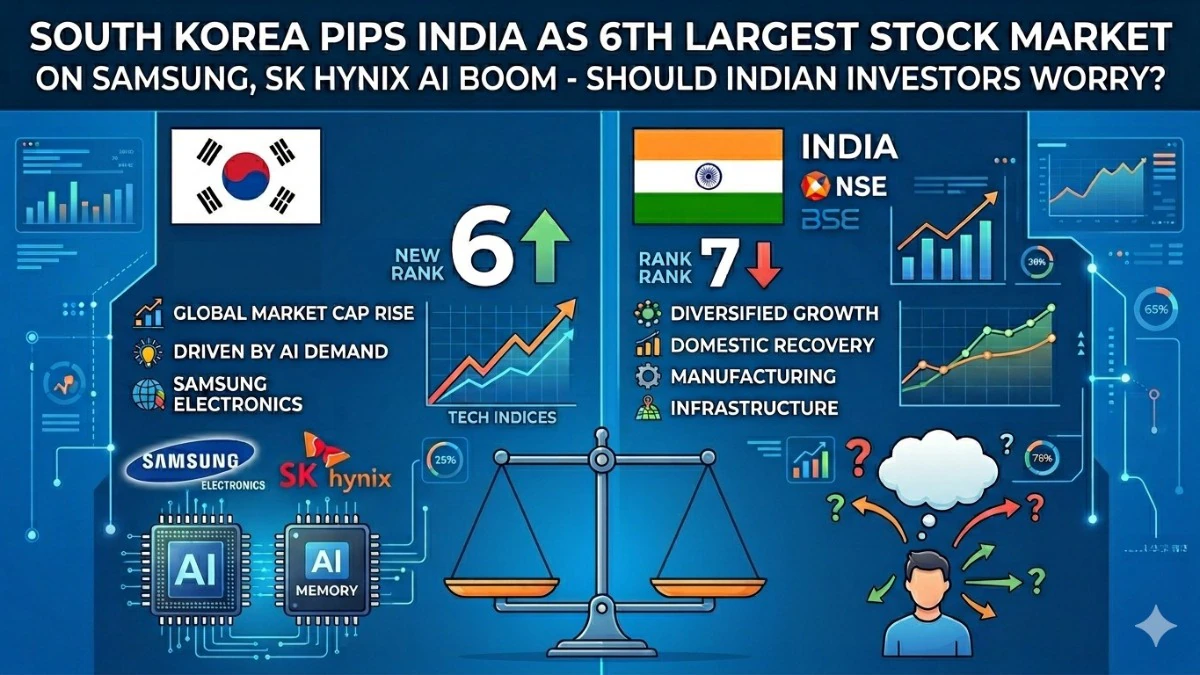
Days after Taiwan taking over India as the fifth largest stock market, it is South Korea that has now moved a ladder up, dragging the domestic market down to the seventh spot in global rankings. This comes as South Korean giant Samsung saw its shares soaring 173.93 per cent while those of SK Hynix Inc zooming 243.57 per cent in 2026 so far, with the two companies now commanding market values in excess of $1 trillion each. In contrast, none of the Indian stock is now among top 100 global corporates in terms of market capitalisation, losing out on the $12 trillion rally globally.
India market now at 7th spot: Near-term outlook
South Korea’s market capitalisation has crossed the $5 trillion mark, making it the sixth-largest globally and overtaking India’s $4.85 trillion (at Tuesday’s intraday level).
Data showed Korean Kospi has doubled investor wealth, rising 100 per cent year-to-date. Taiwan’s market is also up 53 per cent in 2026 so far. YES Securities said the common denominator across these markets appears to be structural sector exposure rather than purely index composition. Taiwan and South Korea are deeply embedded in the semiconductor and hardware supply chain, allowing AI-linked gains to diffuse across a wider ecosystem rather than concentrate in a handful of names.
Nifty and Sensex, on the other hand, are nursing losses to the tune of 11-13 per cent.
“In the near term, the domestic market will remain hostage to volatile developments arising from the West Asian crisis. Higher commodity prices will be the key monitorables, as a prolonged elevated level could affect India’s macro parameters and engender a tight monetary policy stance,” MOFSL said.
Should Indian investors worry? Long term outlook
Meanwhile, India’s market cap-to-GDP ratio now stands at 118 per cent against Korea’s 273 per cent.
Morgan Stanley’s Equity Strategists Ridham Desai and Nayant Parekh in a note on “India Equity Strategy Playbook” said domestic equities appear poised for a strong year ahead.
The strategists said earnings growth acceleration is likely in the pipeline and valuations and sentiment are coming off near extremes. “Bottom may be behind us,” Desai and Parekh wrote on June 1.
For equity investors, broad-based growth acceleration, low foreign positioning make for a compelling mix, Morgan Stanley noted suggested.
“India’s share of global profits exceeds its global index weight by the highest margin ever ex-2009,” the note said adding that the policy backdrop is also supportive with an undervalued currency, modest real rates and fiscal stability.
This made Morgan Stanley Strategists believe India earnings are once again in the throes of an upcycle. The key short-term risks to this outcome include prolonged strife in the Middle East and a severe drought due to bad weather in the coming summer sowing season, they said.
“The earnings growth acceleration could last several quarters beyond these near-term hurdles given our strong view on capital spending across numerous sectors including Energy, Defence, Semiconductors, fertilizers and data centres – we expect investments to GDP to rise to 37.5 per cent in the coming five years,” Desai and Parekh said.
Disclaimer: Business Today provides stock market news for informational purposes only and should not be construed as investment advice. Readers are encouraged to consult with a qualified financial advisor before making any investment decisions.