

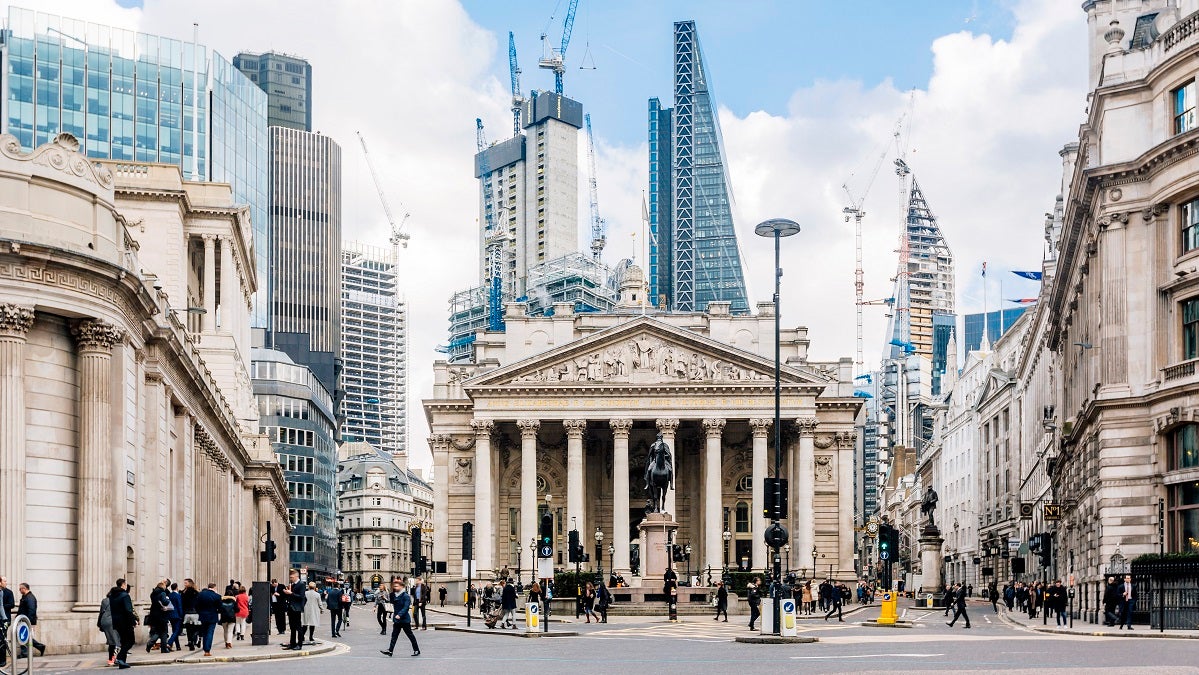
For hundreds of years, London’s stock market has been a cornerstone of global finance and the UK economy. Its beginnings can be traced back to the seventeenth century after rowdy stockbrokers were kicked out of the Royal Exchange for being loud and uncouth, settling instead in the city’s coffee houses. A main meeting place was Jonathan’s Coffee House in Change Alley and it was here they began publishing a list of prices for stocks and commodities – what eventually became the London Stock Exchange (LSE).
More recently, however, the LSE has been plagued by concerns that it is rapidly losing its status as a global centre for raising new capital, having endured a tumultuous few years marked by a deluge of de-listings and high-profile IPO snubs.
Despite the UK government’s plans for capital markets reform, more than half (53%) of FTSE 350 company boards surveyed in the Chartered Governance Institute UK & Ireland’s Boardroom Bellwether report, believe the LSE will decline over the next five years, fuelled by further de-listings and a worsening of its international position. Just under a third (31%) said the stock market was set for a recovery.
In 2021, London was the largest centre for IPOs globally outside of the US and China, welcoming over 120 companies to the UK market. So, what happened?
Where did it all go wrong?
Some blame Brexit and the political chaos that followed, which prompted many investors to withdraw their money from the UK. Others argue that the LSE’s standing has been slowly eroded over decades thanks to adverse regulatory decisions and changing global market dynamics.
“Other exchanges worldwide have been quicker to innovate, benefiting from local cultural support and temporary regulatory changes that favoured their growth,” says Radu Tunaru, professor of finance and risk management at Henley Business School.
An increase in competition from overseas stock exchanges has been exacerbated by the LSE’s complacency, Tunaru says. “It was presumed that its status alone would suffice. Unfortunately, this has not been the case.”
The UK’s regulatory framework is partly to blame. Pension funds used to be one of the biggest buyers of British equities, but tighter regulation in the wake of the 1991 Mirror Group scandal, where thousands of workers lost their pension benefits, prompted a more risk-averse culture. According to a report by New Financial, a think-tank, in 1997 UK pension schemes allocated 73% of their assets to equities; in 2024 that figure was 31%.
The LSE will have to decide how much deterioration of reporting standards it will be willing to tolerate
George Lagarias, chief economist at Forvis Mazars, a financial advisory firm, argues that London’s listing slump, while more pronounced than in most countries, is part of a wider global trend. The global IPO market has been sluggish for the past two years amid soaring inflation and volatility caused by war in Ukraine. “The British stock market is affected by geopolitical headwinds not of its own making, so there’s very little it can do,” he says.
Broader market trends have also contributed to the LSE’s decline. Private equity has become an attractive alternative to public listings. Privately held firms face fewer regulatory constraints and are free to operate out of the public eye. Their investors have deep pockets too. Last year’s £4.3bn take-private of Darktrace, considered one of the UK’s great tech success stories, shows the willingness of private equity firms to wield their wealth for the right target.
The reality is that the UK economy has been struggling. According to a new EY report, one in five UK-listed companies warned investors about plummeting profits last year, underlining the growing pressure on businesses as costs rise.
Knox Mcilwain, head of regulatory and licensing at Airwallex, a fintech company, believes sluggish economic growth and increased competition overseas is drawing companies away from the LSE in droves. “Many are being pulled towards the US market, with the Nasdaq boasting high-profile tech success stories,” he says. This has been fuelled recently by Trump’s promise of deregulation.
Amazon, Apple and Tesla are among the ‘magnificent-seven’ stocks that have supercharged the US stock market. By comparison, the UK’s blue-chip companies offer less glitz and glamour. With no major technology companies on its listing board, the London exchange has struggled to keep up with the S&P 500.
Tunaru highlights the over-representation of the old economy on the LSE: “When comparing the top 10 companies on the S&P 500 with those on the FTSE 100, would an entrepreneur prefer to list their company alongside the likes of Apple, Microsoft, Nvidia, Alphabet, Amazon, Tesla, Berkshire Hathaway, Meta, UnitedHealth Group and Johnson & Johnson, or with Shell, HSBC, Unilever, AstraZeneca, GlaxoSmithKline, Diageo, BP, Rio Tinto, British American Tobacco and Barrick Gold?”
That is not to say the LSE is dead. Far from it: many of these UK stocks, including NatWest and Rolls-Royce, delivered two times the return of the US index. And, on January 20, the FTSE 100 closed above 8,500 points – a record high.
Is a recovery on the horizon?
There are signs that the LSE is not done just yet. Recent successes in the FTSE 100 hint at changing perceptions of the UK’s investability under a new government. Shein, the fast-fashion giant, is planning a multibillion-pound London IPO for mid-2025, for instance. Meanwhile, falling inflation and the prospect of a spike in M&A activity offer further hope for an LSE revival.
But David Beech, CEO at Knights, an AIM-listed legal firm, says the “fundamental issue with the LSE is that it has become disconnected from company performance. For almost four years now money has been leaving the market,” he explains. The result is a seller-dominated market with too few buyers, even when a company is performing well.
It presumed that its status alone would suffice. Unfortunately, this has not been the case
“At some point that investment will come back, but we can’t just sit tight and wait for that to happen,” he says. “If the status quo continues, markets could become too thin, with not enough listed companies, especially on the AIM market.”
The UK Government is eager to put an end to “crisis-era” regulation, having rolled out reforms to the LSE’s listing regime last year that simplify the IPO process. But some, including Beech, argue that these changes alone will not incentivise companies to float in London. The City must offer enhanced incentives for research, better policies to attract global talent and a friendlier tax regime, too.
Others are concerned that Labour’s plans to deregulate the UK stock market go too far. “In the next few years, the LSE will have to decide how much deterioration of reporting standards it will be willing to tolerate,” says Lagarias. “Will it go head-to-head with the US in a race for more business, or will it maintain higher standards and wait for the next crisis to prove its value to those who decide to list there?”
Over its 300-year existence, the LSE has withstood many destabilising events, from the Black Monday stock market crash to the 2008 global financial crisis to the Covid-19 pandemic. It was even hit by a rocket during the second world war. A full recovery from this latest setback may seem improbable – but it’s not impossible.

For hundreds of years, London’s stock market has been a cornerstone of global finance and the UK economy. Its beginnings can be traced back to the seventeenth century after rowdy stockbrokers were kicked out of the Royal Exchange for being loud and uncouth, settling instead in the city’s coffee houses. A main meeting place was Jonathan’s Coffee House in Change Alley and it was here they began publishing a list of prices for stocks and commodities – what eventually became the London Stock Exchange (LSE).
More recently, however, the LSE has been plagued by concerns that it is rapidly losing its status as a global centre for raising new capital, having endured a tumultuous few years marked by a deluge of de-listings and high-profile IPO snubs.
Despite the UK government’s plans for capital markets reform, more than half (53%) of FTSE 350 company boards surveyed in the Chartered Governance Institute UK & Ireland’s Boardroom Bellwether report, believe the LSE will decline over the next five years, fuelled by further de-listings and a worsening of its international position. Just under a third (31%) said the stock market was set for a recovery.