

The U.S. midterm elections have triggered a massive shock in global stock markets.
U.S. tech stocks plummeted, and the impact spread to Asian markets such as Japan, South Korea, and Taiwan. Intense selling pressure was particularly evident in AI-related and semiconductor stocks.
Is this stock market decline merely a disappointment with the election results?
Or is it a precursor to the collapse of the ‘AI bubble’ that has been driving global stock markets until now?
To understand this stock market decline, it is necessary to consider the causes in two separate categories.
The convergence of these two factors may have led to the global stock market decline.
In this article, we will conduct a thorough analysis of the global stock market decline in November 2026, covering everything from its causes to future developments and the impact on Japanese investors.
1. What happened globally? The chain reaction of stock market declines across countries
On November 5, 2026, a significant drop in stock prices occurred in the U.S. stock market.
Selling spread, particularly among tech stocks, with the Nasdaq market seeing a notable decline.
Furthermore, the impact spread to Asian markets on the following day, the 6th.
The main market movements are as follows.
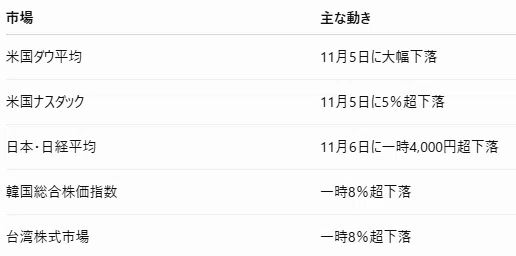
*The decline rates for each market vary depending on trading hours and the basis for comparison with the previous day.
AI-related companies and semiconductor-related companies were particularly heavily sold.
When U.S. tech stocks fall, the selling pressure spreads to Japanese semiconductor manufacturing equipment makers and South Korean memory semiconductor companies.
Global investors moved in unison to avoid risk.
However, this stock market decline cannot be explained solely by the midterm elections.
What is important is that factors of instability had been accumulating in the stock market even before the election.
2. Causes of the stock market decline (1): Political impact of the US midterm elections
First, I would like to organize the election factors that triggered this stock market decline.
In the November 2026 US midterm elections, the Democratic Party made significant gains.
This could potentially affect President Trump’s policy management.
Investors are primarily wary of the following four points.
1. Strengthening of AI-related regulations
The most closely watched area is regulation of the AI industry.
Until now, the Trump administration has prioritized the growth of the AI industry and promoted policies to enhance US technological competitiveness.
On the other hand, with the Democratic Party’s influence in Congress strengthening, there is a possibility that oversight and regulation of AI companies will be tightened.
Specifically,
-
regulations regarding AI safety and transparency
-
protection of personal information and copyrights
-
environmental regulations for data centers
-
burdens on power consumption and the power grid
will become the focus.
The AI industry is growing rapidly, but if regulations are tightened, it could affect companies’ business plans and capital investment.
2. Constraints on data center construction
The spread of AI requires massive data centers.
However, data centers consume large amounts of electricity and water.
In some regions, there are concerns about rising electricity costs and environmental impacts.
If environmental regulations and the tightening of construction permits continue in the future, the construction of data centers may be delayed.
This is also an important issue for AI semiconductor and server-related companies.
③ Policy Stagnation under the Trump Administration
If the Democratic Party’s influence in Congress strengthens, the tax cuts, budget, and industrial policies promoted by the Trump administration may face difficulties.
What is important for companies is policy predictability.
If the direction of policy becomes unclear, decisions regarding large-scale investments and new business ventures will become more cautious.
④ Conflict between the Administration and Congress
If the Democratic Party takes the lead in both the House and the Senate, the conflict between the administration and Congress may intensify.
If conflicts over budgets and bills are prolonged, uncertainty regarding the entire U.S. economy will increase.
However, just because a party has gained a majority in Congress does not mean that all policies can be changed immediately.
There are also institutional constraints, such as the President’s veto power and procedures within Congress.
In other words, it is believed that the wariness toward policy changes brought about by the election has cooled investor sentiment.
3. Cause of Stock Price Decline ②: Market Problems That Existed Before the Election
Actually, this is more important regarding the current stock price decline.
Even before the election results became clear, multiple sources of anxiety existed in the stock market.
① Overvaluation of AI-related Stocks
Due to the AI boom, the stock prices of semiconductor and data center-related companies have risen significantly.
However, questions have begun to arise as to whether the actual profits of these companies are keeping pace with the rise in stock prices.
Companies whose stock prices have risen solely on expectations for the future are more susceptible to being sold off heavily even on minor negative news.
Investors are beginning to strictly evaluate not only the growth potential of AI, but also whether current stock prices are commensurate with corporate value.
(2) Will AI capital investment really lead to profits?
Major IT companies such as Microsoft, Amazon, Google, and Meta continue to invest huge sums in data centers and semiconductors for AI.
However, the question is whether that investment will truly lead to profits.
Even if the number of AI service users increases, if capital investment and electricity costs swell, corporate profits may not grow as expected.
In the early stages of the AI boom, expectations for future growth drove stock prices up.
However, from now on, how much profit can be generated relative to the investment amount will become important.
(3) US interest rates and inflation
If interest rates remain high, corporate borrowing costs will increase.
This is a headwind, especially for data center businesses and AI-related companies that require huge amounts of capital.
Also, if inflation re-accelerates, the Fed may hold off on interest rate cuts.
High interest rates are a major burden for growth stocks that are bought in anticipation of future profits.
(4) Profit-taking and withdrawal of investment funds
Profit-taking is likely to occur for stocks that have risen significantly in price.
When a sharp decline overlaps with this, margin calls on margin trading and position reduction due to risk management may occur.
When some investors start selling, other investors also sell to avoid expanding losses.
This chain reaction accelerates the decline in stock prices.
(5) Chain reaction to global markets
When US high-tech stocks fall, selling spreads to semiconductor-related companies in Japan, South Korea, Taiwan, and elsewhere.
Furthermore, if global investors move funds from stocks to bonds or cash, the selling could spread to stocks that are not directly related to AI.
This is the mechanism that leads to a simultaneous global stock market decline.
4. How do election factors compare to market factors?
The current stock market decline is considered to be a combination of political shocks caused by the election and pre-existing market anxieties.
The comparison between the two is as follows.

What is important here is that while the election may have triggered the stock price decline, the magnitude of the drop is determined by the state of the market itself.
Even if political uncertainty is resolved, it will be difficult for stock prices to recover if the profitability of AI-related companies fails to meet expectations.
Conversely, if AI-related companies demonstrate high profitability, stock prices could recover even if political uncertainty remains.
In other words, it is not just the election results that will determine the future of the market.
The question of whether AI investment can truly generate profits will become more important.
5. How long will the midterm election shock last? Three scenarios
I would like to consider three scenarios for the future of the stock market.
Scenario A: Ends with a short-term correction
Estimated duration: 1 to 3 weeks
If market caution regarding the Democratic Party’s gains subsides and the performance of AI-related companies exceeds market expectations, stock prices may rebound.
It is also possible that investment funds will return to stocks that have become undervalued due to this decline.
In this case, the current stock market decline will end as a temporary correction.
Scenario B: Prolonged adjustment phase
Estimated duration: 1 to 3 months
This is the scenario to be wary of.
Doubts regarding the capital investment and profitability of AI-related companies remain unresolved, which may weigh on stock prices.
Furthermore, if debates surrounding AI regulation are prolonged, it is possible that unstable market conditions, centered on semiconductor stocks, will continue.
We should also anticipate a scenario where the stock market loses its sense of direction from the end of 2026 through the beginning of 2027.
Scenario C: Development into an AI Bubble Burst
Estimated duration: 6 months to over 1 year
The most serious case is one where investment plans for AI-related companies are significantly scaled back.
If the monetization of AI services falls short of expectations and investment in data centers decreases, it will also have a negative impact on the performance of semiconductor manufacturers and related companies.
There is also a possibility that the decline in stock prices will not be limited to high-tech companies but will spread to the entire global economy.
However, at this point, an AI bubble burst is not a certainty.
6. What is the impact on Japanese stocks? Semiconductor-related companies to watch
With this stock market decline, the Japanese market must be particularly cautious about semiconductor-related stocks.
Japan is home to world-class semiconductor manufacturing equipment makers and related companies.
Tokyo Electron
A major company in semiconductor manufacturing equipment.
If global semiconductor capital investment shrinks, there are concerns about the impact on its performance.
Advantest
A major company in semiconductor testing equipment.
While it benefits if demand for AI-oriented semiconductors grows, caution is required if AI investment slows down.
Kioxia
A memory semiconductor manufacturer.
While storage demand for AI data centers is a growth driver, it is also influenced by memory prices and capital expenditure trends.
Nikkei Stock Average
The Nikkei average is susceptible to the influence of high-priced semiconductor-related stocks.
If US tech stocks fall, selling pressure could spread to the Japanese market.
However, not all Japanese companies will decline in the same way.
There is a possibility that funds will shift to companies that are relatively less affected by economic fluctuations, such as domestic demand stocks, daily necessities, telecommunications, and food.
7. What should those investing via NISA do?
In the event of a sudden drop like this, what individual investors should be most careful about is emotional trading.
Especially for those investing long-term through NISA, it is important to calmly consider whether it is necessary to change investment policies based solely on short-term stock price fluctuations.
For those investing through long-term accumulation
If you are investing long-term in mutual funds such as global stocks or the S&P 500, there is no need to stop your accumulation just because of a short-term decline.
However, you should re-examine your investment concentration and risk tolerance.
For those holding individual stocks
Caution is required if your assets are concentrated in specific AI-related or semiconductor stocks.
You should check the company’s performance and future growth potential, and consider reviewing your asset allocation if necessary.
For those starting to invest now
You should avoid investing your entire amount just because prices have dropped sharply.
There are methods such as splitting your investment funds into multiple parts to diversify the timing of your purchases.
Above all, it is important to invest only after securing emergency funds for living expenses.
8. Five points to watch in the future stock market
To determine whether stock prices will recover in the future, I would like to focus on the following five points.

Of particular importance are the capital investment plans of major IT companies.
Will AI-related companies continue to make huge investments, or will they review their plans with an emphasis on investment efficiency?
This decision could determine the direction of the global stock market, including semiconductor stocks.
9. Summary: Is this stock market decline a perfect buying opportunity, or the beginning of an AI bubble burst?
This global simultaneous stock market decline was triggered by political changes resulting from the US midterm elections.
However, in the background, there are concerns about the overheating of AI-related stocks and questions regarding massive capital investments.
To understand this stock market decline, it is important to distinguish between the following two factors.
Election Factors
Caution regarding the strengthening of AI regulations due to the Democratic Party’s progress, the impact on the Trump administration’s policy management, and the uncertainty of US politics.
Market Factors
The overvaluation of AI-related stocks, questions about the profitability of massive investments, interest rates, inflation, and profit-taking sales.
Even if political anxiety due to the election subsides, a full-scale recovery in stock prices may be difficult if market factors are not resolved.
What I would like to pay particular attention to in the future is the capital investment and profitability of AI-related companies.
The AI industry has the potential to continue growing. However, not all companies in a growing industry can necessarily generate profits that justify their current stock prices.
Is the AI boom really over? Or is this stock market decline an adjustment for the next phase of growth?
From the end of 2026 to the beginning of 2027, it seems that important phases for the global stock market will continue.
Rather than panicking and buying or selling due to the sharp drop in stock prices, I want to calmly assess both political movements and corporate performance.
Information sources to refer to and check
-
Reuters: Trends in the Stock Market and AI-Related Stocks Following the U.S. Midterm Elections
-
Associated Press: The Sharp Decline in the U.S. Stock Market and Its Ripple Effects on Asian Markets
-
Federal Reserve Board (FRB): Monetary Policy and Interest Rate Trends
-
U.S. Securities and Exchange Commission (SEC): Corporate Disclosure Information
-
Earnings Announcements and Capital Investment Plans of Various AI-Related Companies
*This article is a market analysis based on information as of November 7, 2026. As market movements and political situations change, please check for the latest information. The timeframes for scenarios are estimates for forecasting purposes and are not statistically calculated probabilities. This does not constitute a recommendation to buy or sell any specific stock.