
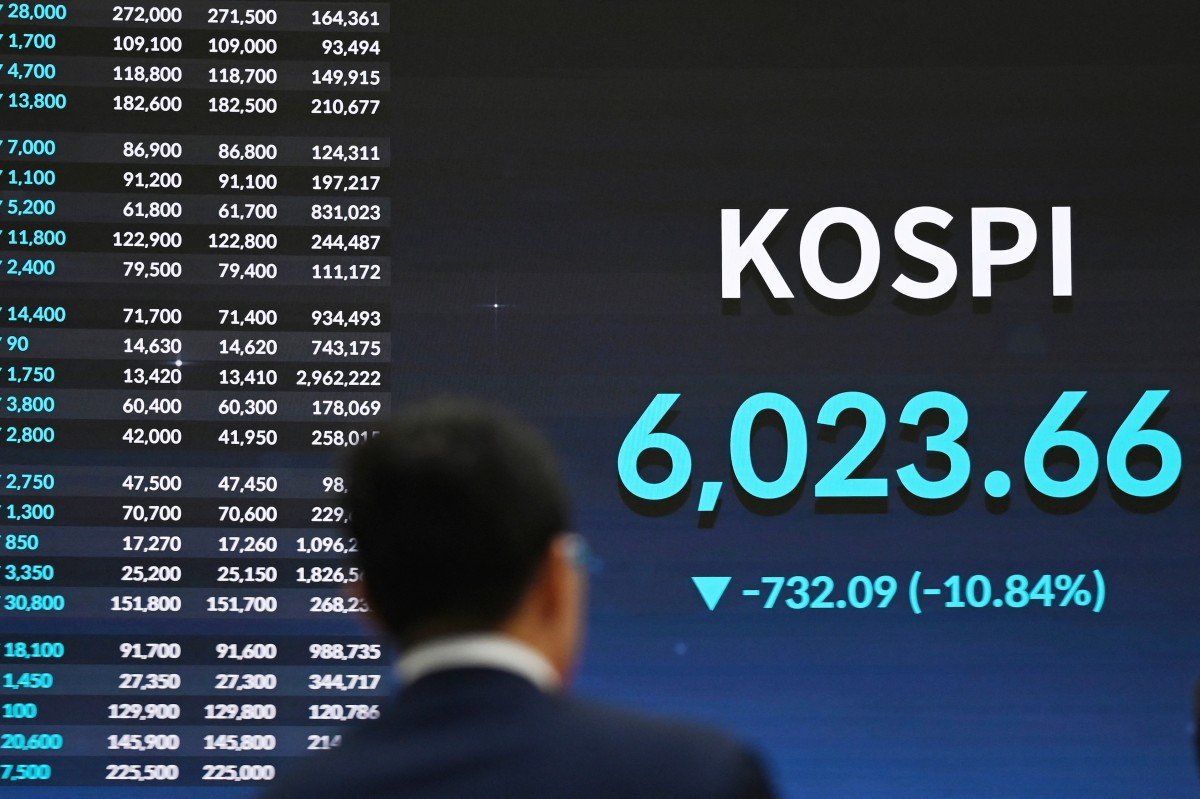
outh Korea’s brutal summer equity rout showed how margin debt can turn a sell-off into a market-wide tailspin. Korea’s artificial intelligence giants remain exposed, but the next Asian crash may follow different fault lines.
The sharp correction in South Korean equities, which saw the KOSPI collapse 39 percent from June 22 to July 30, has been widely attributed to the rapid buildup and subsequent unwinding of margin loans held by retail investors.
Driven by AI euphoria, millions of South Korean retail investors used broker loans to buy the equities of tech giants as well as highly volatile single-stock leveraged exchange-traded funds. This helps explain how the KOSPI spiked 116 percent in the year through June 22.
When tech shares tumbled in June on worries about the sustainability of AI capital spending, falling collateral values triggered widespread margin calls or demands for additional cash or securities to cover losses. Lacking the cash to meet these demands, traders faced automatic, forced liquidations. Brokers dumped shares from over a million leveraged accounts, creating a self-reinforcing cascade that erased billions in market value even when fundamentals had not materially changed.
Margin loans have also risen sharply in other Asian markets, raising major red flags.
India’s Margin Trading Facility (MTF) book has surged from just over US$1 billion at the end of 2020 to $16.3 billion as of Aug. 31, according to data from the National Stock Exchange (NSE) and the Bombay Stock Exchange (BSE).

Every Thursday
Meanwhile, China’s outstanding margin balance, according to Shanghai Stock Exchange data, has tripled from $68 billion at the beginning of 2019 to $200 billion as of Aug. 31. And Japan’s margin loan balance has almost doubled from $18 billion at the beginning of 2020 to over $35 billion as of Aug. 31, according to Japan Exchange Group.
The question now is whether this means another major leverage-driven correction could be coming.
Today’s margin loan balance throughout Asia may appear modest as a proportion of total equity market capitalization. India’s and Japan’s represent just 0.3 percent and 0.45 percent of their respective market caps.
However, when South Korea’s margin balance was at its recent peak of 38.7 trillion won ($28.75 billion) in late June, that represented barely 0.6 percent of the market’s cap and it still caused massive damage when it unwound.
That makes the picture in China all the more concerning. China’s Shanghai Stock Exchange margin balance of 1.34 trillion yuan ($200 billion) as of Aug. 31 equates to 2 percent of its market cap, significantly higher than its peers.
China’s margin balance is also notable in that it is 8 percent higher than its previous peak in May 2015. That spike preceded a 48 percent crash in the Shanghai Composite Index over the next eight months.
The comparison is not exact, of course, given changes in market rules and regulatory oversight since then, but the scale of leverage remains a red flag.
Another major risk to examine is concentration.
South Korea provided a stark lesson on the destructive power of concentrated margin loans. When the KOSPI margin balance reached its peak in the third week of June, Samsung Electronics and SK Hynix together accounted for 9.09 trillion won ($5.9 billion), representing nearly 31 percent of total KOSPI leverage.
This crowding helps explain why Samsung Electronics and SK Hynix plummeted by such large amounts, respectively 43 percent and 55 percent, when margin loans unwound.
Margin loans in both China and India are also concentrated, though in very different areas.
Chinese traders, like their Korean counterparts, have channeled leveraged capital primarily into large-cap electronics, semiconductor and telecoms stocks. Given the enormous size of many of these firms, a rapid unraveling of margin loans could have a huge market impact.
Japan’s margin loan profile seems to mirror Korea’s mania for large-cap technology titans. Data from the Japan Exchange Group indicates that margin buying is primarily concentrated in semiconductor and electronic component names such as Kioxia Holdings, Murata Manufacturing, Tokyo Electron and Ibiden.
Indian retail traders, on the other hand, have allocated a significantly greater share of their margin capital to small- and mid-cap stocks. According to data from NSE and BSE, 55 percent of Indian margin loans are in micro-, small- and mid-cap stocks. In a sharp sell-off, investors may be forced to sell larger, more liquid stocks to meet margin calls, amplifying the impact of the correction.
It’s important to note that regulators have noticed the growing risk posed by margin loans and are acting. South Korea’s Financial Services Commission this month unveiled several measures to curb highly volatile single-stock ETFs. The Reserve Bank of India in July banned the use of loans against shares (LAS) for buying securities or applying for IPOs.
Earlier in January, the China Securities Regulatory Commission raised the minimum margin requirement to 100 percent for new margin accounts.
These changes haven’t eliminated the risk but simply stopped it from metastasizing.
Moreover, the attractiveness of margin loans depends critically on borrowing costs. It’s no surprise that Korean equities tumbled after the Bank of Korea warned about rate hikes in June. And interest rates in much of the region, with the glaring exception of China, appear to be heading up.
For investors, navigating Asian equities in this high-leverage era will require close vigilance: The next margin-driven fault line may not replicate South Korea’s footprint but could instead target the unique pockets of leverage quietly compounding across the region.
—
The writer is founder and CEO of Emmer Capital Partners Limited. The views expressed are personal.