
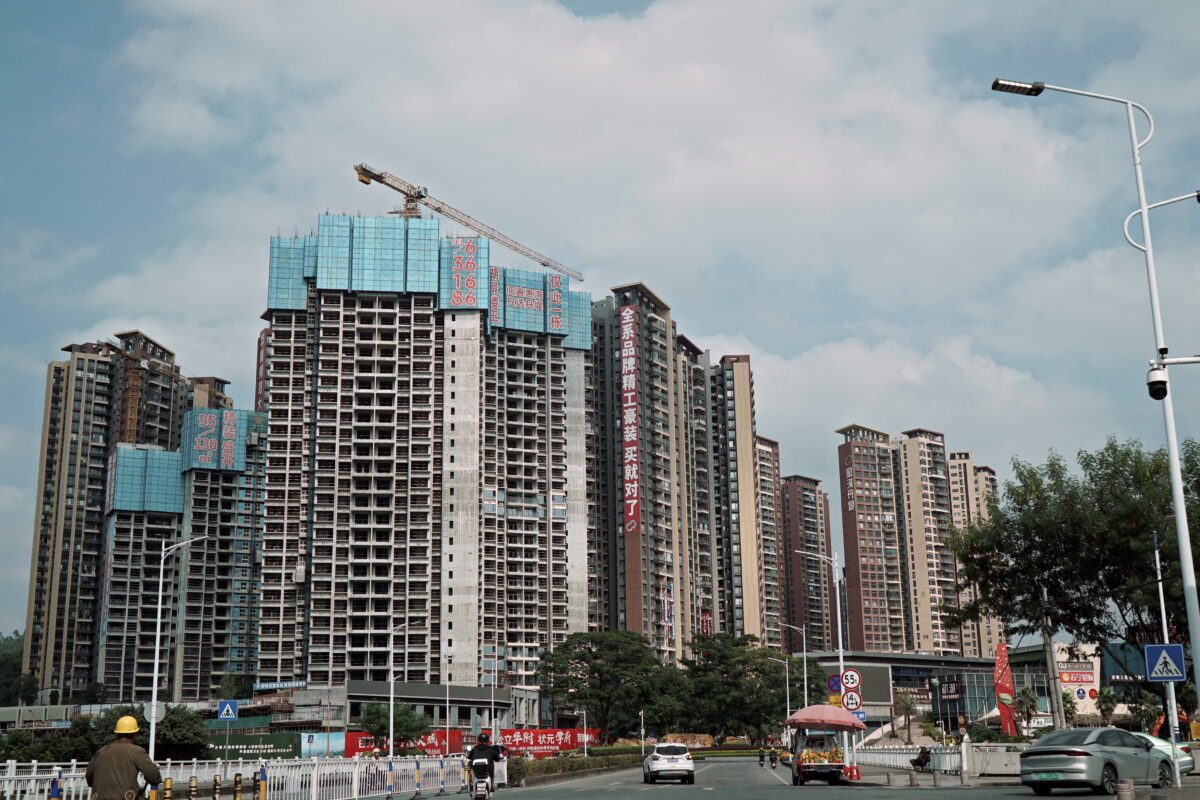
For much of China’s high growth era, land finance provided local governments with resources and discretion that the formal fiscal system did not. After the 1994 tax-sharing reform left local governments responsible for most public services and development, localities increasingly relied on selling land-use rights and borrowing off budget, often using land assets as collateral. The model helped finance infrastructure and accelerate urbanisation, but it tied local budgets to the housing cycle.
Land finance was central to China’s investment-led growth model, in which local officials competed to generate growth. Yet that model was inherently procyclical. At the housing market peak in 2021, broadly defined land revenue — including land sale proceeds and other taxes — accounted for nearly half of local governments’ consolidated revenue, or 10 per cent of GDP. By 2025, it had fallen to around 25 per cent of local revenue, or less than 5 per cent of GDP. That figure likely overstates genuine demand because local government financing vehicles bought many land plots, artificially inflating land-sale revenue.
The revenue collapse exposed how much debt local governments had accumulated during the boom. From 2019 to 2023, debt service on official debt, including principal and interest payments, rose from 8 per cent of local revenue before central transfers to 18 per cent. The debt-servicing burden also grew for off-budget debt, much of which was raised against land collateral during the housing boom and became harder to roll over as land values fell. Some heavily indebted provinces, such as Guizhou, even openly pleaded for Beijing’s help.
The consequences extend well beyond local finances. Localities have delayed payments to contractors and withheld wages or benefits from employees. A February 2025 estimate put local government arrears at 10 trillion RMB (US$1.37 trillion) by the end of 2024, about 7 per cent of GDP. These arrears act like a hidden tax on companies, squeezing profits and depressing investment and employment.
Beijing sought to ease localities’ immediate liquidity constraints through greater transfer payments, refinancing and debt swaps. Central transfers to provinces have exceeded the central government’s own revenue since 2023, requiring Beijing to rely partly on debt issuance to fund them.
Beijing has also allowed localities to issue more long-term, low-interest government bonds to refinance debt and replace off-budget liabilities. These measures have eased immediate cash-flow pressures — from 2019 to 2025, the average maturity of outstanding local government debt rose from 5.1 to 10.5 years, while the average interest rate declined from 3.6 per cent to 2.8 per cent. Debt service as a share of local revenue started to drop after 2023.
But Beijing’s strategy offers more relief than repair. Debt swaps and transfers buy time, but they do not reduce the overall stock of local government liabilities, which must eventually be reckoned with. Nor can they create a durable post-land-finance fiscal model to replace the one that has failed. They may even reinforce local dependence on Beijing and encourage moral hazard. To the extent that banks are forced to bear the cost of that relief through lower returns, it also puts further pressure on the financial system.
Despite Beijing’s relief measures, fiscal support to the broader economy weakened at precisely the wrong time. Since 2023, more than half of local government bond issuance has gone towards refinancing debt or replacing off-budget liabilities rather than financing new spending. Local government spending has continued to decline as a share of GDP since peaking in 2020, and higher central spending has not entirely offset that retrenchment. The contribution of government spending to aggregate demand has therefore weakened — the opposite of what an economy struggling with persistent deflationary pressures needs.
China needs a more forceful countercyclical fiscal expansion to support domestic demand and break the deflationary cycle. While such an expansion would require Beijing to tolerate a larger fiscal deficit and higher debt in the short run, it has room to do so. The central government still has a relatively strong balance sheet, with its net financial worth among the strongest of any major economy. Once inflation has durably returned to target, Beijing should raise taxes and cut spending to stabilise the debt ratio.
Over the long run, a sustainable post-land-finance fiscal model requires two major changes. The central government should assume more responsibility for nationally important spending, including social protection, which local governments administer almost entirely, while reducing unfunded local mandates. Local governments also need a broader tax base and greater tax authority, combined with further constraints on off-budget borrowing.
The reform blueprint unveiled at the 2024 Third Plenum points in this direction, proposing greater local control over excise tax collection and a local tax surcharge whose rate localities could set within limits. But these incremental measures alone are unlikely to be enough. The plenum omitted a nationwide property tax, likely due to concerns that it could further depress the housing market. Once the market stabilises, a carefully designed property tax should be considered as a more stable local revenue source.
Land finance helped build China’s economic miracle, but left local government finances hostage to the housing cycle. Now that the housing bubble has burst, China needs to recalibrate its fiscal system to fund public services, respond to shocks and support the country’s broader growth model transition without relying on land. That requires Beijing to permanently rebalance spending responsibilities and revenue authority between levels of government. Without that repair, the costs of the old model will continue to fall onto firms, workers and the broader economy.
Tianlei Huang is Senior Fellow at the Peterson Institute for International Economics.
His forthcoming book is Detox: China’s Fiscal Reckoning in the Shadow of the Housing Bust (PIIE).