
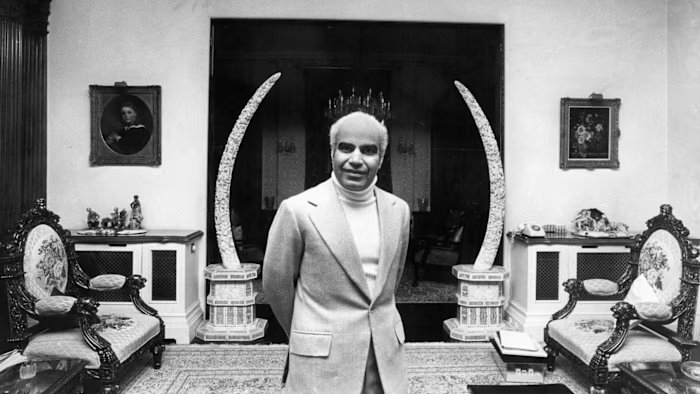
The billionaire owner of bottled water company Highland Spring has been hit by defaults and enforcement actions from creditors across his family’s heavily indebted property empire.
The family of Mahdi Al Tajir, the United Arab Emirates’ first ambassador to the UK who was ranked for years as the richest man in Scotland, is now looking to sell chunks of a real estate portfolio that spans luxury developments in London to sprawling estates in the Perthshire countryside.
Bahrain-born Tajir amassed a fortune in Dubai as one of the most trusted advisers to Sheikh Rashid bin Saeed al-Maktoum, the emirate’s former ruler who in the 1960s and 1970s developed it into a diversified entrepôt by channelling oil revenues into commercial infrastructure.
Described as Dubai’s “Cardinal Richelieu” by another senior adviser, his influence waned in the early 1980s when Sheikh Rashid’s sons, including current ruler Sheikh Mohammed bin Rashid al-Maktoum, consolidated their authority.

Tajir bought a raft of British trophy properties and country estates in the 1970s, including a Kent stately home featured in early James Bond spoof Casino Royale, at a time when Middle Eastern investors entered the British property market in earnest. He also amassed a collection of historic English silverware, including a record purchase in 1993 of a chandelier designed for King George II.
In 1979 he established Highland Spring in the Scottish village of Blackford after buying nearby Keir House, the ancestral home of SAS founder David Stirling. It became the UK’s largest brand of bottled water, sourced from the surrounding Ochil Hills.
Property companies owned by Tajir’s family have borrowed heavily in recent years, both from Gulf banks and US institutional investors such as Apollo Global Management.
The 94-year-old last month put a more than 620-acre golf resort near Gleneagles up for sale. While the gWest course was completed in 2009, it never opened to the public and an adjoining hotel and residential development were not completed.
National Bank of Kuwait, which provided a £12.75mn loan against the Perthshire golf course, according to its 2024 annual accounts, filed a breach of contract claim in London’s High Court in August against three members of the Tajir family.


Full details of the lawsuit are not yet available. Accounts for the company behind gWest, filed in December 2025, noted that NBK’s loan had matured the previous month without being repaid and said the business was in “extension discussions with the lender”.
NBK did not respond to a request for comment.
The Tajirs embarked on a major reorganisation and restructuring a couple of years ago, according to people aware of the process. One of them insisted it was “business as usual” for the family, adding that their lenders were unfazed by the debts.
Contact us
If you have any information related to this story, please contact Robert Smith on Signal at robert_smith_ft.55 or by email at [email protected]. For any other news tips, contact [email protected]
However, in June, one of the family’s lenders repossessed a mews house they owned in London’s affluent Belgravia, according to an official notice seen by the FT. Swiss bank UBS held a mortgage charge on the property, according to the Land Registry.
UBS declined to comment. The family was dealing with this and other issues, the person with knowledge of their restructuring efforts said.

The Emirati tycoon has also been trying for more than a year to sell a six-storey townhouse in London’s wealthy St James neighbourhood, according to people familiar with the matter, having mortgaged the property with a high-interest bridging loan in 2023.
Estate agency Aldersley London is handling the sale of the property, according to people familiar with the matter, and is asking for £125mn. One of the people said potential buyers in the Gulf had expressed interest. Aldersley declined to comment.
High-profile London developments owned by the family have also faced serious debt issues.
The vehicles that own the Park Tower Hotel in Knightsbridge and Arlington House in St James, both of which Tajir purchased in the 1970s and are slated for major refurbishments, have defaulted on separate loans raised against them last year, according to their latest accounts.
CBRE Loan Services, which manages loans on behalf of other property lenders, also filed a claim this month in London’s High Court against Amer and Khalid Al Tajir — two of the former ambassador’s sons.

While details of the lawsuit are not yet available, CBRE holds a mortgage charge on behalf of another lender over a high-profile property development owned by Tajir’s sons on The Bishops Avenue, a street in north London commonly known as “Billionaires’ Row” for its wealthy residents.
Tajir’s family bought a plot of land on the street in Hampstead for £18mn in 2018 and has been building 36 luxury apartments with property developer Valouran. The company behind the project had more than £100mn of debt at the end of last year, according to its accounts.
The development is “back on track”, according to one of the people aware of the restructuring process.
Valouran and CBRE declined to comment.
One person close to the family said Tajir had been “a genius businessman, a visionary” and that his “amazing” array of assets had been mismanaged. “This is a classic case of the next generation not knowing how to carry on developing the business.”
The family, approached through third parties, declined to comment. Dubai-based Tyburn Capital, the Tajirs’ family office, did not respond to a request for comment.
The company through which Tajir’s family owns the Park Tower hotel borrowed £347.5mn from US private capital firm Apollo Global Management, New York hedge fund King Street Capital and London property-lending firm Cohort Capital in October last year.

That company breached a number of its debt covenants and went into default this year, according to its latest annual accounts. Financial statements published last month note that lenders “remain supportive and continue to engage constructively” but warned that they hold the “right to demand repayment”.
Apollo holds the safer senior tranche of debt that is not in default, according to a person familiar with the matter. King Street and Cohort hold the riskier mezzanine tranche of the loan.
Apollo and King Street declined to comment.
King Street and Cohort also agreed to provide an up to £171mn mezzanine loan against Arlington House last year, alongside a £147mn senior loan from Dubai lender Emirates NBD.
Both tranches of debt breached covenants and went into default last year, according to the company that owns the property’s accounts. Emirates NBD declined to comment.
A website outlining redevelopment plans for Arlington House, which is adjacent to Green Park and near the Ritz Hotel, describes it as “no longer fit for purpose” and requiring “sensitive improvement to meet modern expectations”.
The debt against Arlington House and Park Tower carries “personal guarantees” from the directors of the companies that own them — Amer and Khalid Al Tajir — allowing lenders to pursue their wider assets to recover any potential losses.

Cohort Capital, a Mayfair-based bridging loan specialist, has also lent against a wider range of the family’s properties in recent years. The firm did not return requests for comment.
These loans include mortgages against Keir House, Mereworth Castle in Kent, a pub in West Sussex and 18 Carlton House Terrace — the St James townhouse the family is now looking to sell.
Bridging loans usually carry double-digit annual interest rates and are typically intended as a stopgap solution until a sale takes place or longer-term financing is secured.
Cohort’s co-founder Bal Sohal said in 2023 that its loan against the Carlton House Terrace property had proved the company’s “mettle in completing complex lending deals for the country’s most iconic residential properties”.
The company that owns the West Sussex pub, which Cohort lent against in January, was subject to a winding-up petition from HM Revenue & Customs last month. These court actions allow creditors to try to push a company into insolvency over outstanding bills and are used by the British tax authority as an enforcement mechanism to collect unpaid tax.
HMRC declined to comment, citing “taxpayer confidentiality law”.