
News Analysis
Chinese regulators unveiled a sweeping package of real estate reforms late last month, signaling a gradual shift away from the decades-old pre-sale model that fueled the country’s housing bubble. However, the reform offers no relief to millions of homebuyers still stuck servicing mortgages on unfinished apartments.
Jointly issued on Aug. 28 by China’s Ministry of Housing, Ministry of Natural Resources, the central bank, and top financial regulators, the measures encourage developers to sell only completed homes, extend mortgage maturities, and ease financing conditions for builders.
On paper, the policy aims to replace China’s high-risk “pay first, build later” development model with the more conventional “build first, pay later” approach. However, according to analysts who spoke with The Epoch Times, the change comes years too late to help the millions of ordinary families who have already been financially devastated by stalled construction. Furthermore, it offers no solution for the massive amount of bad debt left in the crisis’s wake.
A Dangerous Model Runs Out of Steam
Under China’s pre-sale model, which took root in the 1990s, homebuyers pay substantial down payments and begin servicing full mortgages while their apartments are still blueprints. Real estate developers historically used this upfront customer cash as cheap, interest-free capital to acquire more land and fund rapid expansion.
Related Stories


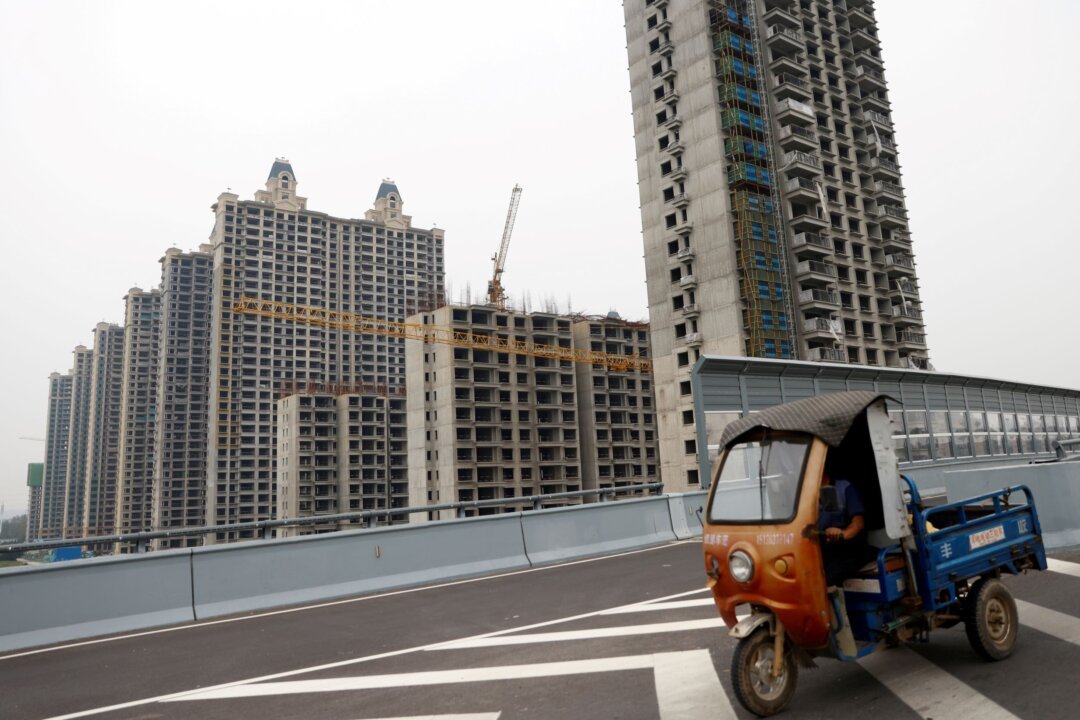
In 2020, Beijing introduced strict limits on property developers’ borrowing, known as the “Three Red Lines.” Many developers, especially those who relied on excessive leverage, suddenly lost access to the financing they needed to keep projects moving. Major firms such as Evergrande defaulted, halting construction nationwide. The crisis hit homebuyers especially hard. Many had already paid deposits and taken out mortgages for apartments that were still under construction. With developers running out of cash, buyers were left making monthly mortgage payments on homes they could not move into.
By the end of 2024, more than 1,660 Chinese real estate developers had filed for bankruptcy, and at least 10 major builders were delisted from stock exchanges, according to court and industry filings compiled by the research arm of the China Real Estate Association. Meanwhile, market data reported by Chinese financial portal Sina indicated that stalled housing projects exceeded 2.7 billion square feet (250 million square meters), affecting an estimated 8 million unfinished homes nationwide.
According to official state media, including Xinhua news, selling completed homes will protect consumers by ensuring that “what you see is what you get,” shifting delivery risk from buyers to developers and banks.
However, analysts noted the reform only concerns future projects and leaves past problems unaddressed.
“This policy arrives far too late, as widespread unfinished housing has already occurred,” Mike Li, a U.S.-based investment consultant and China expert, told The Epoch Times. “Massive numbers of families have already paid the price for the real estate crisis.”
Li noted that the government’s announcements contained no nationwide audit of stalled projects, nor any plan to compensate families who have already lost their life savings.
“Selling finished homes addresses future risks, but it does nothing to handle the accumulated damage from the past,” he said.
Local Governments Rely on Pre-Sales
While the policy aims to restore buyer confidence, it stops short of a nationwide ban on pre-sales. Instead, official documents stated that authorities should “give priority” to selling completed homes.
That careful wording provides local officials with substantial room to maneuver, according to Sun Kuo-hsiang, a professor of international affairs and business at Nanhua University in Taiwan.
For decades, pre-sales functioned as a financial amplifier for municipal governments, which relied heavily on selling state-owned land to developers to fund public services and repay local government debt.
“Requiring developers to fully construct buildings before collecting sales revenue means they must front far more capital and bear holding costs for several years,” Sun said. “Smaller private developers simply cannot afford that. If all land sales required completed homes, developers would stop bidding, causing land auctions to collapse and dealing a heavy blow to local revenues.”
Sun expects a divided market to emerge: Strong state-owned builders will adopt the completed-home model on prime plots in major cities, while local governments will quietly allow pre-sales on secondary plots once construction is near completion, helping keep land sales alive.
In his view, the shift will also accelerate a state takeover of the sector. Deep-pocketed state-owned enterprises, backed by state banks, have the balance sheets to finance long construction cycles, while cash-starved private builders face being bought out or driven out of business.
A Shield for Banks and Local Treasuries
The reform represents an abrupt policy reversal. Just a few years after implementing the “Three Red Lines” policy to restrict developer borrowing, the authorities are now doing the opposite. They are scrambling to loosen credit and extend debt timelines, a move Li views as a way to prevent the real estate sector from dragging down the broader economy.
While framed as consumer protection, the package functions primarily as a defensive firewall for local governments and state banks, Li said.
According to Li, the reform aims to encourage buyers to return to the market. At the same time, as the completed-home sales model is voluntary, Beijing is protecting municipal land auctions and, in turn, protecting the local government from insolvency. Additionally, loosening developer financing and extending loan terms allows state-owned banks to roll over troubled debts rather than book them as catastrophic loan losses.
In short, Li said, the plan channels state credit to keep public institutions afloat, while leaving millions of ordinary citizens to foot the bill for the housing crash alone.
Zhao Bin and Gu Xiaohua contributed to this report.