
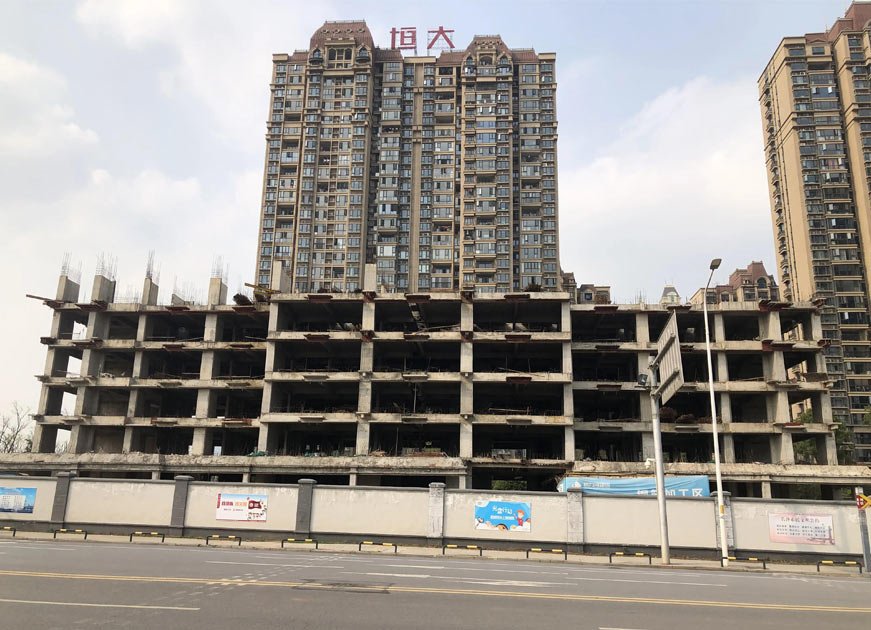
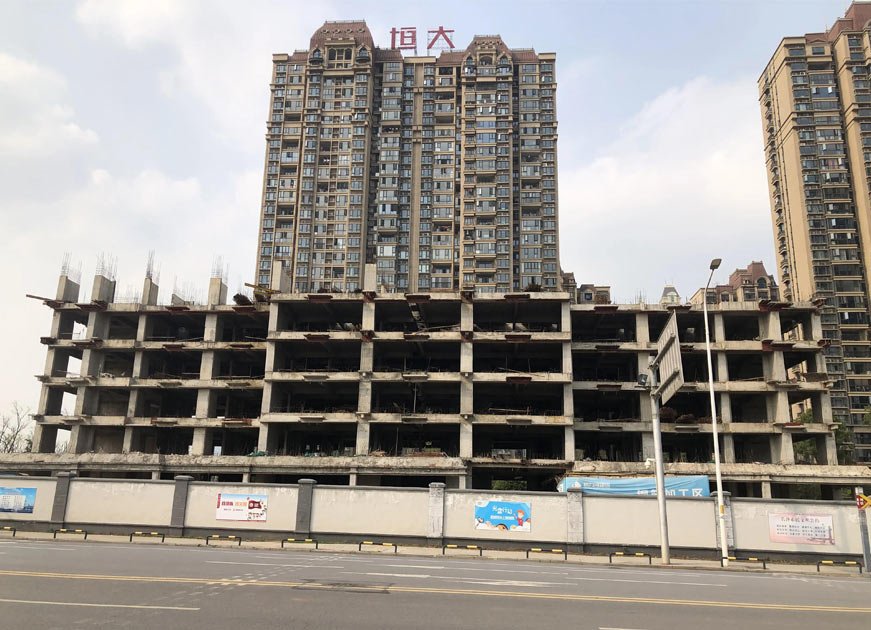
China’s real estate mogul Xu Jiayin (also known as Hui Ka Yan) received a life sentence on 20 August, sealing the fate of the Evergrande founder, who was once counted among the nation’s wealthiest businesspeople. With the conviction, Xu’s personal assets will be confiscated; additionally, the Evergrande Group and its subsidiaries will also have to pay penalties totalling 15.82 billion yuan (approximately US$ 2.4 billion). In its heyday, Evergrande Group‘s sprawling corporate empire spanned 1,300 housing projects across 280 cities, wealth-management services, a football team (Guangzhou FC), a vacation resort with 58 hotels, and several theme parks modelled on Disneyland. Much of Evergrande’s expansion was propped up by debt; as a result, the company was saddled with US$ 300 billion in liabilities, and it defaulted on payments to overseas bondholders in 2021. Following this development, investors staged protests outside Evergrande’s offices.
Xu’s guilty verdict put the spotlight on the property sector that underpinned China’s growth model. The property sector accounted for nearly 20 percent of Chinese economic activity, and also supported related services such as leasing, renovation, and maintenance.
First, in a rapidly urbanising China, housing demand was fuelled largely by a burgeoning middle class looking to invest its savings. Given the scarcity of other avenues offering good returns, buying a house was seen as a safe bet, owing to the steady rise in property values. Second, housing became the preferred savings vehicle for a large segment of the population, which in turn fuelled expectations of sustained appreciation in property and land prices. These factors made it easier for developers to access credit, buy land, commence development, sell under-construction apartments to buyers, and channel the proceeds into new housing projects, with sustained urbanisation creating a reinforcing cycle. Third, at the other end of this cycle, local governments replenished their coffers through the sale of land-use rights and tax revenues from real estate development, both of which proved to be steady sources of revenue.
Beijing often stimulated growth by expanding the property sector through increasing land supply and cutting interest rates. Evergrande expanded substantially during a period when debt-driven infrastructure development was key to China’s growth strategy.
Yet Xu’s wrongdoings were not merely about reckless borrowing and Evergrande’s unsustainable business model. The tycoon was found guilty of falsifying financial documents, overestimating financial assets, and misrepresenting the true extent of the group’s liabilities. He was also convicted of giving payoffs to obtain loans and of fraud, after diverting dividend payouts for personal gain.
China’s urbanisation in the 1990s and the consequent housing boom had propelled Xu’s rise, making him a poster boy for the economic liberalisation steered by the Communist Party of China (CPC). Forbes magazine declared him the richest person in China in 2017. A year later, on the occasion marking the 40th anniversary of China launching its reform programme, Beijing’s official pantheon of ‘pioneering entrepreneurs’ from the private sector featured Xu alongside Alibaba’s Jack Ma and Tencent’s Pony Ma.
Yet in recent years, concerns had grown within the CPC about real estate developers and other corporate groups acquiring equity stakes in banks. Vanke, one of China’s largest property developers, had acquired stakes in Huishang Bank; Evergrande, meanwhile, held equity in Huaxia Bank. A private investment firm with a large stake in Baoshang Bank had bled the financial institution dry after borrowing money through 200 proxy companies. Such bank collapses, and their spiralling effects on the broader economy, prompted Beijing to step up efforts to address financial risk.
At a December 2020 meeting, the Politburo called for an end to the ‘disorderly expansion’ of capital and measures to promote the ‘healthy development’ of the property sector. The government began to require developers to cap their asset-liability and debt-equity ratios and maintain enough cash on hand to meet short-term borrowing before they could access further credit — measures dubbed the ‘three red lines’. Another rule restricted banks’ lending to property developers and individuals’ access to mortgages.
Chinese President Xi Jinping’s zero-COVID policy, which mandated strict lockdowns and restrictions on movement, also stifled demand for housing, aggravating developers’ financial troubles. As government regulations restricted financing avenues and prospective buyers put off real-estate purchases, Evergrande’s financial troubles deepened. Overall, the funding crunch meant that developers started defaulting on overseas bond payments and abandoning projects, leading to one of the most serious downturns in the property market in nearly two decades.
In recent years, Beijing’s housing policies have sought to stabilise the market and steer the sector towards a more sustainable model.
Since buyers begin paying their mortgages even before the homes they have purchased are constructed, a wave of civil disobedience grew, with people across nearly 100 cities reneging on mortgage payments. With an eye on quelling social discontent and maintaining financial stability, the Party-state sought, in November 2022, to stabilise the market by relaxing lending to developers, in a move aimed at partly reversing previous curbs.
In recent years, Beijing’s housing policies have sought to stabilise the market and steer the sector towards a more sustainable model. The International Monetary Fund (IMF) notes that loans have been disbursed to complete pre-sold projects, affordable housing has been expanded, and the state has, in some instances, shored up developer finances by buying completed housing stock and idle land.
While the disgraced real estate mogul’s sentencing puts a dramatic end to his story, the issues facing the property sector are expected to linger. According to the IMF, private developers are still grappling with a financial crunch, as restructuring initiatives related to housing projects become stalled: declining asset values undermine restructuring agreements sealed earlier, necessitating fresh negotiations between developers and creditors. The IMF estimates that the resources needed to complete pre-sold projects of distressed developers could total around 5 percent of GDP over three years.
A regulatory regime perceived as fickle and unpredictable could dampen animal spirits without restoring private-sector confidence.
To conclude, the court verdict also reinforces a clear divergence in China’s political economy across leadership generations. Earlier, elites seemed to tacitly tolerate entrepreneurial buccaneering, so long as it contributed to economic growth. Under Xi, financial stability and security are key priorities, which place greater constraints on private capital. Through Xu’s conviction, Xi has also reinforced the message that previous contributions to China’s economic development offer no immunity to the powerful. The concern, however, is that a regulatory regime perceived as fickle and unpredictable could dampen animal spirits without restoring private-sector confidence.
Kalpit A. Mankikar is a Fellow with the Strategic Studies Programme at the Observer Research Foundation.
The views expressed above belong to the author(s). ORF research and analyses now available on Telegram! Click here to access our curated content — blogs, longforms and interviews.