
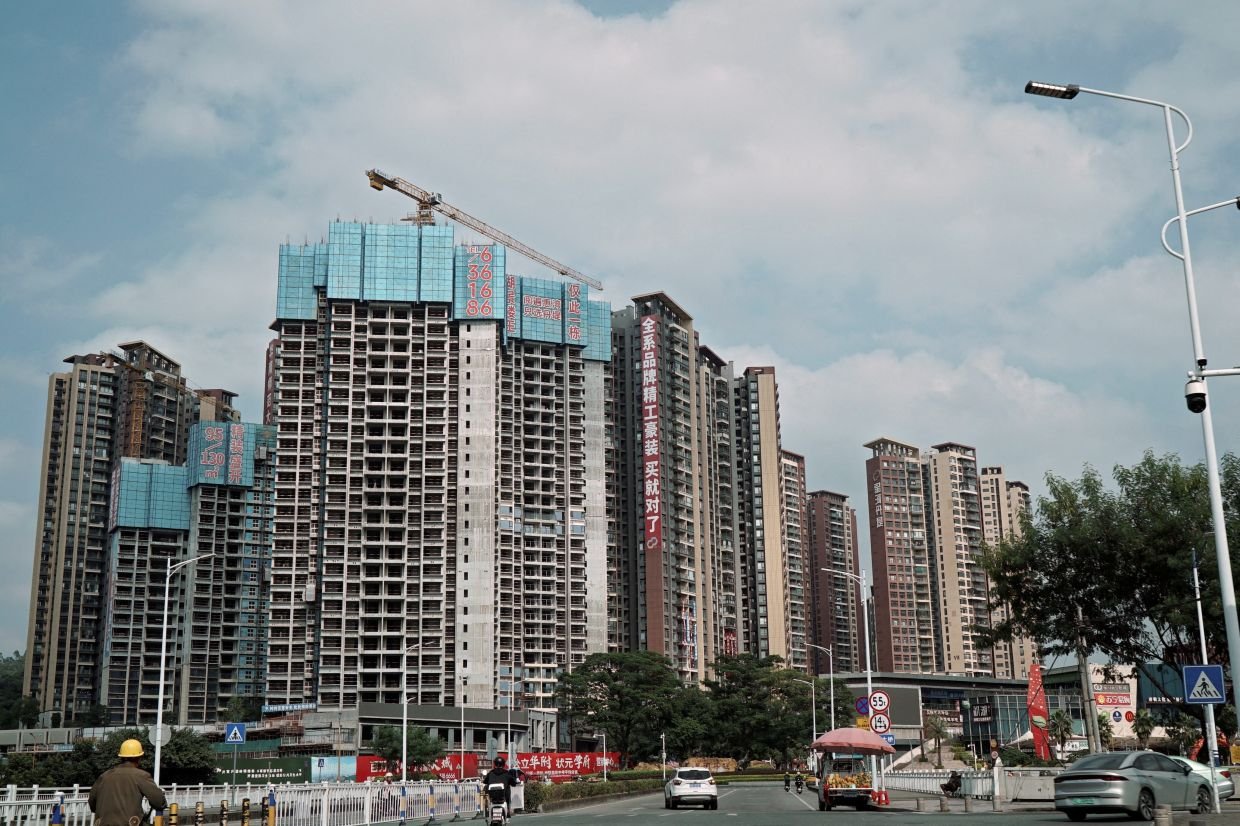
BEIJING: China unveiled a much anticipated plan on March 16 to invigorate consumption by boosting jobs and strengthening the social safety net, at a time when joblessness is creeping up and a property recovery is fizzling out.
Analysts are reserving judgment about the plan until more details are out.
Boosting consumption is a top economic priority for China in 2025 as the world’s second-largest economy struggles to shake off deflationary pressures while bracing itself for a trade war with the United States.
China’s consumption took a hit during the Covid-19 pandemic in 2020 to 2023 and has yet to fully recover.
Economists estimate that consumption needs to increase by 3 trillion yuan (US$414.73 billion) in 2025 for China to hit its economic growth target of around five per cent.
It will need to increase by even more than that in the very likely scenario that exports – which accounted for 30.3 per cent of economic growth in 2024 – slow down in 2025 compared with the year before due to the tariffs that US President Donald Trump’s administration has imposed, and vowed to increase, on China.
An annual government work report unveiled earlier in March mentioned the word “consumption” a record 31 times but was light on details.
Chinese stocks surged the day after the government announced on March 13 that a press conference would be held to talk about consumption, signalling the market’s desire for a concrete action plan.
Officials at the press conference on March 17 talked about 30 measures to boost consumption that were announced a day earlier. Analysts whom The Straits Times spoke to were measured in their evaluation of the effectiveness of these measures.
A main thrust of the measures is boosting people’s incomes and wealth.
The government plans to extend subsidies for companies that do not lay off their staff, help the jobless upgrade their skills and start their own businesses, and help farmers monetise their agricultural resources. It also wants to stabilise the stock and property markets.
To encourage the buying of big-ticket items like property, China is making it easier and cheaper for people to draw from their Housing Provident Fund accounts.
However, analysts’ enthusiasm for the government’s consumption boosting plan was dampened by fresh data released on March 17 that showed the urban unemployment rate in February had risen unexpectedly to 5.4 per cent, 0.2 percentage point higher than in January, and the highest level in two years.
“For now, I think these measures are helpful, but eventually consumption depends on income, which requires a healthy labour market,” Zhang Zhiwei, president of hedge fund company Pinpoint Asset Management, told ST.
He wants to see the government take stronger action to boost the labour market and adopt a more proactive fiscal policy.
Data released on March 17 also showed that the recovery of the property market has lost momentum, with new home sales down an average of 5.1 per cent in floor space and 2.6 per cent in value year on year in the two months of January and February. Figures for January and February are combined to even out the impact of the Chinese New Year holidays.
Chinese people whose wealth is largely tied up in properties will understandably not be easily persuaded to spend as the value of their home drops.
Another focus of the government’s measures is improving the social safety net so that people feel a greater sense of security and are encouraged to spend.
Measures include giving retirees higher pensions, giving migrant workers maternity insurance, and providing more student loans. China also wants to enforce the law to ensure that workers are paid on time and allowed to go on leave, so that they can have the money and time to consume.
Other measures centre around the supply of more services, such as having longer opening hours for tourist attractions and allowing concert organisers to sell more tickets. The government also hopes to rev up car sales by growing the second-hand car market.
China is devising a childcare subsidy scheme to help families defray household costs, but officials at the press conference did not say how much money the state has earmarked for this purpose.
Economists at Maybank note that government ministries and bodies are due to release more details over the coming weeks.
For example, China’s central bank has said it will publish detailed plans to facilitate greater financing support for consumer industries, while the state planner, the National Development and Reform Commission, said local governments will roll out policies tailored to suit local circumstances.
China’s plan to boost consumption includes extending a trade-in subsidy scheme to include more electronic products. Analysts say this is effective as a short-term measure, which has helped boost retail sales of durable goods such as mobile phones and home appliances, but cannot be relied on for sustained consumption growth in the long run.
While it is encouraging that the government has a plan to boost consumption, some worry that the plan could be thrown out of the window as competition with the US heats up.
“If Beijing thinks that to win the competition it needs to revert to a ‘fortress economy’ mentality, which is the doubling down on investment in industries and infrastructure, then the goal of distributing wealth to its people through social welfare and consumption subsidies will be put on the back burner,” said Qiu Mingda, a senior analyst with US-based consultancy firm Eurasia Group. – The Straits Times/ANN