
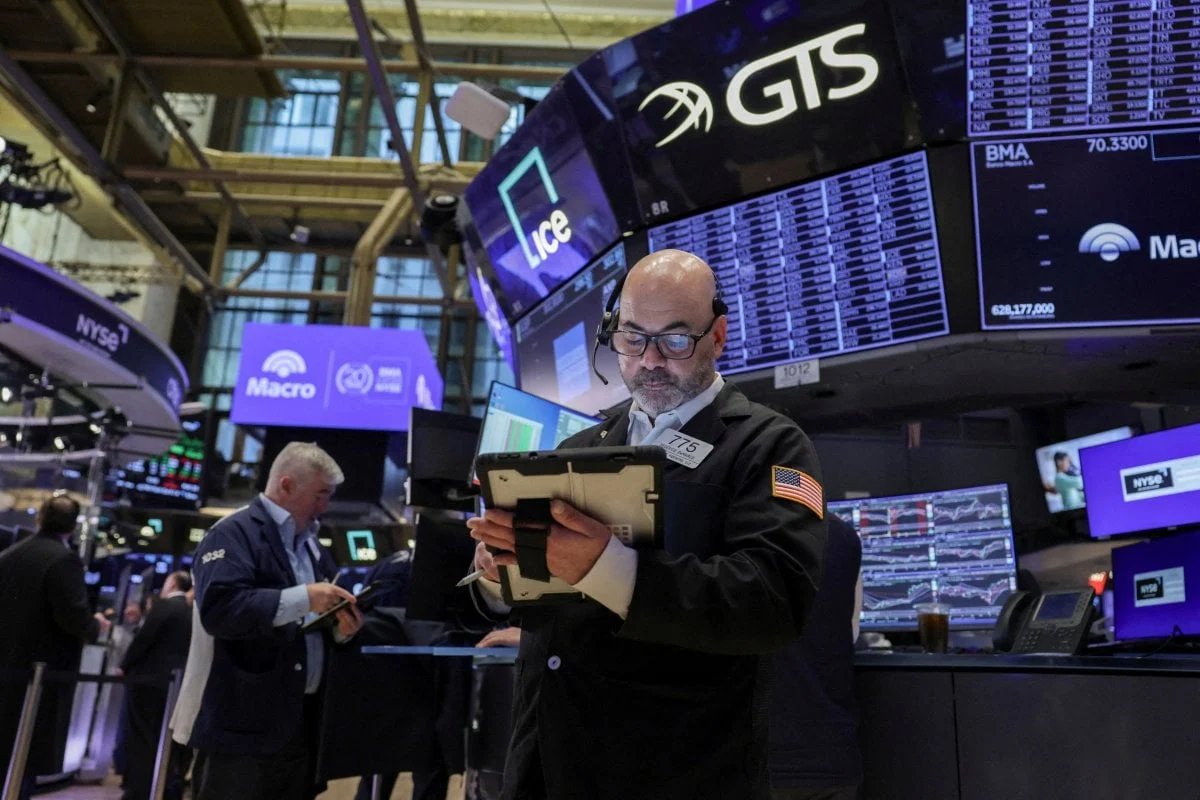
Investing.com — Wall Street on Monday kicked off the first full trading week of July with a positive performance, as chip stocks bounced back after a two-week losing streak. Investors returned from a long weekend on account of the U.S. Independence Day holiday.
Stocks are coming off solid gains from last week’s shortened trading, in which they also notched their best quarter in six years. Market participants are looking ahead to fresh catalysts in the days ahead in the form of the Federal Reserve’s latest minutes and the start of the earnings season.
At 15:02 ET (19:02 GMT), the benchmark S&P 500 index was up 0.9% to 7,547.72 points, while the tech-heavy surged 1.2% to 26,144.62 points. The blue-chip added 0.2% to 52,997.13 points and was on the track for a record close.
Get Wall Street insights with InvestingPro – now 60% off
Chips rebound after recent slide
With diplomatic progress in the Middle East and sliding oil prices effectively removing the geopolitical risk premium, markets have refocused their attention on the high-flying artificial intelligence trade. Chip stocks, which have been the main driver of the AI boom, have been under pressure over the last two weeks amid a bout of profit-taking and concerns that the AI trade had flown too high and too fast.
The Philadelphia Semiconductor Index — a key barometer of chip stocks — slumped about 12% over a two-week losing streak, amid swirling questions around lofty valuations in AI-exposed names. Capital expenditures on the infrastructure needed to power the nascent technology have soared, raising doubts over when, if ever, the spending will translate into returns.
But the staged a comeback on Monday, last up 2.7%. Also higher were memory stocks, another sub-sector of the AI trade that saw weakness over the last two weeks. Soaring demand for more memory processing power to facilitate AI developments have boosted the market capitalization of companies such as storage product makers and and memory chipmakers and its South Korean rivals and .
Rotation out of the technology sector last week also intensified, as investors took some money off the table.
“There has been a strong bid to the tape led by the semiconductor, memory, and storage names. Goldman Sachs raised price targets on several companies. Additionally reports out of Asia indicate Samsung is planning a 20% DRAM price increase this quarter. The company is expected to release preliminary Q2 earnings tonight,” Michael O’Rourke, chief market strategist at Jones Trading, told Investing.com.
“It appears investors are aggressively rotating back into the AI trade and the broadening out rally that was strong last week is reverting today,” he added.
Trump rings opening bell at the Oval Office in a first
Away from tech and AI, President Donald Trump on Monday was joined by representatives from the New York Stock Exchange and Nasdaq to jointly ring the opening bell at the Oval Office in a first-of-its-kind event. The occasion marked the launching of Trump Accounts, a government initiative to provide an investment vehicle for U.S. children.
“On Saturday…our administration deposited one-time seed contributions, $1,000 each, into the Trump Accounts of over 500,000 American children,” the president told reporters.
“If we have a good market like we do now, they could become actually very rich. They’ll have hundreds of thousands of dollars,” Trump added.
The U.S. leader has frequently cited Wall Street’s record-breaking performance this year as an achievement of his administration and has noted milestones such as the S&P 500 topping 7,000 points and the Dow surpassing 50,000 points.
Wall Street’s major indexes climbed in the last, holiday-shortened week, with the S&P adding 1.8% and the Nasdaq Composite surging 2.1%. The Dow advanced 2% to notch a record close.
Monetary policy outlook remains in the spotlight
Aside from a rotation out of the technology sector into other heavyweight areas such as consumer staples and healthcare, U.S. markets were boosted last week by labor market data that slightly dented Fed interest rate hike expectations.
A softer-than-expected reading on nonfarm payroll growth for June, compared with revisions to figures for April and May and a downtick in the unemployment rate, was received favorably by traders as it meant that the labor market was resilient but not too strong, giving the Fed some breathing room to potentially keep interest rates on hold and not tighten policy.
The Fed under new chair Kevin Warsh last month signaled that it would give up forward guidance and focus solely on combating inflation, as the labor market remained steady. Warsh reiterated his stance of not giving forward guidance in public comments in Portugal last week. The minutes of the Fed’s June meeting will now be looked at on Wednesday for further insight into the thinking of policymakers, half of whom indicated that rate hikes could be warranted this year.
Separately, Monday’s economic calendar showed that U.S. services sector activity improved in June. As per S&P Global, its headline purchasing managers’ index (PMI) for business activity in the sector hit its highest level since the outbreak of the Middle East conflict. The Institute for Supply Management (ISM) said prices paid by respondents in the services sector slipped to its lowest level since February.
“Service-providing businesses account for most private employment. Recent months’ steadier PMI reports reinforce our confidence that the economy will continue to add jobs in the second half of the year,” Bill Adams, chief U.S. economist at Fifth Third Commercial Bank, said.
“Recent macro data will make the Fed feel less worried about the job market, giving them more latitude to focus on inflation. And inflation was still a problem in June, when the ISM Services Prices sub-index was near the highest since late 2022 despite a monthly drop,” he said.
“However, the outlook for inflation looks better in the second half of 2026. Price shocks from the war and tariffs look set to fade. Housing costs are no longer exacerbating inflation like they did three or four years ago,” Adams added.
Dell pops on Trump comment, reverses course
Turning to Monday’s active movers, gained nearly 4% after Trump at the Oval Office event told Americans to “go out and buy a Dell computer.”
Elsewhere, Strategy was marginally higher. The top corporate holder disclosed an $8.32 billion loss on digital assets for the three months ended June, and sold the world’s largest cryptocurrency to fund preferred stock dividends.
Later this week, the earnings season will kick off with , and among the first major companies to report.
Ayushman Ojha and Scott Kanowsky contributed to this article