
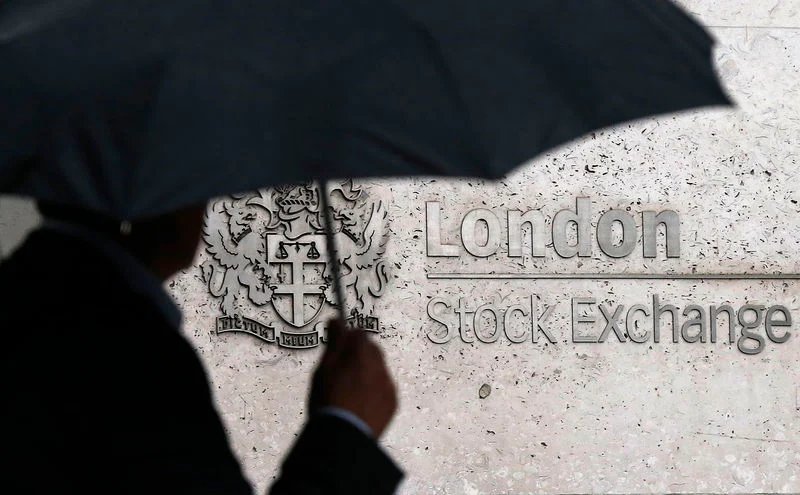
Investing.com — British stocks edged higher on Monday as a sharper-than-expected fall in U.S. retail sales reduced expectations for near-term Federal Reserve tightening, helping London blue chips claw back ground after losing 1.4% last week.
The FTSE 100 rose 0.26% as of 03:25 ET (07:25 GMT). Germany’s DAX slipped by 0.03% while France’s CAC 40 inched lower 0.05%. Sterling firmed 0.22% to $1.3562.
U.S. retail sales fell 0.6% month-on-month in July, sharply missing expectations of a 0.1% rise and marking the steepest monthly decline since May 2025, pushing Treasury yields and the dollar lower on Friday and improving sentiment heading into Monday’s session.
Speaking at Market Regulation Headquarters on Sunday evening, Iran’s vice president said Tehran would be successful in its “economic warfare” as Washington anticipated an announcement of fresh sanctions this week.
Ship-tracking firm Kpler recorded no commodity vessel crossings of the Strait of Hormuz on Sunday and just five on Saturday, against 31 the previous weekend.
The 60-day U.S.-Iran memorandum of understanding, signed in June to halt hostilities, expired Monday with no extension talks under way; Tehran has said Washington must first honour its original obligations.
The Mecca Joint Defence Agreement, signed Aug. 7 by Saudi Arabia, Turkiye and Pakistan, establishing collective-defence provisions, drew a welcoming statement from Washington; Turkish President Erdogan said the pact had “sent an important message to the world” and called Egyptian participation “possible.”
Analysts at Jefferies said Monday they saw no straightforward resolution to the standoff, describing the situation as “no war and no peace” with the Strait of Hormuz closed.
“The only possibility remains a fudge or look the other way arrangement by which some traffic can start to flow through the Strait while the US and Iran try to negotiate a deal,” strategist Mohit Kumar wrote in a morning note.
Jefferies warned the uneasy truce may hold only through the U.S. mid-term elections, after which the risk of escalation rises, and said from a market perspective the critical variable was how high oil prices climb before Washington is prepared to offer concessions.
The broker added that Asia and Europe were more exposed than the United States to a prolonged Hormuz disruption given their heavier reliance on imported energy.
UK housing data compounded a cautious domestic picture. Asking prices fell 2% month-on-month in August to an average £364,999, the largest August drop since 2018 and the sharpest annual decline, down 1% year-on-year, since December 2023, according to a media report citing Rightmove data. Available homes for sale hit a 12-year seasonal high.
Rightmove downgraded its full-year 2026 price forecast to between 0% and minus 2%, from a prior projection of plus 2%. “The mini Burnham bounce and some renewed general optimism have brought a degree of improvement,” Rightmove’s Colleen Babcock was quoted as saying, “but whether that develops into a more sustained recovery will likely depend on confidence, mortgage rates and the new chancellor’s first budget this Autumn.”
Brent crude slipped 0.30% to $88.26 a barrel and WTI fell 0.70% to $80.90. Gold futures rose 0.36% to $4,453.35 an ounce; spot gold gained 0.46% to $4,397.18.
UK round up
AstraZeneca discontinued the Phase III eVOLVE-Lung02 trial after an independent review found volrustomig plus chemotherapy was unlikely to meet its progression-free or overall survival endpoints versus pembrolizumab plus chemotherapy.
The trial enrolled 895 patients, with no new safety signals identified; other Phase III volrustomig trials will continue as planned.