

It’s not a flagship profit center right now, but give it time. It could become one, helping to further offset any Department of Justice moves.
There’s no denying that Google parent Alphabet (GOOG 1.17%) (GOOGL 1.11%) is facing an alarming legal challenge right now. The Department of Justice (DOJ) has successfully argued that it’s a monopoly…in more ways than one.
The company intends to appeal the ruling, of course, but in the meantime is preparing to have to fend off the DOJ’s recommendations for remedies. A divestiture of its Android operating system and/or its Chrome web browser are both possibilities, and Alphabet’s payments to third parties to make Google their suggested search engine may also be coming to an end. We’ll know more in September after the decision-making stage of the trial begins.
Here’s the good news: Google is a proven powerhouse and has been in similar situations before. So headlines may be making the matter seem to be more of a threat than it really is. Even if the company’s forced to shed Chrome or Android, or required to share more data with competitors, it’s going to be fine.
Indeed, Alphabet is likely to be even healthier in the foreseeable future for reasons that have nothing to do with its web-search business. Google’s cloud computing arm is an underestimated growth engine for three reasons investors may be overlooking.
How Google Cloud makes Alphabet stock a buy
1. Growing market share
Alphabet competes with the likes of Amazon (NASDAQ: MSFT) and Microsoft (NASDAQ: MSFT) on the cloud computing front. Enterprises that would rather not make major upfront investments in their own cloud infrastructure can simply tap Google (or a competitor) to handle this work remotely.
Google is not a huge cloud computing player, mind you. It’s much smaller than Microsoft’s operation in this market, which is much smaller than Amazon Web Services (AWS). Nevertheless, numbers from Synergy Research Group indicate Google Cloud’s share of the global cloud-computing market is actually growing faster than either of its rivals’ share.
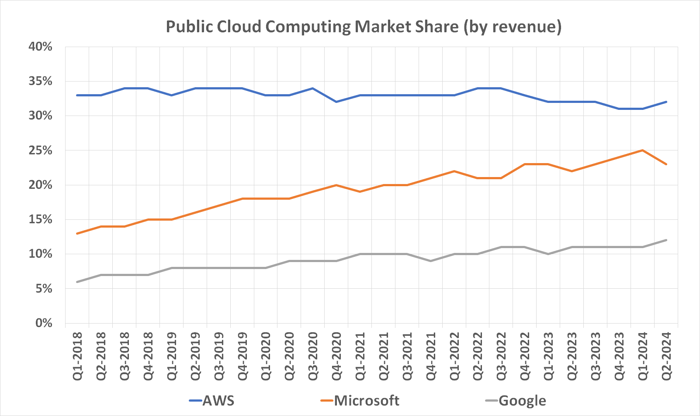
Data source: Synergy Research Group. Chart by author.
Granted, it can sometimes be easier to gain share when you start from a smaller base, while larger players have a harder time moving the needle as much. In the case of the cloud computing technology industry, however, larger scale is normally a competitive advantage, so it looks like Google Cloud is simply doing something better than its competitors.
This growing degree of market share should persist into the foreseeable future if the underlying computer processing architecture has anything to do with it.
2. New chips
To date, most cloud computing data centers (including those focused on artificial intelligence tasks) have relied on processors and chips that worked well enough but were reworks of tech designed for other purposes. For example, Nvidia‘s (NASDAQ: NVDA) earliest AI processors were mostly just repurposed graphics cards coincidentally capable of handling the huge amount of data required in artificial intelligence applications.
As the next chapter of the AI revolution unfolds, we need better technology.
That’s where Google’s new Axion chips enter the picture. Based on Arm Holdings‘ (NASDAQ: ARM) architecture, Google’s in-house-designed Axion processors provide 30% better performance than similar general purpose microchips and 50% better performance than the basic computer processors manufactured by Intel (NASDAQ: INTC) or Advanced Micro Devices. Perhaps most important, Google’s Axion-based cloud platforms will legitimately compete with Nvidia’s solutions, which have dominated the AI market largely because there’s been no viable alternative.
3. Margin moves
Last but certainly not least, Google Cloud may finally be profitable, but it’s still far from contributing as much to the companywide bottom line as it eventually will.
The graphic below tells the tale. Google’s cloud business first turned an operating profit in the first quarter of last year and has steadily widened this net income in step with revenue growth. Of last quarter’s $10.3 billion in cloud computing revenue, nearly $1.2 billion of it — roughly 11% — was converted into operating income. Not bad.
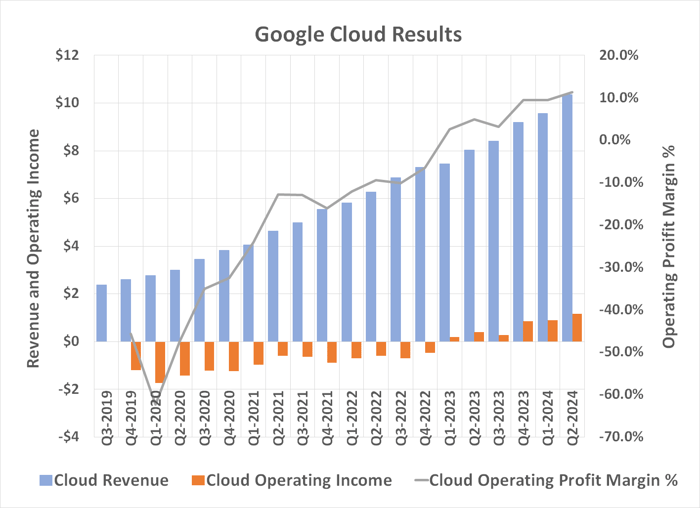
Data source: Alphabet. Chart by author. Revenue and operating income figures are in billions.
But that’s only a fraction of the sort of margins Google Cloud’s top rivals are seeing with their cloud businesses. Through the first half of this year, AWS boasted operating profit margin of 36%. Microsoft’s cloud operating income was on the order of 45%. Were Google Cloud already this profitable, its Q2 operating profits would have been in the ballpark of $4 billion rather than only $1.2 billion.
For perspective, Alphabet’s total operating income last quarter was $27.4 billion.
Connect the dots. Google Cloud has the potential to make a serious bullish dent in Alphabet’s bottom line, particularly given the cloud computing industry’s continued growth. Market research outfit Mordor Intelligence believes the global cloud market is set to expand at an annualized pace of more than 16% through 2029.
Alphabet stock still has plenty of upside
None of this is to suggest that current and would-be shareholders should ignore Alphabet’s current legal troubles. Even if all of the company’s appeals are successful, regulators are still clearly taking aim at big tech. The organization will be forced to change at least some aspects of its business sooner or later, and these changes will likely weaken the leverage Alphabet presently enjoys.
But I’m confident that even if the DOJ’s prospective remedies undermine its business, the company will find a way to win.
In the meantime, the market is arguably underestimating just how much profit Google Cloud could eventually add to the bottom line. It may well offset any profit setback suffered in relation to the DOJ’s moves.
In other words, there’s still more reason to own this stock at its present price than not.
Suzanne Frey, an executive at Alphabet, is a member of The Motley Fool’s board of directors. James Brumley has positions in Alphabet. The Motley Fool has positions in and recommends Advanced Micro Devices, Alphabet, Microsoft, and Nvidia. The Motley Fool recommends Intel and recommends the following options: long January 2025 $45 calls on Intel, long January 2026 $395 calls on Microsoft, short August 2024 $35 calls on Intel, and short January 2026 $405 calls on Microsoft. The Motley Fool has a disclosure policy.