

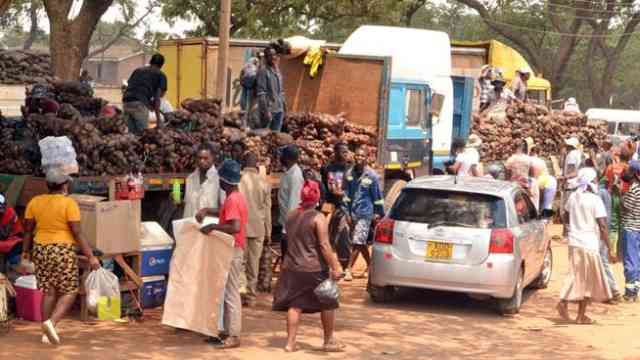
Many African countries produce a lot of raw commodities every year but the majority of farmers lack information and knowledge about market supplies in terms of specific periods when markets experience gluts and shortages.
THE quality of agricultural commodities and incomes is influenced by the quality of evidence and knowledge accessible to value chain actors, thanks to evidence from African mass food markets.
More importantly, the survival of any business depends on the trust, relationships and networks built with existing and potential suppliers and buyers.
Many African countries produce a lot of raw commodities every year but the majority of farmers lack information and knowledge about market supplies in terms of specific periods when markets experience gluts and shortages.
This makes it difficult for farmers to determine return on their investments into the agriculture sector.
While government and development organisations are providing much needed support to smallholder farmers especially vulnerable households trying to improve their productive capacity and income base, much of the support starts and ends at production level.
In most cases, the support provided is not informed by market requirements in terms of what to produce, varieties, when to produce, for who and in what quantities as well as quality and other specifications.
The absence of such critical information for respective value chain producers often leads to mismatches between volumes produced and volumes that can be consumed by the market without causing food losses.
The market is more than a physical trading space
Mounting evidence in many African countries shows that the definition of a market has shifted from physical space by location to the movement of commodities according to fluid demand patterns defined by income classes, demographics, tastes and preferences among other parameters. Where demand for rural populations used to be associated with a few staples like maize, small grains and leafy vegetables, with the urban population associated with relatively “high value” commodities like beef, chicken, eggs, processed mealie-meal, cooking oil, tinned foods, bread, margarine and many others, the situation has changed markedly.
Changes on the demand landscape are making it difficult for policymakers to define boundaries between rural and urban in terms of demand and consumption patterns.
This is because demand preferences of urban consumers have been extended to rural areas and vice versa.
What is demanded in urban areas is equally demanded in rural areas and the reverse is true.
This new demand landscape is largely being fuelled by a number of new socio-economic classes in rural, urban and peri-urban areas.
Territorial markets, restaurants, supermarkets, processors and food vendors are responding to these emerging trends and fluid demand patterns in various ways.
Unfortunately, much of production by smallholder farmers lack systems that can consolidate information to adequately respond to these market dynamics. The following steps can help:
Value chain mapping and analysis
This process involves conducting value chain mapping and analysis starting from markets all the way to the target production area like ward. Key information that can be collected through this process include:
Market supply sources for different commodities
This can show farmers where different markets are sourcing specific commodities and value chains. With that intelligence, farmers can strategically position themselves where there are gaps along supply chains.
Developing database of potential markets and buyers
As a group or syndicate, farmers can easily develop their own database of potential markets and buyers for diverse commodities that they produce including what they are not currently producing but demanded by the market.
Prioritisation, what to produce for the market
This involves analysing market demand for different crops to be able to focus on the top priority crops to be produced for defined markets.
Unless farmers prioritise, they will waste resources trying to produce everything without sufficient information about the levels of competition.
Priorities have to be reviewed time and again based on changes in demand pattern and return on investment.
The power of market tours in informing aggregation and market linkages
One of the most overlooked sources of market intelligence by most farmers is touring markets to see and learn from what happens when markets are in action.
It is from visiting markets and meeting other market actors like traders that farmers can start building relationships with diverse markets as well as gaining in-depth understanding of market operations and requirements.
While the temptation has been to visit formal markets like processing companies and supermarkets, the deepest and most vital lessons are obtained from territorial markets from which many formal markets also borrow practical wisdom.
Following market tours, farmers can go back and start aggregating commodities in response to active demand and avoid taking commodities to a market full of unknown buyers.
Based on relationships built through market tours, farmers can also begin to deliver directly to targeted markets or buyers. In addition, buyers will start coming to purchase from the source in line with agreed arrangements.
That relationship will trigger the aggregation of commodities in production areas for building stocks to meet confirmed niche market orders per given period.
Such an arrangement enables farmers to become consistent suppliers of required volumes with expected standards and specifications.
It will also enable farmers to enjoy economies of scale associated with aggregation and distribution business models.