
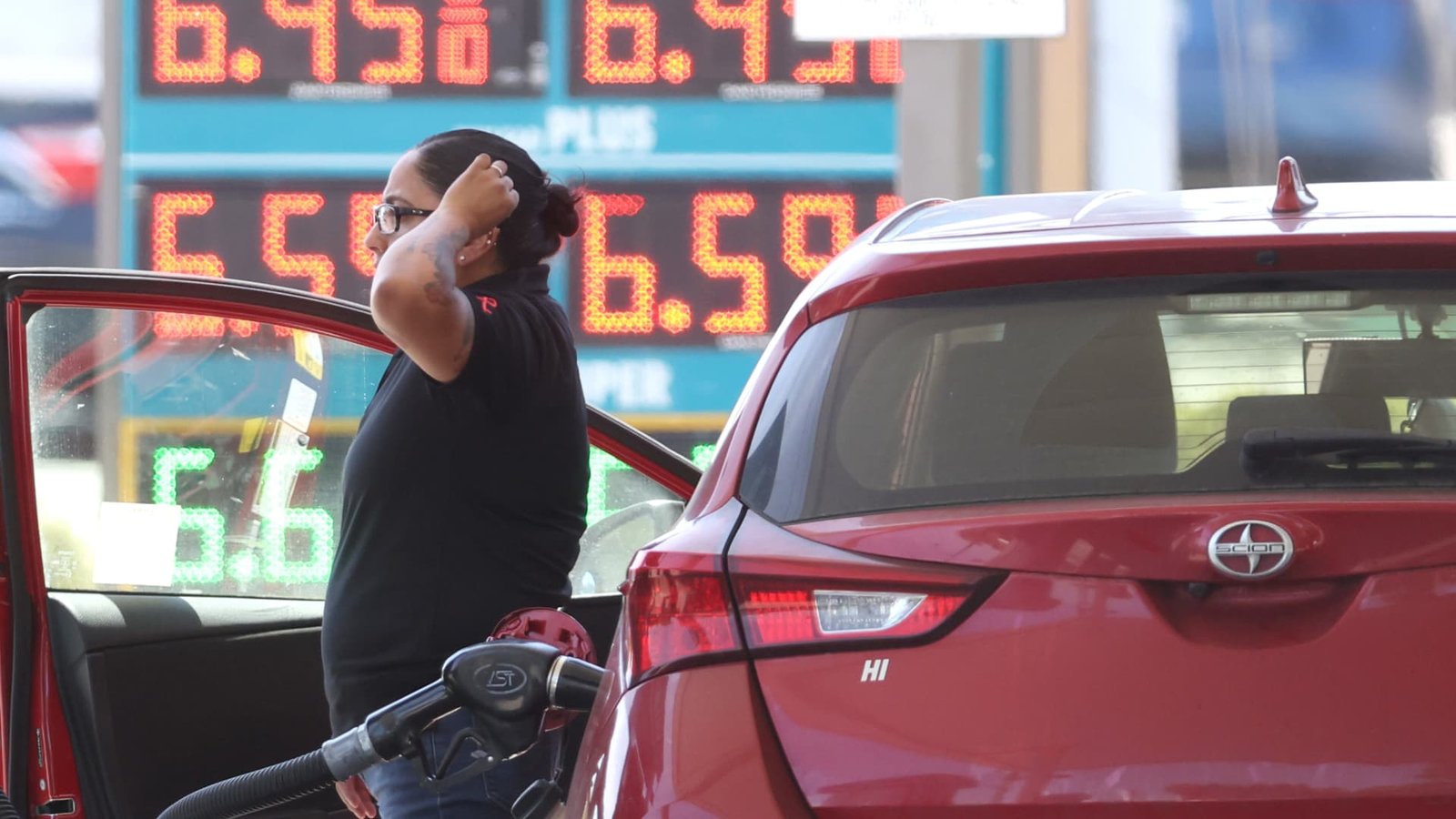
A customer pumps gas into their car at a gas station on May 18, 2022 in Petaluma, California.
Justin Sullivan | Getty Images
Not many people understand commodities markets, but as the Federal Reserve decides just how much to raise interest rates, commodity prices have a lot to do with today’s high inflation and the rate hikes designed to halt it – and that affects everyone.
The Fed is widely expected to raise interest rates by three-fourths of a percentage point at its meeting ending Wednesday, in response to the blistering 1.3 percent gain in consumer prices in June, which brought 12-month inflation to a 41-year high of 9.1 percent. Nearly half of the monthly gain reflects just the impact of energy commodities like oil and natural gas that the Labor Department breaks out in the report.
And that’s not all: other commodities like copper, iron ore, corn, wheat and even soybeans also play a role in driving inflation in the rest of the economy, even as many of them fall outside the food and energy prices that are excluded from the so-called “core” inflation measure. With commodity prices now falling fast, will future inflation reports show inflation tailing off?
“For now, inflation is a commodity story,” said Moody’s Analytics economist Bernard Yaros Jr. “Even though commodities are coming down now, they’re still elevated.”
Most economists don’t expect the Fed to bet on lower commodities to bring inflation to heel with smaller rate hikes, saying price gains in the rest of the economy need to be battled. But commodity declines are themselves a signal of slower economic growth, and at least in energy they are already showing up at the gas pump.
Lower gas prices, unacceptably high inflation
“We expect a clear message [from the Fed] that inflation remains unacceptably high,” Morgan Stanley economist Ellen Zentner said last Friday. “While it is likely that Fed Chair Jay Powell will acknowledge the recent decline in gasoline prices as a signal that headline inflation will slow going forward, the strength in core inflation leaves little room for complacency.”
Major commodities rose as much as four-fold from the beginning of the Covid pandemic, helping to get the inflation surge started. Crude oil rose to $124 a barrel in June from $64 just before the first U.S. Covid case in January 2020. Wheat went from around $195 to $351, and corn doubled. Lumber, used for housing and renovations, went from $426 to $1,686. Natural gas, a market that, like wheat, has been squeezed by embargoes against Russian exports for the invasion of Ukraine, has also doubled in the last year and quadrupled since early 2020.
All this translates more or less directly into consumer prices.
The easy part to track is energy. The jump in crude produced a 60 percent jump in gasoline prices in the last year. Natural gas’ climb led to a 13 percent climb in electricity prices, along with a big jump in coal, the No. 2 fuel used to generate power. Exploding wheat and corn prices drove a 12.2 percent climb in grocery prices.
The contribution of other commodities to inflation is harder to determine. That’s because the Labor Department doesn’t have data on exactly how much steel adds to the cost of a car, what lumber does to new home prices, or even the relationship between wheat prices and the cost of baked goods, which rose 13 percent for the year ending in June, according to Bureau of Labor Statistics economist Steve Reed.
Coffee is up 17 percent in the last year, thanks to the near-doubling of coffee commodity prices since 2020.
To some degree, consumers can limit their exposure to inflation. They can drive less or use mass transit (which has only gone up 0.8 percent in the last year) to use less gas. Beef roasts and steak have gone up much less than chicken. Many can wait to buy a used car to see if prices settle. And so on.
That’s harder to do with services, which make up 57 percent of the government’s Consumer Price Index. Housing alone is a third of the index, with only a small contribution from commodities, and housing is up more than 5 percent since last year.
Many commodities markets are calming down, which is cooling certain kinds of inflation. Oil has dropped to $105 a barrel from $140, bringing gasoline prices down 10% since mid-June, though Tom Kloza, head of the Oil Price Information Service, warns that gasoline is probably within days of a short-term bottom.
Crude oil market upside will be critical in the debate over where the economy is headed next.
“Oil is the tightest physical market ever on record,” said Jeffrey Currie, Goldman Sachs’ global head of commodities research on CNBC recently. “Financial markets are trying to price in a recession. The physical markets are telling you something really different.”
Iron ore is down one-third since April, one reason new-car inflation has decelerated. And so on.
How much that will spread is the big question for the Fed over the months ahead, one that will help determine how many more rate hikes are needed. Some economists are skeptical.
“Other than [gasoline], not sure there’s a lot of evidence that lower commodity prices have translated into lower goods prices,” said Richard Moody, chief economist at Alabama-based RegionsBank. “That just takes time, in general, and then there’s the question as to how much of the price reductions producers will keep and how much they will pass on.”
Recent commodities action and outlook
Crude oil
Price: Crude rose from below $65 pre-Covid to as high as $140, but has recently traded in the range of $100, and as low as $95 on Monday.
Consumer impact: Drive less, switch to electric cars or other higher-mileage vehicles. Mass transit prices are little changed recently.
Outlook: Depends on outcome of Ukraine war and whether there’s a recession soon.
Cotton
Price: Cotton prices more than doubled during peak inflation from a pre-Covid price of 71 cents/pound, but have come back down sharply if still elevated, recently trading at 99 cents/pound.
Consumer impact: Delay clothing purchases or switch to other fabrics.
Outlook: Shows up in apparel prices, which have been volatile from one month to the next.
Iron ore
Price: Iron ore rose from $94/ton pre-Covid to over $200/ton during peak inflation, but recently was trading at $104/ton.
Consumer impact: Delay car purchases.
Outlook: Iron ore is already down by half from its peaks, reducing vehicle inflation in recent months. Soft China demand affects the outlook.
Lumber
Price: Lumber rose from $426/1,000 board feet pre-Covid to over $1,300/1,000 board feet during peak inflation, but was recently trading at $579/1,000 board feet.
Consumer impact: Delay new home purchases and renovations.
Outlook: High interest rates are a bigger factor in consumer behavior, and are dampening home price gains.
Chicken
Price: Rose from $2.07/kg pre-Covid to $3.67/kg in recent trading, with prices for popular consumer purchases, such as chicken breasts, sharply higher as well.
Consumer impact: Switch to beef, since consumer chicken prices are up twice as much as beef in the last year.
Outlook: Department cut production forecasts and raised its egg price outlook last week, blaming high corn and soybean prices.
Sources: CNBC, Macrotrends, Markets Insider, U.S. government
Correction: Nearly half of the monthly gain in CPI reflected just the impact of energy commodities like oil and natural gas that the Labor Department breaks out in the report. An earlier version of this article misstated that figure in one instance.