


Bitcoin mining profitability weakened in November 2026 as several older ASIC machines fell below their estimated shutdown prices. Reports published on November 22–23, citing Antpool and F2Pool data, identified Antminer S19-series, Whatsminer M60 and M66, and Avalon A1466 models facing negative estimated returns at electricity costs of $0.06 per kilowatt-hour (kWh). One F2Pool-based snapshot placed the Antminer S19 XP shutdown price at $66,089 per BTC, compared with a Bitcoin reference price near $60,590. Luxor’s November 23 data also showed dollar-denominated hashprice falling 3.0% over seven days to $29.36 per PH/s per day.
Key Takeaways
-
Older mining rigs face profitability pressure: November 22–23 reports citing F2Pool and Antpool identified several Antminer, Whatsminer, and Avalon models operating below estimated electricity break-even at $0.06/kWh.
-
Antminer shutdown prices vary significantly: F2Pool-based estimates placed the S19 XP threshold at $66,089 per BTC, compared with $90,824 for S19 Pro and $105,154 for S19.
-
Hardware efficiency affects operating margins: At the same electricity rate, a 30 J/TH mining rig consumes 50% more electricity per unit of mining work than a 20 J/TH model.
-
Network difficulty remains important: Bitcoin difficulty fell 9.1% on November 14 to 134.82 trillion, while Luxor subsequently projected a possible 9.5% increase around November 26.
-
Actual equipment shutdowns remain unconfirmed: Negative estimated daily returns do not establish how many physical machines stopped operating or whether individual mining companies experienced broader financial losses.
Which Older Bitcoin Mining Rigs Reached Shutdown Prices in November 2026?
Several older Bitcoin mining rigs fell below their estimated operating break-even levels in November 2026 as mining revenue weakened. Reports published on November 22–23, citing F2Pool and Antpool data, identified multiple Antminer, Whatsminer, and Avalon models generating insufficient revenue to cover electricity expenses at an assumed rate of $0.06/kWh. These findings illustrate the financial pressure on less efficient mining hardware, although reaching a shutdown threshold does not necessarily mean operators have stopped using the machines.
What Were the Shutdown Prices for Antminer S19, S19 Pro, and S19 XP?
Antminer S19 Series: Estimated Shutdown Prices in November 2026
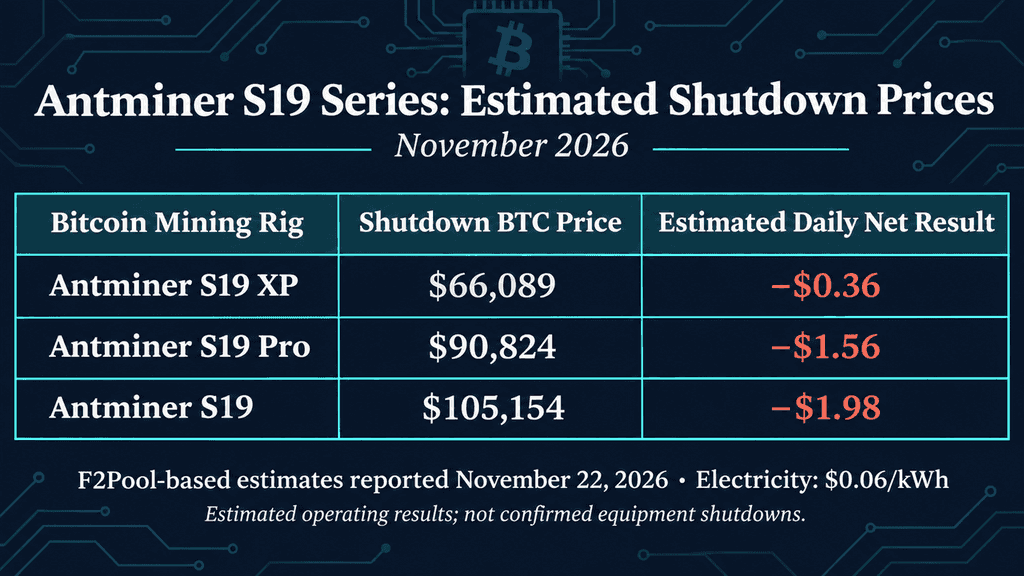
The differences between these shutdown prices reflect the machines’ respective computing power and energy requirements. Hardware specifications help explain why models from the same product family can experience substantially different operating margins.
-
Antminer S19: Rated at approximately 95 terahashes per second (TH/s), with power consumption around 3,250 watts.
-
Antminer S19 Pro: Offers approximately 110 TH/s while consuming about 3,250 watts, improving output without a comparable increase in power demand.
-
Antminer S19 XP: Bitmain’s listed specifications include 141 TH/s, 3,031.5 watts, and energy efficiency of 21.5 joules per terahash (J/TH).
The S19 XP’s greater efficiency gives it a lower estimated electricity break-even price than the earlier S19 configurations. However, even a relatively efficient machine can generate negative daily returns when mining revenue falls below its operating expenses.
Which Whatsminer M60 and M66 Models Reached Break-Even?
MicroBT’s Whatsminer M60 and M66 models also appeared in November profitability reports. The F2Pool-based snapshot placed their estimated Bitcoin shutdown prices near $61,170, assuming electricity costs of $0.06/kWh. With BTC valued near $60,590 in that calculation, electricity expenses represented approximately 101% of estimated mining revenue.
Separately, November 22 reporting attributed to Antpool identified a 280 TH/s Whatsminer M66 configuration as generating negative estimated daily returns. These findings should not be treated as one universal shutdown threshold for the entire M60 or M66 product range. Whatsminer variants differ in hashrate, power consumption, and cooling requirements, while mining calculators may use different network conditions and operating assumptions. The exact model configuration and calculation date matter when assessing whether an individual machine can cover its electricity costs.
Why Did the Avalon A1466 Also Face Mining Profitability Pressure?
Canaan’s Avalon A1466 was another mining machine identified in Antpool-based reporting as operating below estimated electricity break-even in November 2026. Its inclusion showed that profitability pressure extended beyond equipment manufactured by Bitmain and MicroBT. Canaan’s September 2023 announcement described an A1466 configuration delivering approximately 150 TH/s at 3,230 watts, equivalent to roughly 21.5 J/TH. Other product configurations can have different specifications, so those figures should not automatically be applied to every A1466 machine.
The November reporting did not provide a sufficiently verified, model-specific shutdown price for the Avalon A1466 that could be compared directly with the F2Pool-based Antminer figures. Its reported negative profitability is therefore best understood as a model-level operating estimate under specific electricity and network assumptions, rather than evidence that all Avalon A1466 machines became unprofitable or were physically disconnected.
Why Did Bitcoin Mining Profitability Deteriorate in November 2026?
Bitcoin mining profitability weakened in November 2026 as lower Bitcoin prices reduced the dollar value of mining rewards while electricity remained a substantial operating expense. Although the Bitcoin network experienced a significant difficulty reduction during the month, that adjustment did not fully protect every miner’s dollar-denominated revenue. The pressure was particularly noticeable among machines requiring more electricity for each unit of computing power, where even relatively small changes in mining revenue can determine whether operations cover their direct energy costs.
How Did Bitcoin Hashprice and Mining Difficulty Change?
Bitcoin hashprice measures the expected daily mining revenue generated by a given amount of computing power. According to Luxor’s November 23 reporting, dollar-denominated hashprice declined 3.0% over seven days, from approximately $30.27 to $29.36 per petahash per second per day (PH/s/day). Over the same reporting period, Bitcoin’s reference price fell 4.9%, from about $64,760 to $61,606. Meanwhile, BTC-denominated hashprice remained nearly unchanged at approximately 0.00046850 BTC/PH/s/day. This distinction matters: miners were earning roughly similar amounts of BTC per unit of computing power, but the dollar value of those rewards had weakened.
How Do Electricity Costs and ASIC Efficiency Affect Mining Profitability?
Electricity costs are central to determining whether an ASIC miner can cover its daily operating expenses. A machine with a lower J/TH rating generally performs the same amount of mining work using less energy, giving it a stronger position when revenue declines. At Luxor’s November 23 hashprice of $29.36 per PH/s/day, each TH/s of computing power represented approximately $0.02936 in expected gross daily revenue. Comparing that revenue with electricity consumption illustrates how differences in energy efficiency can change a miner’s break-even position.
-
At 20 J/TH: A machine consumes approximately 0.48 kWh per TH/s over 24 hours. At $0.06/kWh, electricity costs about $0.0288 against estimated gross revenue of $0.02936.
-
At 30 J/TH: Electricity consumption rises to approximately 0.72 kWh per TH/s daily, costing $0.0432 at the same power rate. That exceeds the estimated gross mining revenue.
-
Electricity price sensitivity: A 3,000-watt machine running continuously uses 72 kWh per day. Every $0.01/kWh change in electricity price therefore changes its daily power expense by $0.72.
These examples assume continuous operation at the stated power draw and use a single historical hashprice snapshot. They exclude additional expenses such as mining pool fees, cooling, maintenance, hosting, and equipment financing. Electricity-only profitability is not the same as total business profitability, particularly for operators running older hardware with significant upkeep costs.
What Do Shutdown Prices Mean for Bitcoin Miners Going Forward?
The number of older Bitcoin mining machines approaching or falling below estimated shutdown prices illustrates the growing importance of operating efficiency and cost management. However, negative estimated daily returns do not automatically establish permanent equipment closures or financial distress across the mining industry. The implications depend on how operators respond, the prices they pay for electricity, the performance of their hardware, and subsequent changes in Bitcoin’s mining economics.
Have Bitcoin Miners Actually Switched Off Older Rigs?
A shutdown price is a calculated break-even threshold, not a record of equipment being disconnected. It generally identifies the Bitcoin price at which a particular mining machine’s expected revenue no longer covers electricity expenses under stated assumptions. Some operators may temporarily suspend less efficient machines, while others may continue running them because they have cheaper electricity, different operating arrangements, or reasons to keep equipment available. The November 22–23 profitability reports did not establish a verified count of machines that had actually been switched off.
Could the Next Bitcoin Difficulty Adjustment Change Mining Profitability?
Bitcoin automatically adjusts mining difficulty approximately every 2,016 blocks to maintain an average block interval near 10 minutes. If difficulty increases while other conditions remain unchanged, a fixed amount of computing power generally earns fewer BTC over a given period. If difficulty decreases, the opposite applies. In its November 23 report, Luxor estimated that difficulty could increase approximately 9.5% around November 26, 2026. That figure was a forward-looking estimate, not a confirmed adjustment at the time of publication.
A higher difficulty level could place additional pressure on machines already operating near electricity break-even. Its actual effect would depend on Bitcoin’s price, transaction fees, and subsequent network activity. The final adjustment and updated profitability calculations are therefore more useful than treating a preliminary estimate as an established result.
What Are the Main Operating Risks for Bitcoin Miners?
Mining profitability extends beyond Bitcoin’s market price and a machine’s advertised energy efficiency. Operators must maintain reliable electricity supplies, manage aging equipment, and cover expenses that are not always included in public shutdown-price calculators. A rig may generate enough revenue to pay its direct electricity bill while still contributing to an overall operating loss once additional business costs are considered.
Several factors can materially influence the outcome:
-
Energy contracts and power availability: Variable electricity tariffs, interruptions, and temporary power curtailments can alter operating costs and machine utilization.
-
Maintenance and facility expenses: Cooling systems, equipment repairs, mining pool fees, and hosting arrangements reduce the amount of mining revenue retained.
-
Equipment age and capital costs: Older ASIC machines may require more maintenance, while depreciation and financing obligations can remain significant even when mining output improves.
For investors assessing publicly traded or privately held mining businesses, model-level shutdown estimates should be considered alongside company-reported electricity costs, fleet efficiency, production figures, and financial obligations. A single Bitcoin price threshold cannot establish whether an entire mining operation is economically sustainable.
Conclusion
The November 2026 figures show that Bitcoin mining profitability depends as much on operating conditions as on the market price of BTC. Several older machines failed to cover estimated electricity expenses under the reported assumptions, while more efficient hardware had greater capacity to absorb weaker mining revenue. A shutdown-price estimate is therefore a measure of cost pressure, not proof that an operator has closed facilities or suffered a company-wide financial loss.
The next meaningful test is how Bitcoin prices, transaction fees, and network difficulty develop after the November reporting snapshots. Luxor estimated a possible difficulty increase of 9.5% around November 26, but the final adjustment was not confirmed in its November 23 report. Verified changes in network hashrate, updated mining revenue estimates, and company-reported operating capacity will provide a clearer picture of whether profitability pressure is translating into actual equipment shutdowns.
FAQs
What Is the Difference Between a Bitcoin Miner’s Shutdown Price and Its Total Mining Cost?
A shutdown price generally refers to the Bitcoin price at which a machine’s expected mining revenue no longer covers electricity expenses under specified assumptions. Total mining costs also include equipment depreciation, repairs, hosting, financing, and administration. A machine can cover its electricity bill while still operating at an overall loss.
Why Do Bitcoin Mining Calculators Show Different Shutdown Prices for the Same Machine?
Mining calculators may use different Bitcoin prices, network difficulty levels, electricity rates, mining pool fees, and hardware specifications. Some account only for electricity, while others include additional operating costs. Their results can also change as market and network conditions shift.
Can Changing a Mining Rig’s Power Settings Improve Its Profitability?
Some ASIC miners support operating modes that reduce electricity consumption alongside computing output. Depending on the machine, a lower-power setting may improve energy efficiency, but it does not guarantee higher profits. The outcome depends on the model’s performance, electricity price, and available mining revenue.
How Do Mining Pool Fees Affect Bitcoin Mining Profitability?
Mining pools typically charge fees for coordinating computing resources and distributing rewards among participants. These fees reduce miners’ realized revenue and can raise the effective break-even threshold. Different pool payment methods may also produce different returns under similar network conditions.