

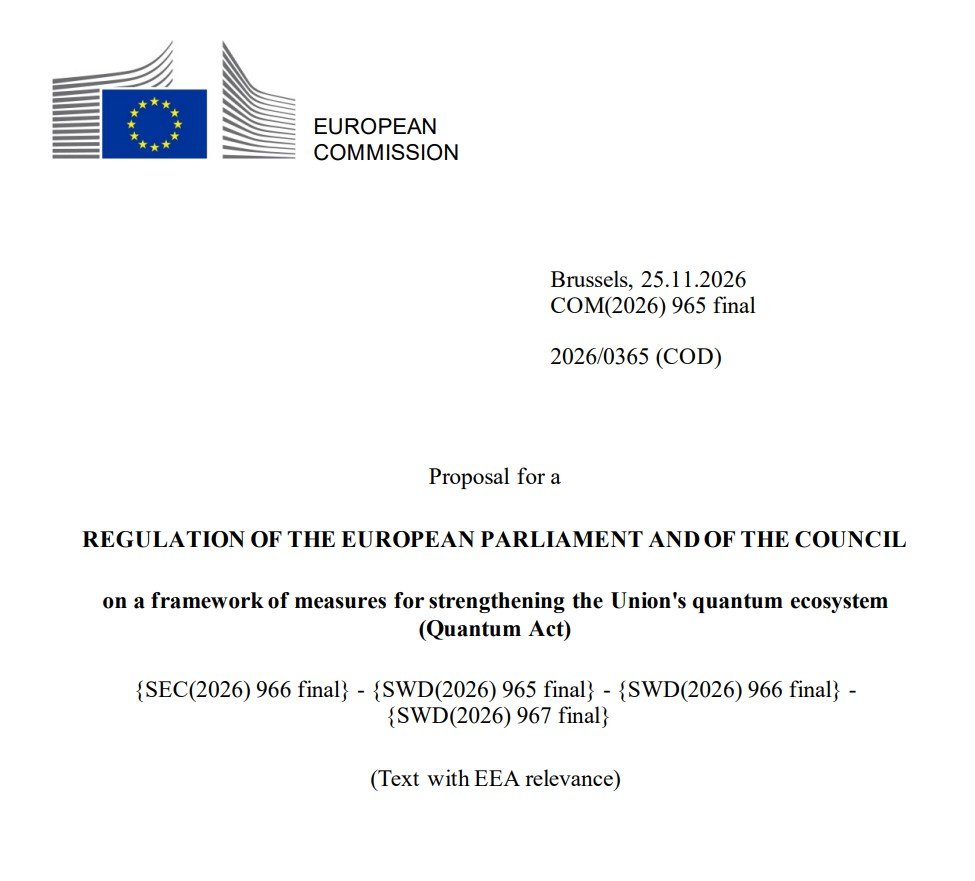
Brussels put a date on the quantum problem. On November 25, 2026, the European Commission proposed the EU Quantum Act, a law that would push member states to protect their most sensitive digital systems against future quantum computers by the end of 2030. Alongside it, the Commission wants a new Sovereign Tech Equity Fund that could reach €50 billion, or about $54.7 billion, to keep AI and quantum companies growing in Europe.
A powerful enough quantum computer, a machine that uses quantum physics to solve certain math problems far faster than today’s computers, could in theory break the digital signatures that prove you own your Bitcoin. No such machine exists today. But Europe has now set a deadline for its own systems, and Bitcoin hasn’t. Here’s what the EU proposed, how the two timelines compare, and what you can do about it.

Binance Referral Code
$100 Sign-Up Bonus
20% Lifetime Discount on Trading Fees
Code Valid: November 2026
BINANCEMB
What the EU Actually Proposed
The Quantum Act does three main things, according to the Commission’s Quantum Act proposal.
- It speeds up the switch to quantum-safe encryption. Post-quantum cryptography (PQC) means new encryption methods designed to resist quantum attacks. The Act would require member states to deliver on an EU roadmap that recommends:
- national transition plans by the end of 2026,
- high-risk systems protected by the end of 2030,
- medium-risk systems protected by the end of 2035.
- It uses public money as leverage. Central-government bodies covered by the EU’s NIS2 cybersecurity law could only buy digital products that support PQC for critical systems, starting six months after the law takes effect. Banks, energy firms, hospitals, telecoms and transport operators would be encouraged to follow the same standard.
- It favors European suppliers. Public tenders for quantum products would mostly be limited to EU-controlled companies, and shared quantum facilities would be reserved for them, too.
“Europe needs to accelerate now,” said Henna Virkkunen, the Commission’s Executive Vice-President for Tech Sovereignty, Security and Democracy.
The €50 Billion Fund: What It Is and What It Isn’t
The Sovereign Tech Equity Fund (STEF) would buy stakes in companies working on technologies Brussels sees as strategic, including AI and quantum computing. The goal is to stop Europe’s best tech firms from turning to US or Chinese investors, buyers or stock markets once they outgrow local funding.
| Scaleup Europe Fund (existing) | Sovereign Tech Equity Fund (proposed) | |
| Target size | €5 billion | Up to €50 billion ($54.7 billion) |
| Public money | €1 billion from the Commission | Commission, European Investment Bank and member states; share undecided |
| Private money | About €4 billion targeted | Aim of up to €6 private for every €1 public |
| Status | Investing since autumn 2026 | Details due in February 2027 |
Here’s our math. At the target ratio of six private euros for each public one, a €50 billion fund would need only about €7.1 billion ($7.8 billion) of public money. So the headline number is mostly a bet that private investors will show up. That’s a reasonable bet in a strong market, but the existing Scaleup Europe Fund is still raising money toward a target one-tenth the size.
The problem it targets is real. A European Investment Bank study found that European scale-ups had raised about half as much capital as San Francisco peers by their tenth year. The Commission also estimates Europe’s quantum sector alone needs €12.9 billion to €18.1 billion of financing for 2028 to 2034.
Europe vs Bitcoin: Two Quantum Timelines
This is the gap the headlines miss. Europe’s plan has dates. Bitcoin’s doesn’t yet.
| European Union | Bitcoin | |
| Main plan | Quantum Act + coordinated PQC roadmap | BIP-360 (new address type) and BIP-361 (phasing out old signatures) |
| Status, November 2026 | Proposed law, now with Parliament and member states | Both proposals still drafts |
| First deadline | National plans by end of 2026 | None set |
| High-risk deadline | End of 2030 | None set |
| Who decides | EU institutions | Developers, miners, node operators and users must agree |
| Can it be forced? | Commission could make milestones binding later | No central authority can force an upgrade |
A Bitcoin Improvement Proposal (BIP) is how changes to Bitcoin are suggested. BIP-360 would add a new type of address that hides the public key, the piece of data a quantum computer would need to attack. As of mid-November 2026, it remained a draft with no activation plan.
Why is Bitcoin slower? Not because developers are ignoring it. In July, nine firms, including BlackRock, Coinbase, and Strategy, pledged $15 million over three years for Bitcoin security research, including quantum resistance. The hard part is coordination. Every upgrade needs broad agreement, and then millions of holders have to move their coins to new addresses themselves.
How Many Bitcoins Are Exposed?
More than 6 million BTC, or 31.2% of the circulating supply, sat in addresses with publicly visible keys in October, according to on-chain estimates. At Bitcoin’s price of about $64,100 on November 18, that’s roughly $385 billion, by our math.
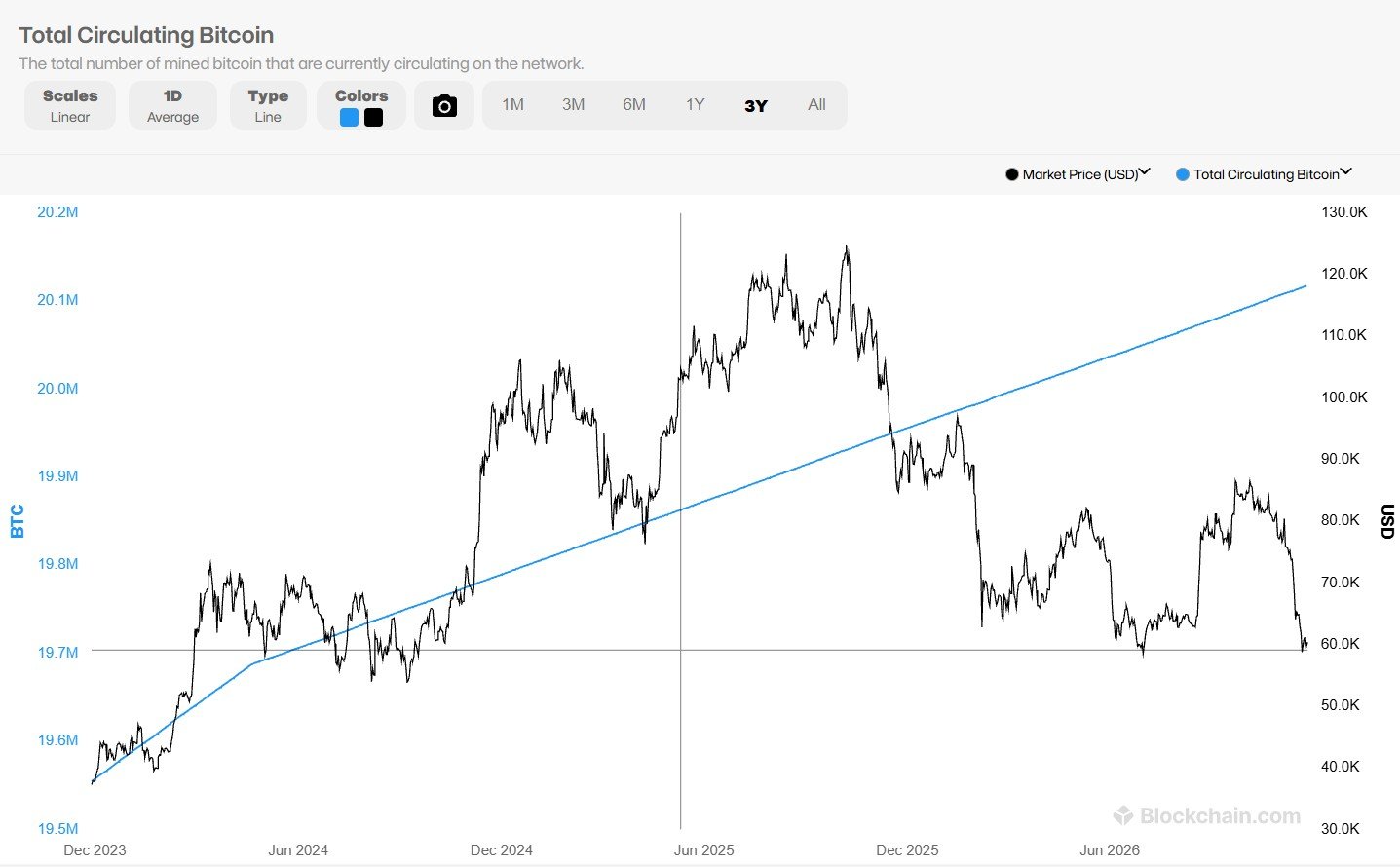
Those coins aren’t at risk today. But they’re the ones a future quantum computer would target first, because the key is already on the blockchain. Coins in addresses that have never sent a transaction are safer, since their public key hasn’t been revealed yet.
Here’s how an attack would work, in simple terms. Every Bitcoin wallet has a private key, which only you should know, and a public key, which anyone can see once you spend from that address. Today’s computers can’t work backward from the public key to the private key. A large enough quantum computer, in theory, could. Anyone who did that could sign a transaction as if they were you and move the coins. That’s why the fix focuses on hiding public keys and, eventually, switching to new signature methods that quantum machines can’t reverse.
What the EU’s Timeline Means for Bitcoin
Our analysis: the EU deadline doesn’t apply to Bitcoin, and Brussels can’t change Bitcoin’s code. But it does three things that matter to crypto users.
- It sets a reference date. Banks and custodians in Europe that hold crypto will face pressure to show a quantum plan by 2030, even if Bitcoin itself hasn’t upgraded.
- It may shape exchanges first. Encryption that protects exchange logins, data and internal systems can be upgraded without Bitcoin changing at all. Expect EU-facing platforms to talk about PQC well before Bitcoin settles on a fix.
- It’s slower than it looks. Lawyers at Freshfields don’t expect negotiations to finish before the end of 2027. If the procurement rule then starts six months after the law takes effect, it likely wouldn’t bite until 2028 at the earliest, by our estimate.

Binance Wallet Referral Code
100 USDT Sign-Up Bonus
20% Lifetime Discount on Trading Fees
Code Valid: November 2026
VU790NKG
Europe’s plan isn’t fast, and it isn’t finished. But it has a calendar. Bitcoin’s biggest quantum question right now isn’t whether a fix exists on paper. It’s whether the network can agree on one before the calendar starts to matter.
This article is for information only and is not financial advice.
FAQs
When could a quantum computer actually break Bitcoin?
Nobody knows. No existing quantum computer is close to the size needed, and estimates range from several years to decades. The concern is that upgrading a global network takes years too, so developers want a plan ready well before the threat is real.
Does quantum computing threaten Bitcoin mining?
Much less than it threatens signatures. Mining uses the SHA-256 hash function, and quantum computers are only expected to speed up attacks on it modestly. The bigger risk is to the elliptic-curve signatures that prove ownership of coins, which is why proposals focus on addresses and keys.
What is the EU’s NIS2 law?
NIS2 is the EU’s main cybersecurity law for important organizations, such as energy, health, transport, banking and parts of public administration. It sets security and incident-reporting rules. The Quantum Act would use it to decide which public bodies must buy quantum-safe technology.
Are Ethereum and other blockchains working on quantum resistance?
Several are researching it, and some newer blockchains were designed with quantum-resistant signatures from the start. Smart-contract platforms face extra complexity, because wallets, apps, and contracts all depend on the same signature system. As with Bitcoin, the main challenge is moving existing users safely.
Can the EU force crypto companies to become quantum-safe?
Not directly under this proposal. The Quantum Act targets public buyers and encourages critical sectors such as banking to follow. Crypto firms licensed in the EU could still face pressure through banking partners, insurers, and future technical rules, but no specific crypto deadline has been proposed.
