
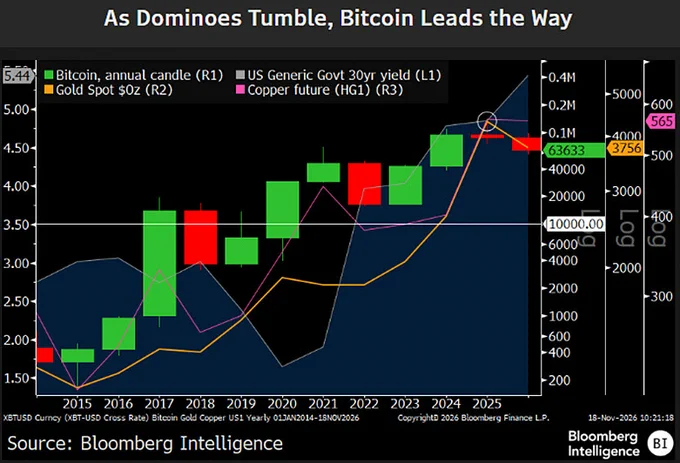
McGlone’s analysis highlights what would mark Bitcoin’s first-ever second consecutive down year. Bitcoin ended 2025 down some 6.3%. By mid- to late-November 2026, $BTC is trading around $63,000–64,000, having begun the year around $88,000, down approximately 26-28% year-to-year, and more than 45-50% below its October 2025 all-time high near $126,000.

Furthermore, McGlone has repeatedly called $BTC a risk-asset leading indicator. In recent commentary, he has cited high U.S. bond yields and the potential for further decline, including to levels below $60,000.
Follow us on X for real-time crypto updates.
James Seyffart: Bitcoin as a Debasement Hedge
In contrast to near-term cyclical problems, James Seyffart has recently emphasized the long-term structural value of Bitcoin. In a November 18 interview, Seyffart stated that if someone does not yet understand Bitcoin, “you probably should at this point,” and added, “it’s not going away any time soon.”
Meanwhile, Seyffart’s comments arrive amid ongoing institutional involvement through spot Bitcoin ETFs and continued discussion of Bitcoin’s monetary properties. While price action in 2026 has been challenging, his framing emphasizes Bitcoin’s role as a non-sovereign, scarce digital asset with core attributes.
These include resistance to censorship, protection against the erosion of fiat purchasing power, and resilience regardless of near-term volatility. That said, Seyffart’s thesis highlights the longer-term institutional perspective that $BTC is more of a strategic allocation than just a cyclical asset.
What Do McGlone’s Warning and Seyffart’s Outlook Mean for $BTC and Crypto Markets?
At press time, Bitcoin was at $63,829.01, down 0.5% in the last 24 hours, and is on track for its first back-to-back calendar-year declines. Last year, $BTC closed down approximately 6%, and 2026 is showing a very negative year-to-date as of mid-November. This performance has led McGlone to question “what stops the tumbling dominoes into year-end and in 2027?”
McGlone also cites potential additional pressure on crypto if equities reprice more significantly or if deflationary pressures, including energy price reversals, AI productivity gains, higher real rates, or credit tightening, deepen.
Therefore, if McGlone’s deflation scenario unfolds, a broader decline in U.S. equities and commodities could fuel further deleveraging across crypto, putting significant pressure on key psychological support at around $60,000 and delaying a recovery well into 2027.
Conversely, if Seyffart’s debasement thesis prevails, any rate-cutting pivot or new fiscal stimulus to counter economic strain by central banks could get institutional money flowing again into scarce, fixed-supply assets. This is a scenario that crypto traders should consider against the backdrop of The Economist’s 2027 outlook.
Subscribe to our YouTube channel for the latest crypto news.
Related: Bitcoin ETFs Shed $2.14B as $BTC Price and Dominance Test Critical Support