
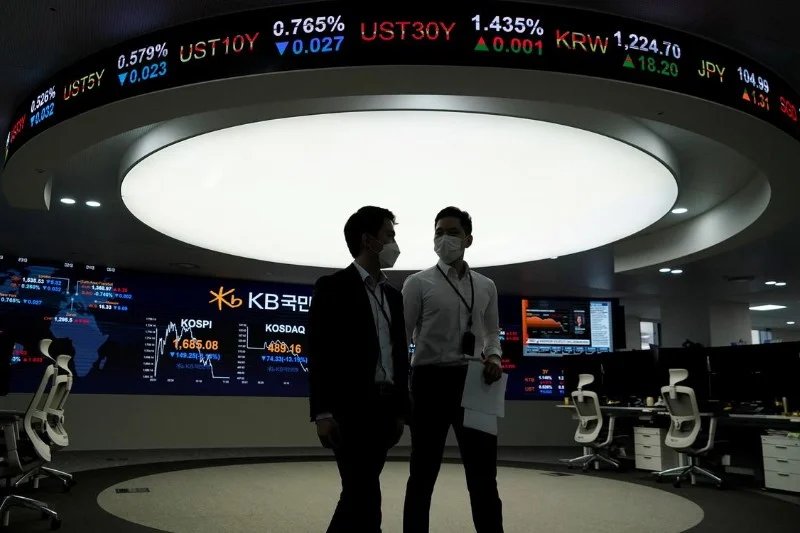
Investing.com — South Korea’s extended its sharp downturn on Friday, leaving the benchmark down more than 6% for the week and on track for its worst weekly performance since last month’s AI-driven selloff, as investors continued to unwind crowded semiconductor positions.
The benchmark has risen in just two of the past 10 trading sessions and was trading around 6,228 points, down about 1.1% on the day.
The latest weakness follows a brutal July, when the KOSPI suffered its steepest monthly decline since the 2008 financial crisis after concerns over artificial intelligence valuations erased months of gains. The KOSPI fell 22% in July.
Unlike previous market corrections driven by slowing economic growth or monetary tightening, the current selloff has been largely concentrated in AI-linked semiconductor stocks.
Investors have increasingly questioned whether massive spending on AI infrastructure can continue to justify elevated valuations, even as the sector continues to report solid earnings.
Chipmakers again dominated Friday’s declines. dropped more than 4%, extending losses after tumbling over 8% a day earlier, while hovered near flat after Thursday’s 5% slide.
In Japan, fell nearly 9%, lost more than 6%, and slipped over 2%, highlighting continued pressure across the North Asian semiconductor supply chain.
The latest bout of selling followed disappointing post-earnings reactions in U.S. AI stocks. fell after investors deemed its outlook underwhelming despite an earnings beat, while retreated following its first quarterly report as a listed company after higher-than-expected AI-related capital spending renewed concerns over returns on industry investment.
Earlier this week, earnings from Sandisk and also reignited worries over the memory-chip cycle, weighing on Asian semiconductor shares.
The correction has exposed how heavily the KOSPI has become tied to the AI trade. Samsung Electronics and SK Hynix now account for a dominant share of the benchmark’s market capitalisation, leaving the index increasingly sensitive to shifts in global semiconductor sentiment.
Much of the recent volatility reflects positioning rather than deteriorating fundamentals, with both companies continuing to post strong earnings even as investors reassess the sustainability of the AI spending boom.
While some institutional investors have begun viewing the correction as a valuation reset, the KOSPI remains firmly at the mercy of the next catalyst for global chip stocks, with sentiment likely to hinge on whether AI demand can continue to support the sector’s lofty expectations.