
The U.S. stock market is rising toward a record on Tuesday as big companies keep piling up profits and oil prices ease.
The S&P 500 added 0.6 per cent and is on track to top its all-time closing high set earlier in the summer. The Dow Jones Industrial Average was up 658 points, or 1.2 per cent, from its own record set the day before, and the Nasdaq composite was 1.1 per cent higher, as of 9:35 a.m. Eastern time.
Despite worries about high inflation, the war in Iran and a possible bubble in stock prices because of euphoria around the boom in artificial-intelligence technology, Wall Street is nearing its latest apex because profits are booming for companies. That’s key because stock prices tend to follow the path of corporate earnings over the long term.
Palantir Technologies helped lead the way and jumped 19.8 per cent after CEO Alex Karp said its overall revenue leaped 93 per cent in the spring from a year earlier in what he called an “otherworldly” quarter. Besides reporting a stronger profit for the latest quarter than analysts expected, the AI company also raised its revenue forecast for the full year of 2026.
Caterpillar rallied 10.5 per cent after the heavy-equipment maker likewise reported stronger profit and revenue for the spring than analysts expected. It was the first time Caterpillar made more than US$20 billion in sales and revenue in a quarter, and CEO Joe Creed said it’s seeing strong order rates and a growing backlog across its main businesses.
They’re the latest companies to deliver even better profits for the spring than investors expected, following strong results from Amazon, Microsoft and others. Coming into this week, companies in the S&P 500 index were on track to deliver growth in earnings per share for the spring of nearly 50 per cent from a year earlier, according to FactSet.
That would be the strongest growth since the historic numbers of the spring of 2021, when the economy was roaring out of the COVID-19 pandemic.
Also helping stocks on Tuesday was another drop for oil prices.
Brent crude, the international standard, sank 4.2 per cent to US$80.29 per barrel as hope once again takes over from fear in the oil market. It had swung sharply between US$72 and US$102 through July on uncertainty about when the war with Iran would allow oil tankers to freely exit the Persian Gulf again to deliver crude around the world. It’s jerked up and down many times, as uncertainty built, receded and then built again.
The latest drop in oil prices helped to pull down yields in the bond market, which relaxes pressure on the overall economy and on prices for stocks and other investments.
The yield on the 10-year Treasury fell to 4.63 per cent from 4.70 per cent Monday and from 4.75 per cent at the end of last week. That’s a notable move for the bond market, but it remains well above its 3.97 per cent level from before the war with Iran.
In stock markets abroad, indexes rose modestly across much of Europe and Asia.
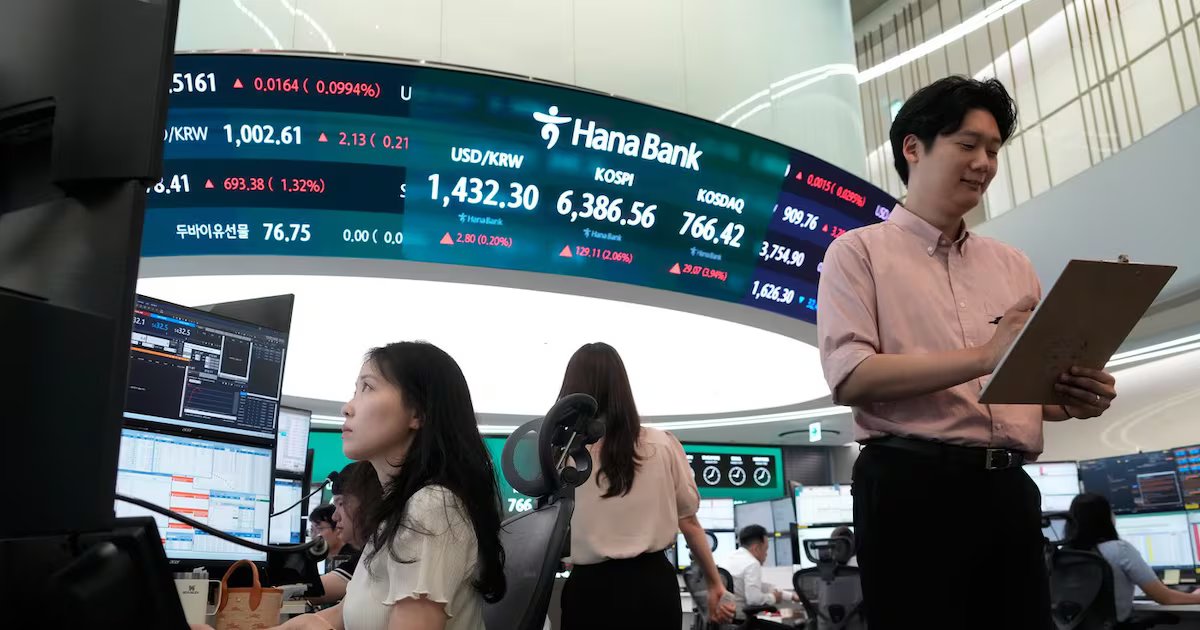
South Korea’s Kospi was an outlier and jumped 1.6 per cent. Seoul has been home to some of the world’s sharpest swings recently because its stock market is dominated by two companies that have been swept up in AI mania, Samsung Electronics and SK Hynix.
The Kopsi had dropped 5.1 per cent and soared 17.9 per cent in the prior two days.
Stocks of computer chip companies also held firmer on Wall Street, where gains of 2.4 per cent for Nvidia, 6.9 per cent for Micron Technology and 4.7 per cent for Broadcom were some of the strongest forces lifting the S&P 500.
___
AP Business Writers Yuri Kageyama and Matt Ott contributed to this report.