

Recent run-ups in tech stock valuations and all-time highs in the S&P 500 index have led some investors to worry that growth stocks are overpriced. Buying utility stocks and utility exchange-traded funds (ETFs) can be a good move for some situations and strategies — like if you want to hedge against a possible tech downturn or future recession.
Utility stocks tend to earn steady income and pay above-average dividends. These companies have also benefited from rising demand for electricity related to the artificial intelligence (AI) data center build-out. But utilities have a few risks and downsides. They’re not the right fit for every investor.
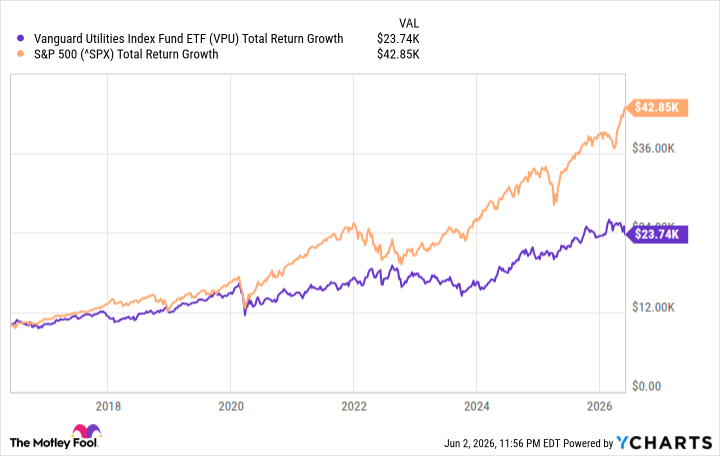
The Vanguard Utilities ETF (VPU +0.79%) is a low-cost way to invest in dozens of utility companies that distribute electricity, gas, water, or operate as independent power producers. This fund has underperformed the S&P 500 for the past five years. But investors who want exposure to this specific area of the economy can use the Vanguard Utilities ETF to easily buy a portfolio of utility stocks at a low expense ratio of 0.09%.
Let’s take a closer look at this Vanguard ETF and see if it might make sense for your portfolio.

Image source: Getty Images.
67 stocks, 22 years of 9.8% annualized returns
The Vanguard Utilities ETF holds a total of 67 stocks. This Vanguard ETF has delivered average annual returns (by net asset value) of 11.9% in the past year, 14.4% in the past three years, 9.6% in the past five years, and 9.4% in the past 10 years. Since the fund’s inception in January 2004, it’s delivered average annual returns of 9.8%.

Today’s Change
(0.79%) $1.51
Current Price
$192.36
Key Data Points
Day’s Range
$190.86 – $193.42
52wk Range
$172.67 – $206.10
Volume
31
Most of the fund’s assets are in electric utilities (62.4% of the fund) and multi-utilities (24.2%) that provide more than one type of utility service. Gas utilities make up 4.9% of the fund, and independent power producers account for another 4.9%. The fund also holds shares in water utilities (2.8%) and renewable electricity companies (0.8%).
Those returns might look pretty steady, and the Vanguard Utilities ETF has paid a strong dividend yield of 2.52% in the past 12 months. But this fund has underperformed the S&P 500 for most of the past 10 years. If you’d invested $10,000 in the S&P 500 10 years ago, you’d have $42,850 today — while that same $10,000 investment in the Vanguard Utilities ETF would have only grown to $23,740.
VPU Total Return Level data by YCharts
Why (or why not) to buy the Vanguard Utilities ETF
There’s a lot of interest in utility stocks right now because of the AI boom. But investors should keep in mind that utilities aren’t the same as AI stocks. Utilities are asset-heavy, heavily regulated, and expensive to operate.
Utility companies might grow along with the build-out of AI infrastructure, but their profit margins are unlikely to be anywhere near as large as the fastest-growing AI stocks and major tech names. There are liabilities for utility investors as well as upside.
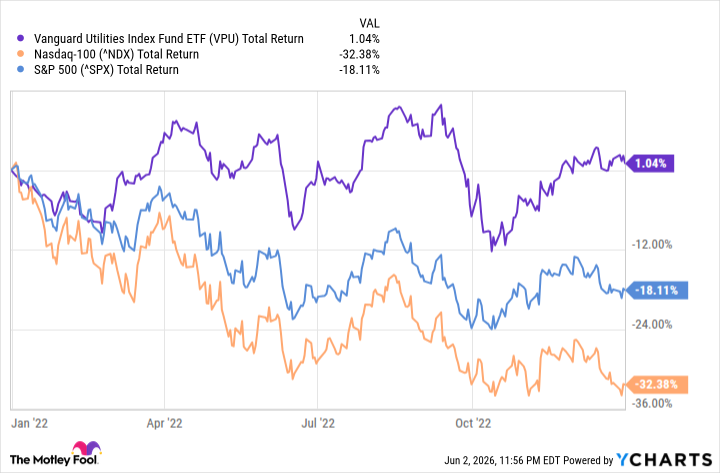
Perhaps the best reason to buy utility stocks is to protect against a tech downturn. The Vanguard Utilities ETF has sometimes outperformed the S&P 500 index and even the tech-heavy Nasdaq-100 index. For example, during the latest bear market in tech stocks during 2022, the Vanguard Utilities ETF outperformed both of those benchmarks:
VPU Total Return Level data by YCharts
However, the long-term upside of utility stocks feels limited. I prefer to diversify my portfolio beyond just 67 stocks in a heavily regulated industry. There are other ways to make defensive moves and earn high dividend yields. I don’t own this ETF, and I wouldn’t recommend it for most investors.