
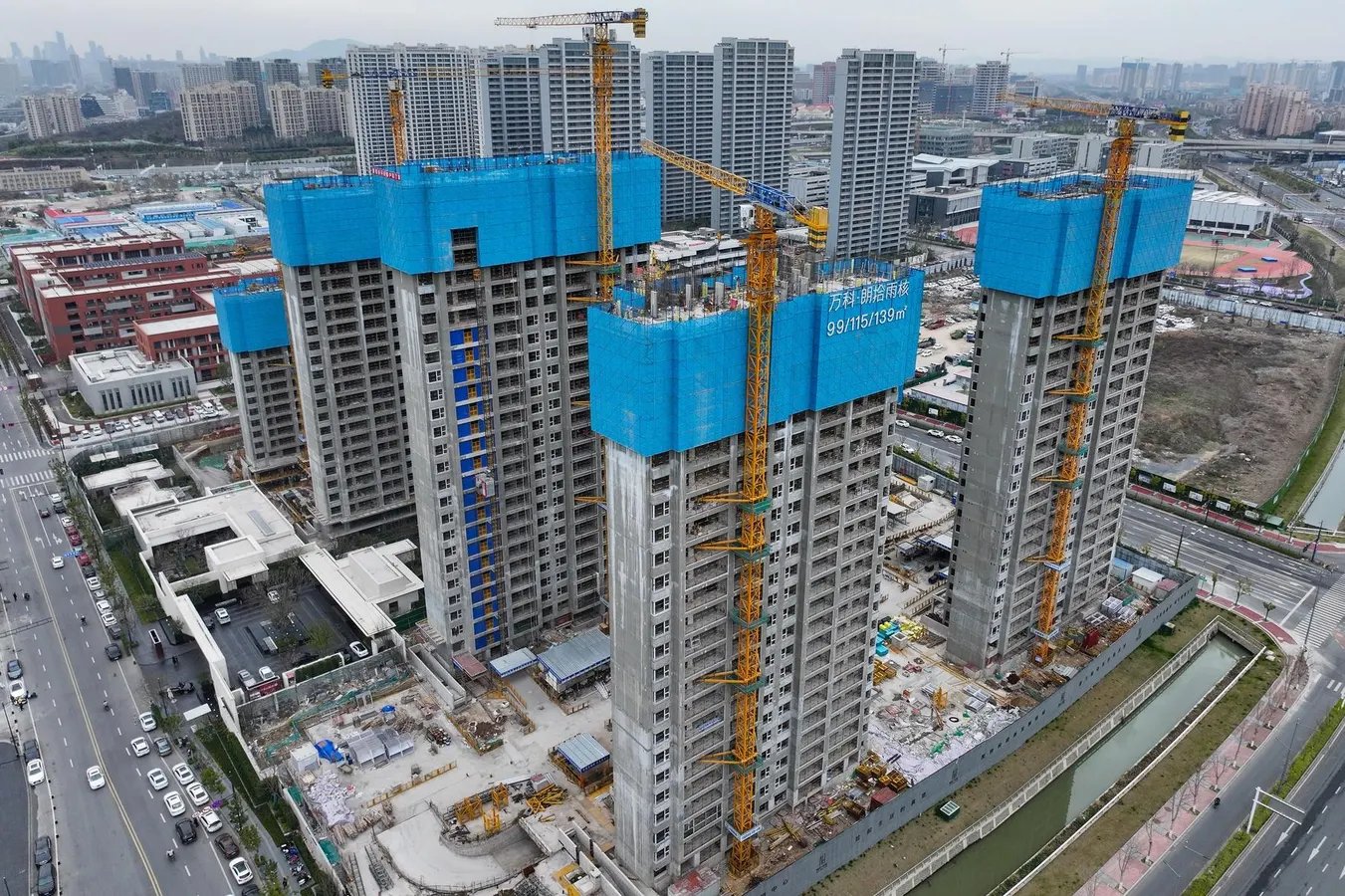
A Vanke property under construction is seen in Nanjing, Jiangsu province, China, March 18, 2024.
CFOTO/Future Publishing via Getty Images
It’s never a great day for Beijing policymakers when #ChinaEvergrande is trending. But here we are as giant developer China Vanke Co. shocks markets by proposing a delay in making a payment on a local bond.
Vanke is among the last few major developers to have avoided a default. The most famous such episode, of course, was Evergrande’s September 2021 reckoning that made China’s property crisis a global story. Investors haven’t viewed the $19 trillion economy quite the same since Evergrande missed two coupon payments on offshore bonds totaling $131 million.
Since then, President Xi Jinping’s team pledged countless times to stabilize property. The industry once generated one-third of gross domestic product. Yet solutions have been woefully inadequate to the task of stopping the financial bleeding.
It’s no coincidence that China is about to enter its fourth year of deflation amid weak household spending and business confidence. Nor is it a coincidence that the gap between China’s two different economies is widening.
One is the “new economy” China is building in real time. This is the buzzy one churning out tech success stories like electric vehicle giant BYD and artificial intelligence upstart DeepSeek. It’s the one where Jack Ma’s Alibaba Group is reinventing itself to disrupt the high-tech part of the economy.
These wins owe much to Xi’s 10-year plan to lead the future of EVs, aerospace, semiconductors, AI, renewable energy, batteries, biotechnology, green infrastructure, robotics, quantum computing and self-driving vehicles.
Yet this new economy is only as vibrant as the old one undergirding it. And this one has some serious problems, not least a property crisis that shows no sign of going away.
Team Xi also faces a slow-burning mini-crisis at the local government level. China’s 22 provinces are drowning in trillions of dollars of debt. Much of it is the off-balance-sheet kind that’s maddeningly difficult for the outside world to calculate and analyze.
Youth unemployment is dangerously high. The population is aging at an accelerating rate, which, as Japan demonstrates, is inherently deflationary.
And then there’s the Communist Party’s insistence on setting annual growth targets, a self-defeating exercise that warps all economic incentives. The way any regional official with national aspirations gets Beijing’s attention is by producing above-trend GDP year after year.
This explains why China has so many giant infrastructure projects, many of them unproductive and overlapping. They include massive apartment complexes across the nation that developers are struggling to complete. And, it follows, more debt than many of the biggest ones can service.
As 2026 beckons, it would be great if economists detected a change in strategy. A pivot toward a more productive and resilient growth model for the entire economy — not just the tech-driven one generating all the headlines.
In 2025, China did an impressive job navigating around the worst of President Donald Trump’s tariffs. Whereas Japan, South Korea and even the U.S. all suffered negative quarterly GDP here and there. China, by sharp contrast, seems on course to hit this year’s “around 5%” target.
Yet China’s ability to continue growing at a healthy rate is in question. It will require considerable heavy lifting to ensure the old economy doesn’t trip up the new one Xi hopes to build.