
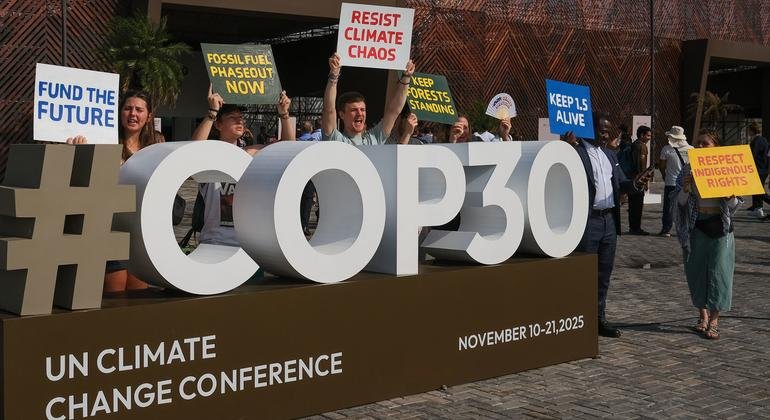
The final decision emphasizes solidarity and investment, setting ambitious financial targets while leaving energy transition language off the table. The burning of fossil fuels emits greenhouse gases that are by far the largest contributors to global warming, making this omission a point of concern for many nations, including negotiators from South America and the EU, as well as civil society groups.
This is the first COP held in the Amazon and the first since the UN warned that the record increase in greenhouse gas levels means it will be “virtually impossible” to limit global warming to 1.5 °C in the next few years without temporarily overshooting the Paris Agreement target.
A closer look
After two weeks of intense negotiations, the text calls for mobilizing at least $1.3 trillion per year by 2035 for climate action, alongside tripling adaptation finance and operationalizing the loss and damage fund agreed at COP28.
It also launches two major initiatives – the Global Implementation Accelerator and the Belém Mission to 1.5°C – to help countries deliver on their nationally determined contributions (NDCs) and adaptation plans.
For the first time, the decision acknowledges the need to tackle climate disinformation, pledging to promote information integrity and counter narratives that undermine science-based action.
Last week, Brazil’s President, Luiz Inácio Lula da Silva, opened the summit declaring it would be known as “the COP of truth,” and this decision marks a significant step toward safeguarding public trust in climate policy – even as the absence of fossil fuel transition language underscores the complexity of energy negotiations.
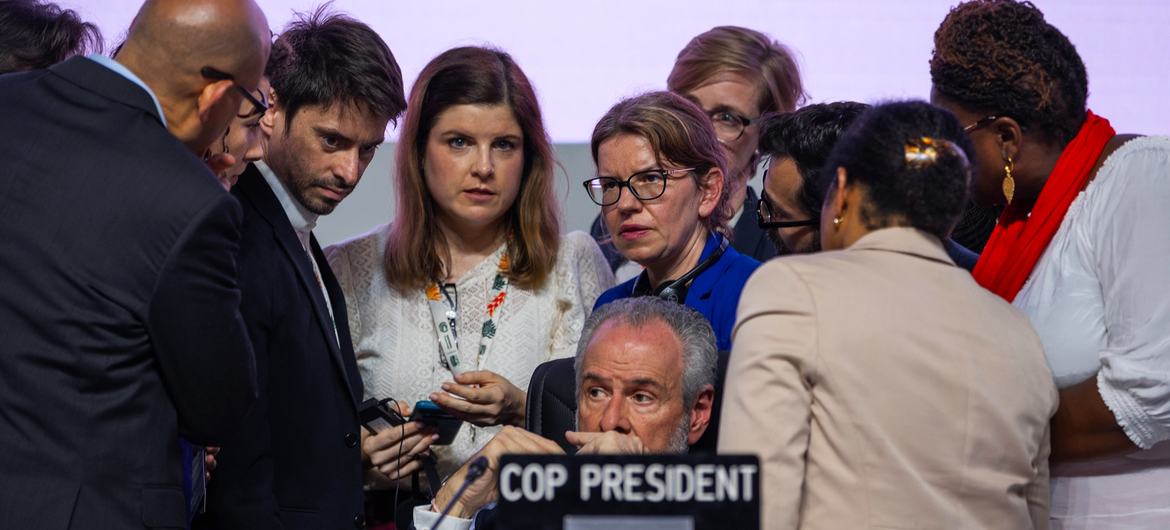
COP30 President André Corrêa do Lago (centre) confers with his team at the closing of the UN Climate Conference.
Two new roadmaps
In the closing meeting, COP30 President André Corrêa do Lago acknowledged what was left out of the deal:
“We know some of you had greater ambitions for some of the issues at hand,” he said, adding, “I know the youth civil society will demand us to do more to fight climate change. I want to reaffirm that I will try not to disappoint you during my presidency.”
Reflecting on President Lula’s call at the opening of COP30 for ambition, Mr. do Lago announced plans to create two roadmaps: one to halt and reverse deforestation; and another to transition away from fossil fuels in a just, orderly and equitable manner, mobilizing resources for these purposes in a “just and planned manner.”
The road to consensus
The road to consensus at the latest Conference of the Parties to the UN Framework Convention on Climate Change (UNFCCC), as the annual COPs are formally known, was anything but smooth.
Earlier this week, Indigenous groups staged blockades demanding stronger protections for the Amazon, and late Thursday afternoon, a fire in the main conference hall disrupted talks during a critical phase.
Negotiators worked through the night on Friday – to bridge gaps on finance and ambition, with Brazil’s presidency steering discussions toward a politically workable outcome focused on support and implementation of agreements from past COPs.
‘Multilateralism is alive’
From the G20 Summit in Johannesburg, UN Secretary-General António Guterres sent a clear message to COP30: At the gateway of the Amazon, Parties reached an agreement that shows nations can still unite to confront challenges no country can solve alone.
The UN chief said that COP30 delivered progress, such as the launch of the Global Implementation Accelerator to close ambition gaps and reaffirmed the UAE Consensus, including a just, orderly and equitable transition away from fossil fuels.
“But COPs are consensus-based – and in a period of geopolitical divides, consensus is ever harder to reach. I cannot pretend that COP30 has delivered everything that is needed.” Overshoot of 1.5°C is a stark warning: deep, rapid emission cuts and massive climate finance are essential. “COP30 is over, but the work is not,” he said.
The UN Secretary-General vowed to keep pushing for higher ambition and solidarity, urging all who marched, negotiated and mobilized: “Do not give up. History – and the United Nations – are on your side.
Holding the line at 1.5 in ‘turbulent geopolitical waters’
UN climate chief Simon Stiell pointed to a series of major gains as COP30 closed in Belém: new strategies to accelerate Paris Agreement implementation, a push to triple adaptation finance, and commitments toward a just energy transition.
And despite what he called “turbulent geopolitical waters” – marked by polarization and climate denial – 194 nations stood together, “keeping humanity in the fight for a livable planet, determined to hold the line at 1.5°C.”
At the heart of this momentum is COP30’s flagship outcome: the Mutirão text, a sweeping deal that bundles four contentious negotiation tracks – from mitigation to finance and trade barriers – into a single, consensus-based agreement. Seventeen additional decisions were adopted alongside it.
The final document declares that the global shift toward low-emissions and climate-resilient development is “irreversible and the trend of the future.” It reaffirms that the Paris Agreement is working – and must “go further and faster” – strengthening the role of multilateral climate cooperation.
The text also recognizes the economic and social benefits of climate action, from growth and job creation to improved energy access, security and public health. Stiell pointed to a decisive trend: investments in renewable energy now outpace fossil fuels two to one – “a political and market signal that cannot be ignored,” he said.
A robust action agenda beyond negotiations
The Brazilian Presidency underscored that COP30’s success extends beyond negotiated agreements, highlighting a wave of voluntary commitments under the Action Agenda.
Among them:
- Tropical Forests Forever Fund: Raised $5.5 billion and now includes 53 participating countries; at least 20 per cent of resources go directly to Indigenous Peoples and local communities.
- Belém Health Action Plan: The first global initiative targeting climate-related health threats, launched with $300 million from 35 philanthropic organizations.
- UNEZA Alliance: Public utility companies pledged $66 billion annually for renewable energy and $82 billion for transmission and storage.
- Cities, regions and companies: A coalition spanning 25,000 buildings reported cutting over 850,000 tons of CO₂ in 2024.
Climate justice at the forefront
Countries also agreed to develop a just transition mechanism, enhancing cooperation, technical support and capacity-building.