
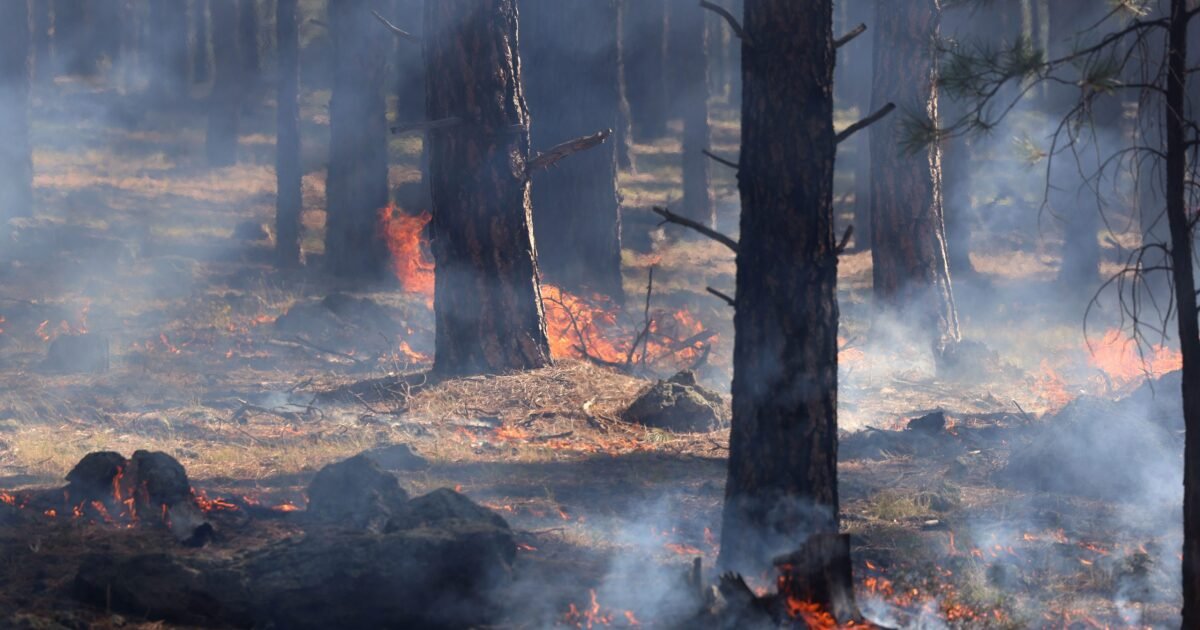
A new Arizona law protects utilities who start wildfires from a certain amount of liability.
The bill as it was originally introduced would have almost entirely protected utilities that get sued for starting wildfires, but it was opposed by insurers and trial lawyers.
Democratic Gov. Katie Hobbs signed a watered-down version of HB2201 this week. It requires utilities to submit plans for review every two years showing how they work to mitigate wildfire risk.
Lobbyist Marc Osborn represents insurers who opposed the first version of the bill.
“The bill is in a much better state than it was when it was introduced, the key is whether or not the plans that are approved by the Department of Forestry are robust and are protective of Arizona,” Osborn said.
“Greater oversight and regulation of utility wildfire mitigation practices will improve grid reliability and make the communities served by electric utilities safer as wildfire risks continue to grow. The law also clarifies what is expected of utilities in Arizona when it comes to wildfire risk mitigation. Additionally, HB2201 provides important clarity around how liability for wildfire-related losses will be imposed and helps protect customers from bearing the costs of business-halting liability arising from meritless lawsuits,” APS spokesperson Jill Hanks said in an email.
The bill establishes that a utility following an approved plan is deemed to have met the standards of care for a prudent entity, unless there’s clear and convincing evidence the utility engaged in misconduct.
Sierra Club Grand Canyon Chapter Director Sandy Bahr says HB2201 started out as a “terrible bill” and ended up as a “bad bill.”
“The bill the way it was originally introduced seemed like a blank check for negligence, and really beyond for the utilities, because it would have been impossible to hold them accountable for really any wildfire,” Bahr said.
Hobbs also signed a controversial bill backed by APS clearing the way for utilities to use a financing measure called securitization even though environmental groups, renewable energy advocates and some fellow Democrats called on her to veto the bill.
Both Osborn and Bahr say there aren’t many details in the law about what utilities need to include in their plans. It’ll be up to the state Department of Forestry and Fire Management to determine whether utility plans meet their requirements.
The Sierra Club opposed both HB2201 and HB2679.
House Bill 2679 allows utilities to transfer debt into low-interests bonds, which critics say will shift the responsibility to cover bad investments onto ratepayers.
APS representatives lobbied for the bill, arguing it will actually insulate ratepayers from costs associated with natural disasters and changing federal regulations.
“Cost of goods and services, inflation and pocketbook issues are all top of mind for our customers and your constituents,” APS lobbyist Michael Vargas told lawmakers. “Securitization is a cost-saving, win-win scenario for our customers.”
The Arizona Capitol Times reported that APS wrote the bill language before providing it to Rep. Gail Griffin (R-Hereford), who sponsored the legislation.
APS representatives also argued it gives utilities a tool to divest from inefficient power plants while giving them the financial flexibility to invest in more-efficient alternatives.
Jeff Allman, an APS attorney, said APS projects securitization would help the utility save money for ratepayers when it divests from the Four Corners coal power plant in 2031.
“Whereas, without securitization, customers don’t fully realize the benefit of having a more cost-effective resource in play,” he said.
But critics argued the new law will effectively prolong the use of inefficient power sources like Four Corners by making it easier for APS to sell those assets to new owners that will keep operating them.
“We know this bill enables APS to sell the Four Corners coal plant and securitize the transaction – effectively extending the plant’s life beyond 2031, in direct contradiction to APS’s own 2020 clean energy commitment,” Autumn Johnson, executive director of the Arizona Solar Energy Industries Association, said in a statement. “Doubling down on coal, when far cheaper options like solar are available, is a terrible deal for Arizona’s economy and our clean energy future.”
Sen. Lauren Kuby (D-Tempe) said the bill should have included a provision requiring securitized assets to be sold off “as has been the case in many other states where securitization has worked.”
Critics also argued the bill did not include enough protections to ensure that ratepayers aren’t saddled with monthly charges to pay off debt resulting from poor utility investments.
And then there is the question of whether HB 2679 violates the state Constitution by infringing on the power of the Arizona Corporation Commission, the elected body that regulates public utilities in Arizona.
Arizona Attorney General Kris Mayes, a former member of the Arizona Corporation Commission, wrote a letter to lawmakers in April arguing the bill “unconstitutionally intrudes on the Corporation Commission’s … exclusive ratemaking authority and because it disincentivizes utility spending discipline.”
The Corporation Commission’s five members, who are all Republicans, also directed staff to send a letter to lawmakers in February expressing similar concerns over an earlier version of the bill.
The legislature ultimately added provisions giving the commission some oversight over the process and requiring that the commission approve securitization requests that “will result in lower costs to the applicant’s customers on a net present value basis as compared to other financing options that are available to the applicant.”
Hobbs signed the bill, calling it a “middle of the road” solution that will save Arizonans money.
“HB2679 will lower costs for everyday Arizonans, improve grid resiliency by growing our energy economy, and ensure utilities are being held accountable to deliver cost savings to Arizonans,” she said in a statement. “I heard the concerns from clean energy and consumer protection advocates who opposed the original version of this bill, and I made it better.”
The signing came shortly after Capitol Media Services reported that Hobbs’ campaign received a previously undisclosed $100,000 donation to its legal defense fund from APS.
Critics said HB 2679 is proof that the governor is too deferential to the utility.
Bahr said it wasn’t really a surprise that the governor signed HB2201, but signing the bills back to back was a blow to the Sierra Club.
“Two huge gifts to utilities in two days? Just really outrageous and that is the big concern you don’t have the elected officials who are supposed to be looking out for the public standing up for these monopoly utilities,” Bahr said.
She added that utilities have a lot of influence.
“They’re very good at spreading their dollars around or I guess our dollars around, but they definitely have a lot of political influence at every level of government, and they give a lot of contributions,” Bahr said.
Hobbs told KTAR that “one thing has nothing to do with the other.”
“I always act on legislation in ways that I think is in the best interests of the state,” she said.
Christian Slater, the governor’s spokesman, pointed out that the bill passed the Legislature with bipartisan support in both the Arizona House and Senate.