
Few things have made Bassam Abdullah smile over the past year. The 60-year-old has mourned the loss of loved ones, the destruction of his property, and dodged death alongside his children and grandchildren in the Gaza strip. But when he walked through his farmland in Khan Younis in early October, he felt genuinely happy. Among the rows of trees dried out by lack of irrigation, he found a few dozen that had produced the fruit most beloved of Palestinians: olives.
Despite the poor condition of the fields and the fear of being bombed, he encouraged his four children and grandchildren to go and collect them. “It is less than a quarter of our annual production, but these trees are alive,” says Abdullah proudly. “They are alive and bearing fruit even though we have not been able to water them for a whole year, and despite everything they and we have been through.”
The relentless bombardment of the entire Strip since October last year, coupled with the destruction of 70% of the arable land and massive population displacement, has deprived Gaza’s 2.3 million inhabitants of their own food production, essential for their survival. According to a recent report by the Gaza Ministry of Agriculture, the two million olive trees that were planted on more than 50,000 square meters across Gaza have been reduced to less than 380,000 trees on 9,500 square meters, while the rest have been razed and destroyed. According to the same report, olive production has dropped from 40,000 tons to just 7,500.
Hence Abdullah’s joy at seeing that his land was not dead and that his trees continued to bear fruit. “Olive trees are like us: resilient and with deep roots in this land,” he says.
In addition to their importance for food, olive trees hold a very important cultural and traditional value for the Palestinian population. Subjected to an Israeli blockade since 2007, which means that nothing and no one can enter or leave Gaza without Israeli permission, many inhabitants of the Strip were engaged in agriculture and the olive tree has been a reliable crop that has been passed down from generation to generation. In addition, it is an environmentally friendly crop and its fruit, essential in Palestinian food, is in great demand.
That’s why the months of October and November, when the olives are harvested, are always a time of joy. Landowners like Abdullah hire other farmers to help them pick the fruit, which creates more job opportunities. “My cousins would come to help with the harvest and then we would go to their lands to help them with theirs. The produce from all the farms would be mixed together and we would taste the richness and variety of the oil we produced,” he recalls, as his experienced fingers pull at the olives.
Abdullah has followed these traditions for as long as he can remember: the sweet mint tea brewed over open fires, next to the bread baking; the dozens of rotating and rumbling presses to squeeze the harvest into aromatic oil to be savored with warm bread. This year, for the second season in a row, there were no parties or family gatherings and his trees produced 1.5 gallons of olive oil, compared to the usual eight gallons, but the farmer is grateful. “These olives are a reminder that this is our homeland. I have prayed hard for this carnage to end now and for us to be able to enjoy these days again, but I am grateful to have come this far and to witness this,” he says.
More than 42,000 Palestinians have been killed since Israeli airstrikes on Gaza began in October 2023, according to figures from the health ministry in the Strip, which is controlled by the Islamist Hamas movement, in power since 2007. The offensive against Gaza began after Hamas-led militias carried out attacks in Israel in which 1,200 people were killed and more than 200 were taken hostage.
“Our roots are in these trees”
The Israeli army razed the 2,000-square-meter farm owned by 76-year-old Omran Suleiman in central Khan Younis, turning it into a mountain of broken trees piled up on his land. “Losing these olive trees is a confirmation of what we already know: our uprootedness and our helplessness. Seeing my olive trees is a heartbreaking feeling of loss of hope,” says the elderly man, who lives with his children and grandchildren in Al Mawasi, one of the areas declared safe by the Israeli army in south-central Gaza. “Our roots are in these trees and what they mean. It is very sad,” he adds.
Suleiman speaks fondly of the tradition of “crushing olives between large stone slabs and tasting the first spurts of oil, or pickling them in jars with salt, pepper and lemon to cover a family’s needs for a year […] I miss the smell of the oil coming out of the press, and the act of lighting the wood fire and warming the bread to taste the oil immediately after pressing it,” he adds. For him, the olive tree “represents the steadfastness of the Palestinians and symbolizes the land.” “These trees are part of our heritage and our homeland, which has been stolen from us for decades. It is much more than the economic value they may have,” he says.
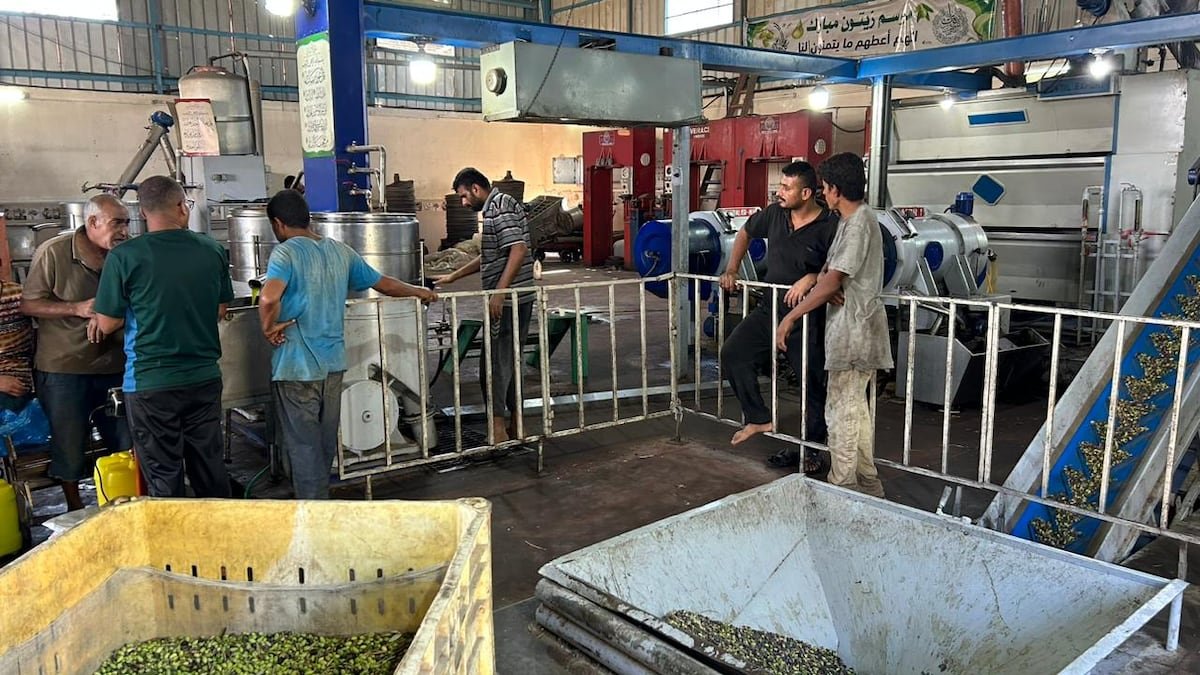
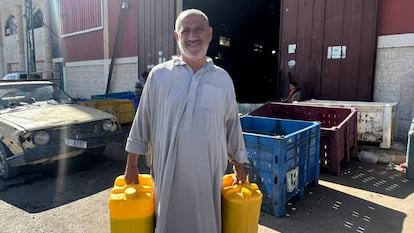
Meanwhile, at the Tal el Zuhur olive oil mill, one of six operating in Gaza out of the 40 that existed before the war, farmers lucky enough to have an olive harvest gather together and pour their meager production into the automated machine. Humud Dallul, the owner of the press, says that operating costs have multiplied because they depend on diesel, which they buy at over $16 per liter, in addition to maintenance and other expenses. “Previously, pressing a liter of olive oil cost between 1 and 2 cents, but now it costs 3 cents. We also received up to 100 tons of olives a day. Now we don’t get more than 20 tons to press,” he explains to this newspaper.
Watching the machines rotate, a palpable excitement grips the crowd, young and old, crowded around the press. Owda al-Aqluk, 15, watches the containers as they fill with oil, inhaling the rich, earthy aroma, his eyes fixed on the scales to make sure they do not exceed 16 liters per container. He says the yield on his family’s farmland in Deir el-Balah in the center of the Strip has dropped from 540 kilos to 310 kilos because they have been unable to irrigate it due to the high price of diesel.
“But we are glad we got this. I can’t wait to go home with these full containers and see how happy my mother and brothers will be,” he said. “They were already crazy when they heard that our olives had survived.”
Sign up for our weekly newsletter to get more English-language news coverage from EL PAÍS USA Edition