

Electrification is the umbrella term for transitioning to electricity in all possible applications to reduce greenhouse gas emissions. Dozens of cities and states have embarked on policies to limit fossil fuel use in new residential buildings. However, electrification increases electricity demand, especially in critical peak periods where many electric grids are already under stress. This complicating factor looms large given recent unprecedented forecasts of future electricity demand growth because of increases in the number of new AI-related data centers and new manufacturing plants.
According to Wells Fargo, U.S. electricity demand could increase by as much as 20% by 2030. By comparison, electricity demand increased by only 1.6% over the last decade. This huge electricity demand surge is causing utilities and grid operators angst across more than a dozen states resulting in delayed decommissioning of coal generation and the addition of gas-fired peaking units to provide power during peak periods — for example, 5 p.m.-9 p.m. in the summer.
These developments prompt a number of questions, including how much will electrification policies reduce greenhouse gas emissions, how much will they increase peak electricity demand, and should electrification initiatives continue in light of this cost/benefit calculation and unexpected generation and transmission challenges. If such initiatives should continue, what strategies can achieve electrification objectives without imperiling the ability of utilities to provide electric power to their customers. A balanced strategy must also consider customer cost impacts — a sensitive issue considering that electric costs have increased by more than 20% over the last three years.
A recently completed study based on analysis of 18,400 U.S. households shows that while residential electrification reduces national greenhouse gas emissions overall, emissions and peak demand impacts vary considerably from state to state.
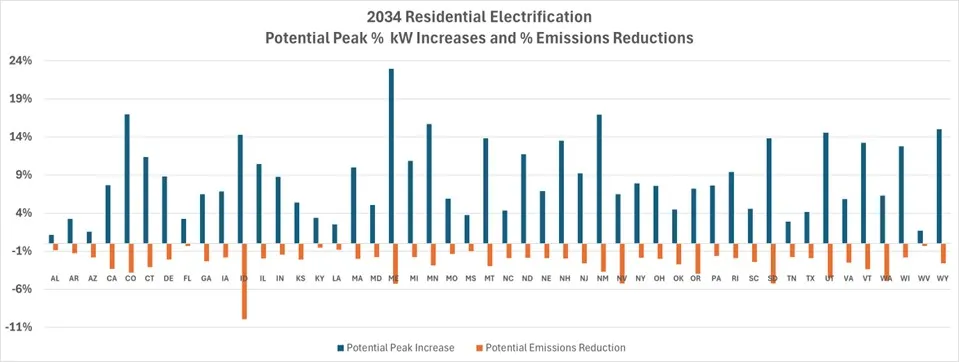
The chart below shows potential percentage increases in peak period kW demand and reductions in greenhouse gas emissions based solely on maximum residential electrification for new dwelling units over the next decade. This “technical potential” analysis is traditionally applied in policy analysis to evaluate costs and benefits that would result if programs were universally adopted. From that baseline, one can adjust results for program adoptions less than 100%.
Permission granted by Jackson Associates
This electrification scenario shows relatively modest state residential emissions reductions for most states with only four states reducing emissions by more than 5% over the decade. Emissions reductions depend on expected growth of residential dwelling units over the next decade and the extent to which the new housing stock relies on electric space heating and water heating. For example, emissions reductions in California and New York, two states that are most active in promoting residential electrification are likely to reduce emissions by only 3.3% and 1.8%, respectively, with peak demand increases of 7.7% and 7.9%, respectively, on top of already strained electric grids. Total number of household growth rates in these states over the next decade are 6.6% and 4.1%, respectively, compared to a 9.1% state average across the country.
Electrification-driven increases in peak demand will not be a significant factor in electric utility peak capacity expansion for about one-third of states, according to the study. For example, Arizona can proceed with aggressive electrification policies reducing residential emissions by 1.8% while increasing electric peak demand requirements by a barely noticeable 1.5% over the decade.
But aggressive electrification programs are likely to cause serious peak demand issues in at least seventeen states. For example, Colorado could reduce residential emissions by 3.8% but would require 17% more peak generation.
To meet these challenges, individual states can develop “smart” electrification strategies that match electrification peak demand impacts with distributed resource peak reduction programs such as smart communicating thermostats and water heater controls, peak period pricing, etc.
Smart electrification means anticipating unintended peak demand impacts of electrification initiatives. A recent Cornell University study identified a potential issue with an increasing number of electric space heating units controlled with smart thermostats as they transition from night setbacks to daytime settings. Smart thermostats are universally promoted for their energy cost savings; however, initial heating loads can easily be twice the maximum daytime loads and the setback to daytime transition can be expected to occur at roughly the same times for most households. This issue can be addressed with a utility communicating programmable thermostats program that can stagger the night setback settings under utility control in exchange for billing credits.
Great River Energy, a Minnesota wholesale electric power cooperative providing power to 1.7 million people, provides an example of a utility doing all the right things to offset peak grid stress with customer demand management programs. Great River’s peak reduction control programs include air conditioning cycling and interruptible water heating which are traditional demand management programs. Great River also has electric thermal storage water heating systems for large water heating tanks (100+ gallons) and thermal heating systems that recharge only overnight freeing capacity during the day. An EV time-controlled charging system rounds out the distributed resource management system.
A smart electrification strategy can achieve a balanced approach to electrification limiting grid stress and residential price increases. States with more aggressive electrification targets can incentivize utilities, demand response aggregators and individual households to encourage uptake of residential distributed resources. By focusing on distributed resources, utilities will also avoid overloading individual distribution feeder circuits and expensive circuit upgrades that might otherwise be required.