

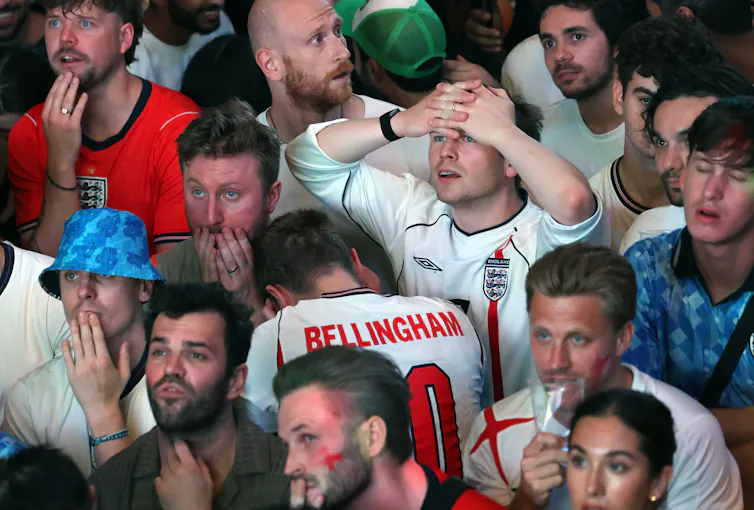
On July 15 2026, England were just five tantalising minutes away from their first men’s World Cup final since 1966. But that was before Argentina scored two goals to claim victory in stoppage time.
The next morning, the professional reputation of England’s head coach Thomas Tuchel had taken quite a hit. So too had the London stock market, which dipped by 0.5% shortly after opening.
Could the two events be connected? Can the stock market really be affected by something as irrelevant as a football result?
Yes it can. Research I conducted with colleagues found that after a national football team lost, its country’s stock market tended to fall on the next day of trading.
Looking at 1,162 international football matches featuring 39 countries, we found that the effect grew with the perceived importance of the match. It was stronger in the World Cup than the European Championship, and stronger in the elimination stages than group games.
After a country is knocked out of the World Cup, its national market drops by an average of 0.5% the next day. Applied to England’s FTSE 100, that’s over £13 billion lost.
All of this provides insight into what really drives financial markets. The traditional view is that markets reflect hard numerical facts – profits, inflation and interest rates – which traders analyse with laser-like precision and ice in their veins.
But our research shows that they’re also influenced by sentiment: emotions, hype and animal spirits.
That’s the idea behind “behavioural finance”, for which Robert Shiller and Richard Thaler won Nobel prizes for economics. To understand financial markets, we need to understand human behaviour.
This opens the door to a host of other inefficiencies. If the market responds to something as irrelevant as a football match, what else might it overreact to?
That’s what I explore in my new book, The Madness of Markets. Looking at other ways in which psychology drives stock prices, I found that the biggest edge does not always come from knowing more. Sometimes it comes from staying cool and, if you’re brave enough, taking the other side.
One factor that may cause the market to overheat is a rebrand. On April 15 2026, the company Allbirds, a manufacturer of wool trainers, announced that it was becoming “NewBird AI”. Its shares jumped 582% in a day, even though Allbirds had no clear expertise in artificial intelligence.
The dotcom bubble produced the same trick. A study of 95 companies that added “.com”, “.net” or “Internet” to their names from 1998 to 1999 revealed that they enjoyed an average stock price boost of 74%, even when nothing else changed.
Chasing trends
Markets also overreact to old news. On May 3 1998, the New York Times featured a report of a potential cancer treatment breakthrough on its front page. The next morning, shares in EntreMed – which produced the drugs – opened at US$85 (£64), up from US$12 (£9). But the same breakthrough had been reported five months earlier, including by the New York Times itself. Investors were getting hyped up about something they already knew.
And sometimes the news is real, but the extrapolation is wild. Like the calls for Tuchel’s sacking after one defeat, investors often overreact to small bits of information.
The lockdown clearly benefited Zoom, but did it justify its shares soaring over 700%? Rivals such as Microsoft Teams and Google Meet quickly caught up, the world reopened, and people remembered that they quite liked meeting in person. By the end of 2022, Zoom had surrendered almost all its gains.
EPA/ANDY RAIN
The best part of this madness is that investors can exploit it, by keeping calm and taking the other side. One of Thaler’s studies sorted US stocks into winners and losers based on their past three-year performance.
But over the next three years, the losers out performed the winners by 25% – a full-blown reversal of fortune. And this pattern is everywhere.
It’s been replicated in 22 other countries, from Austria to Australia, and in bonds and currencies as well as stocks. One paper even went back to 1265, the year of the first English parliament, when people traded barley, cheese and eggs. Over a 750-year period, a strategy of buying commodities with poor recent performance and selling past winners earned an astonishing 13% per year.
The remarkable consistency of these findings points to a common driver: investor psychology. From medieval barley merchants to Gen Z stock traders, people spot trends and chase them too far.
So the lesson is not to bet against the FTSE every time England lose. It is to ask, whenever a market lurches, what changed in the business – and what changed only in investors’ heads?