
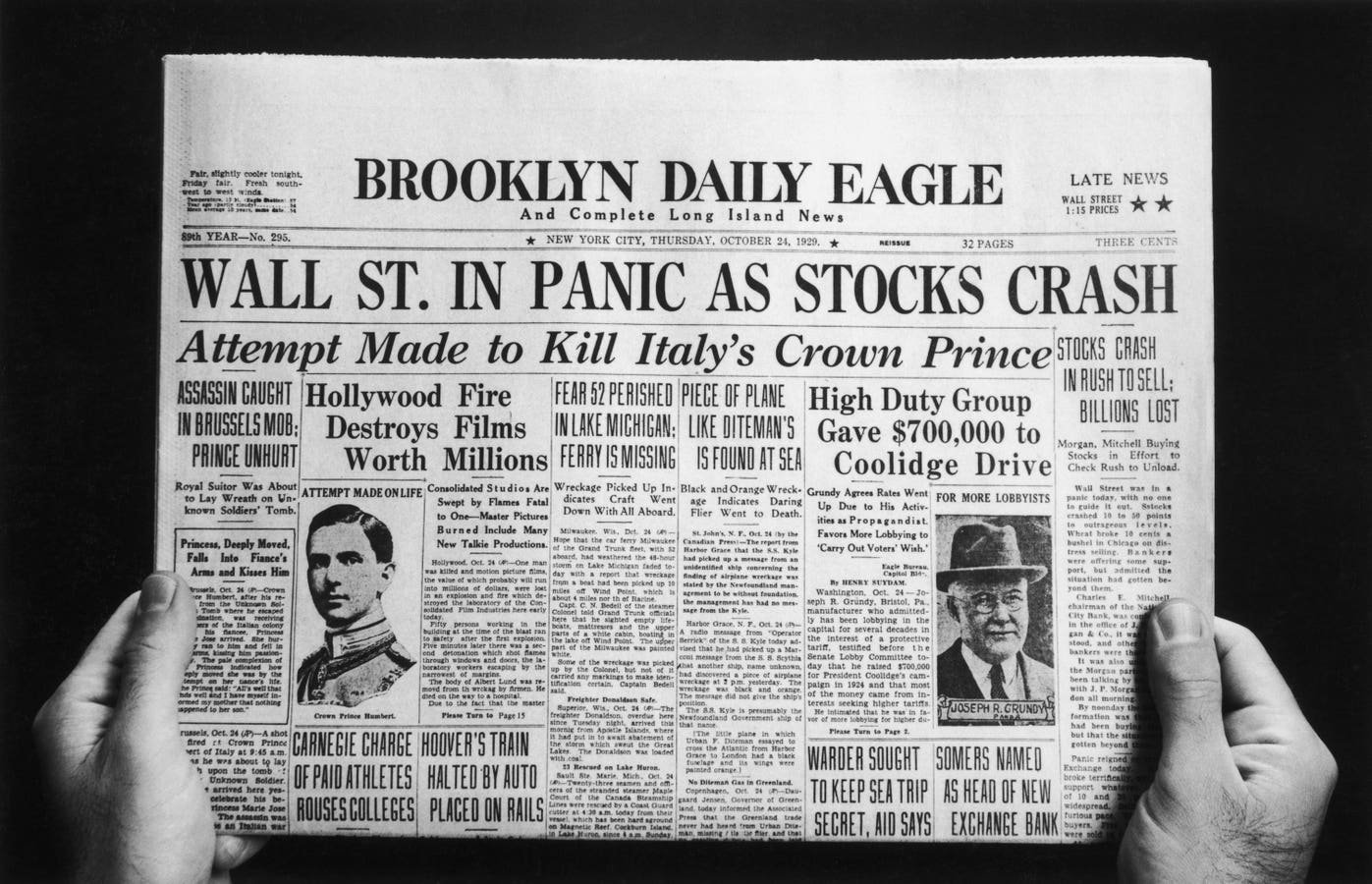
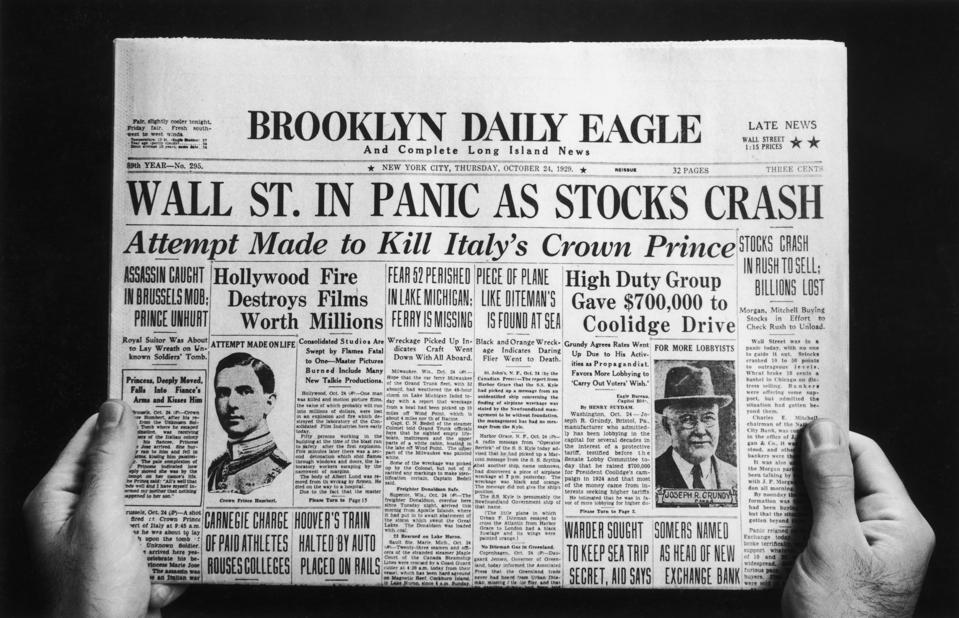
The front page of the Brooklyn Daily Eagle newspaper with the headline ‘Wall St. In Panic As Stocks Crash’, published on the day of the initial Wall Street Crash of ‘Black Thursday’, 24th October 1929. (Photo by FPG/Hulton Archive/Getty Images)
Getty Images
I’ve spent a bit of the summer re-reading the work of Charles Kindleberger, an important economist whose career intersected monetary systems and stock market bubbles, two issues that are top of mind for investors and economists today (see last week’s note ‘Stable Genius’).
Kindleberger had an interesting career. His PhD advisor at Columbia was Henry Parker Willis (a key architect of the Federal Reserve Act in 1913 and the first Secretary of the Federal Reserve Board that became what we now know as the ‘Fed’). Then in one of his first jobs at the US Treasury, Kindleberger worked for Harry Dexter White, the interlocutor and ‘rival’ of JM Keynes at the Breton Woods conference.
To that end, Kindleberger had a very strong sense of the creation of the monetary infrastructure that has built today’s economic world, and he then had the opportunity to play a role in this as one of the architects of the Marshall Plan, which did so much to spur growth in post-war Europe and to cement the view of the USA as the benevolent world power. Benn Steil’s book ‘The Marshall Plan: The Dawn of the Cold War’ is worth a read.
Beyond his policy work, Kindleberger is best known for ‘Mania’s, Panics and Crashes’, the best outline of how asset bubbles form and are followed by crashes.
It is highly pertinent today because a variety of stock market valuation indicators (the long-term ‘Shiller Price Earnings ratio’, the ‘Buffet Indicator’ as well as measures of market concentration – the largest ten stocks account for 75% of the entire market), point to the kind of market behaviour seen only in market bubbles (like 2001). Consistent with this, various investors, as well as entrepreneurs like OpenAI’s Sam Altman are warning of a ‘bubble’.
One test of the bubble thesis is to follow Kindleberger’s theory that asset price bubbles follow a common speculative cycle. According to Kindleberger, bubbles often start with an innovation – in a technology (i.e. railways) or a financial policy or market structure, or even a growth ‘miracle’ (note all the Tiger economies from Hong Kong to Ireland have seen boom/bust cycles) towards which investors channel capital, and then even more as asset prices rise and a narrative around the ‘mania’ begins to build.
This effect helps to loosen the strings of the overall economy and financial sector, but around this point asset prices are reaching incredulous levels as investor euphoria intensifies, drawing in further speculation, until prices then turn down, and the house of cards collapses in a crash. The collapse is always greater when households, institutions and individuals have borrowed on the back of high asset prices, and logically there is greater contagion across the economy.
One lesson from the Kindleberger book is that ‘new’ things – inventions or economic policy liberalizations often provide the spark for a new speculative bubble, that can grow and destabilise a financial system if enough speculative capital is driven towards it.
AI is a case in point. For context, Morgan Stanley estimates that over USD 3 trillion will be invested in AI related infrastructure (data centres, energy), with about half of that coming from the cashflow of the large technology companies, and the rest from private credit. It is clear that the large technology firms (from Microsoft to Nvidia) are the driving force behind this boom, especially so in the context of the fiscal weakness of most Western governments.
The recent results season was instructive in this respect. Often in a bubble, the dot.com one being a good example, the earnings associated with the bubble are only ‘prospective’ or somehow inflated. This is not the case with the large technology firms so far – by and large they report very strong earnings, which helps to soften the bubble argument. The catch is the circularity of the capital expenditure by the large technology firms – META for example is spending aggressively on data centres and chips and running down its cash levels. To that extent, the large tech firms are making a bold bet to get ahead in the AI game, but it is a concentrated and possibly existential bet.
If the strong cashflow position of the firms at the centre of this bubble is unusual in the context of the Kindleberger framework, two other factors also stand out as untypical.
The first is that short- and long-term interest rates in the major economies are close to ‘neutral’, neither too hot not too cold. Bubbles are often characterised, or preceded by ‘easy money’, though it has to be recognised that the last decade has been one of near continual stimulus (from QE to fiscal spending).
The other unusual factor is that the stock bubble is occurring against a backdrop of intense geopolitical and economic policy uncertainty – from great power competition to an unravelling trade order to a reconfiguring of America’s role in the world. The one way in which these dislocations fit the bubble narrative is that AI is a strategic asset, a ‘must-have’, that leads to an environment where for example the US government aims to take a strategic stake in Intel.
Having written in early 2024 of a ‘Bubble Brewing’, I think we are now ‘in’ an AI centric market bubble, though not at the end of it in the sense of there being a ‘mania’ proper. In the short term, we might well see a wobble in AI stocks, before they pick up again.
In a future note I will detail my own experiences of the dot.com and European real estate bubbles, which lead me to think that ‘we are not there yet’ in terms of the evolution of this bubble. It will end with the absurd – Nvidia encroaching on a USD 10 trn valuation, food companies publicly adopting AI and seeing their values double, wild predictions that AI can treble productivity and wipe out the debt, and on the flip side, the structural risks to energy and jobs markets that AI could pose.
But, we are not there yet.
Have a great week ahead, Mike