
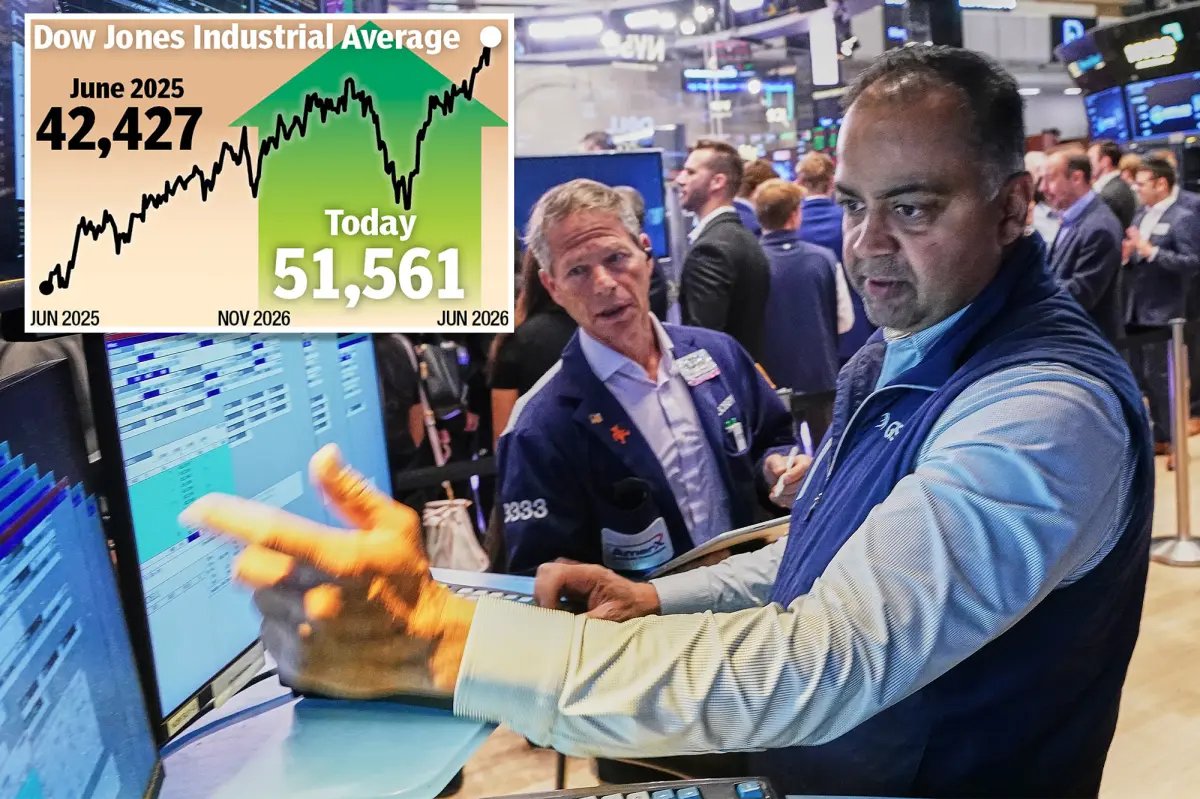
Americans have never had more riding on the stock market.
A record one-third of all household wealth in the US was tied to stocks at the end of 2025, according to Federal Reserve data — a sign that the AI-fueled bull market is showering investors with gains while leaving them increasingly exposed to a painful downturn.
Households and nonprofit organizations held $67.77 trillion in directly and indirectly owned equities at year-end, accounting for nearly 33% of total assets, according to the data highlighted by Axios.
The figure eclipses the roughly 30% peak reached during the meme-stock and SPAC frenzy of 2021 and tops the 27% level seen at the height of the dot-com boom in early 2000, the news site noted.
The surge has been fueled by a stock-market rally that added $10.31 trillion to household portfolios in 2025 alone, boosting equity holdings by nearly 18% in a single year.
“The willingness of households to hold a rising portion of their total financial assets in equities [has] made retail investors overall an important driver of the bull market in equities in recent years,” JPMorgan analysts wrote in a recent report.
The gains have been concentrated among the wealthiest Americans.
The richest 10% of households own roughly 87% of all stock-market wealth, according to Federal Reserve data, meaning the market’s boom has disproportionately benefited affluent investors while much of the country continues to grapple with elevated living costs and lingering inflation pressures.
As a result, wealthy households, buoyed by soaring portfolios, continue spending freely while many lower- and middle-income Americans report increasing financial strain.
That divide has contributed to what some economists describe as a “K-shaped” economy in which wealthy households get richer and poorer households decline.
The concentration of wealth in stocks also raises the stakes for investors. A sharp market reversal would wipe out trillions of dollars in paper wealth and could reverberate through consumer spending, retirement accounts and the broader economy.
“Wall Street and Main Street are telling two different stories right now,” Scott Martin, partner at Kingsview Wealth Management, told The Post.
“Wall Street sees record asset values. Main Street still sees affordability problems.”
That state of affairs has puzzled economists as unemployment remains low, economic growth continues and stocks hover near record highs.
“That disconnect helps explain why GDP can be growing, unemployment can be low, and markets can be near record highs while consumer sentiment remains surprisingly weak,” Martin said.
“People care less about what the Dow did today and more about what they’re paying at the grocery store, the gas station, and for their next insurance bill.”
Some market veterans see echoes of previous periods when a handful of stocks dominated investor portfolios.
“The higher concentration of ownership in equities is a bit of a worry,” said Derek Reisfield, co-founder and former chairman of MarketWatch.
“The ‘Magnificent Seven’ stocks [Apple, Microsoft, Amazon, Alphabet, Meta, Nvidia and Tesla] make up 34.8% of the S&P 500 today versus 29.1% five years ago.”
Reisfield pointed to some historical precedents.
“When we have had this kind of concentration — like during the internet boom or during the 60s ‘Nifty-Fifty’ era — it did not end well for those who were heavily invested in those stocks,” he said.
Still, Martin said the larger risk isn’t that average Americans have too much exposure to stocks.
“The biggest risk isn’t that every American is overinvested in stocks. The reality is that most Americans aren’t,” he said.
“The bigger issue is that so much of the nation’s wealth growth is now tied to the fortunes of a relatively small group of investors and a relatively small number of stocks.”
If markets were to reverse sharply, he added, the consequences would extend beyond wealthy investors.
“The direct financial hit would be concentrated among wealthier households that own most of the stocks,” Martin said. “But everyone would feel the ripple effects through lower confidence, slower spending and a weaker economy.”