

The U.S. stock market saw a sharp decline on the last day of October. While I plan to cover individual stock price trends and market supply-demand data in detail in tomorrow’s report, I would like to take this opportunity to quickly organize my thoughts on what is currently happening.
To state my conclusion first, I do not believe this stock market correction marks the collapse of the AI growth story. I believe that unexpected negative factors have coincided at a bad time, and because these issues are becoming intertwined, anxiety is inflating beyond the actual reality of the companies.
However, this earnings season has some characteristics that are slightly different from the past.
One is the anxiety that the spread of AI might cause cracks in the existing business models of strong companies that have dominated the market until now. I call this the “cracks in the strong.”
The second is the anxiety over whether companies can truly recoup their investments and sustain their businesses while massive investments in AI continue to swell.
And the third is anxiety regarding the supply-demand structure of the stock market. There is a rush of massive IPOs and capital increases by hyperscalers who had been pushing forward with share buybacks. Investors are feeling anxious about these structural changes.
I believe that to understand the current market, it is necessary to consider these three points separately.
1. Unexpected negative factors have coincided at a bad time
The U.S. stock market was very volatile on October 30th. The NASDAQ 100 fell 3.5%, Intel dropped about 29%, and SanDisk fell about 13%. Selling has spread, centered on AI-related companies, and it is no longer rare for stocks to fall 10% or 20% after earnings announcements.
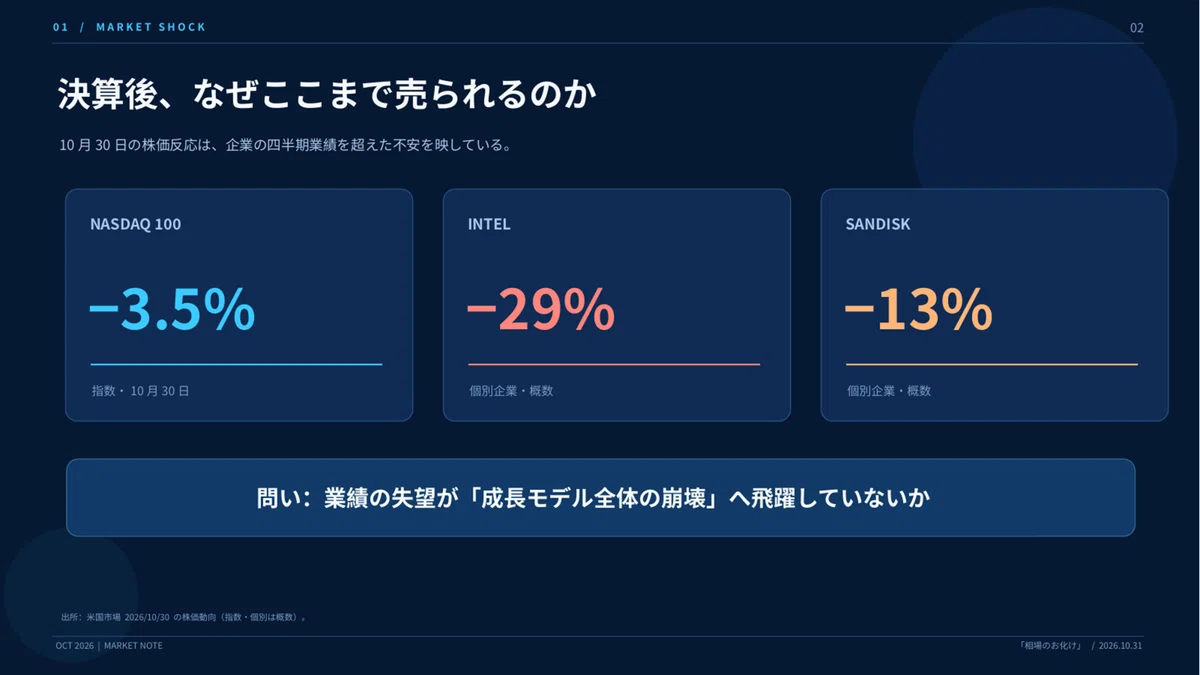
Watching the market this week, I feel that investor anxiety has become quite intense. Stocks are sold even on good earnings. They are sold even when capital investment is increased. Even when management shows a bullish outlook for the future, it is treated as a source of anxiety instead.
When things reach this point, negative factors can be found everywhere.
To begin with, the timing is bad. With the midterm elections approaching in the U.S. on November 3rd, there is strong uncertainty surrounding the shift in the balance of power in Congress and policy management after the election. The situation in the Middle East is also unstable, and concerns about high oil prices and inflation remain. Furthermore, with the large-scale IPO of Anthropic approaching, the market is also conscious of the demand for funds to absorb the supply of new shares. The massive capital investments and new fundraising plans of hyperscalers are also intensifying anxiety about the supply and demand of the stock market.
In this environment, unexpected disappointing news has emerged one after another from the earnings of giant tech companies. If it were just one company, it could be handled as an individual corporate issue. However, when negative news continues from different companies, investors begin to see them as manifestations of a single problem. Sluggish advertising growth, weak PC demand, massive FCF deficits, concerns about fundraising. Even though the circumstances for each are different, before we know it, it turns into a single narrative: “the strain of AI investment has surfaced,” “the AI growth story has begun to collapse,” or “will the social penetration of AI destroy existing business models?”
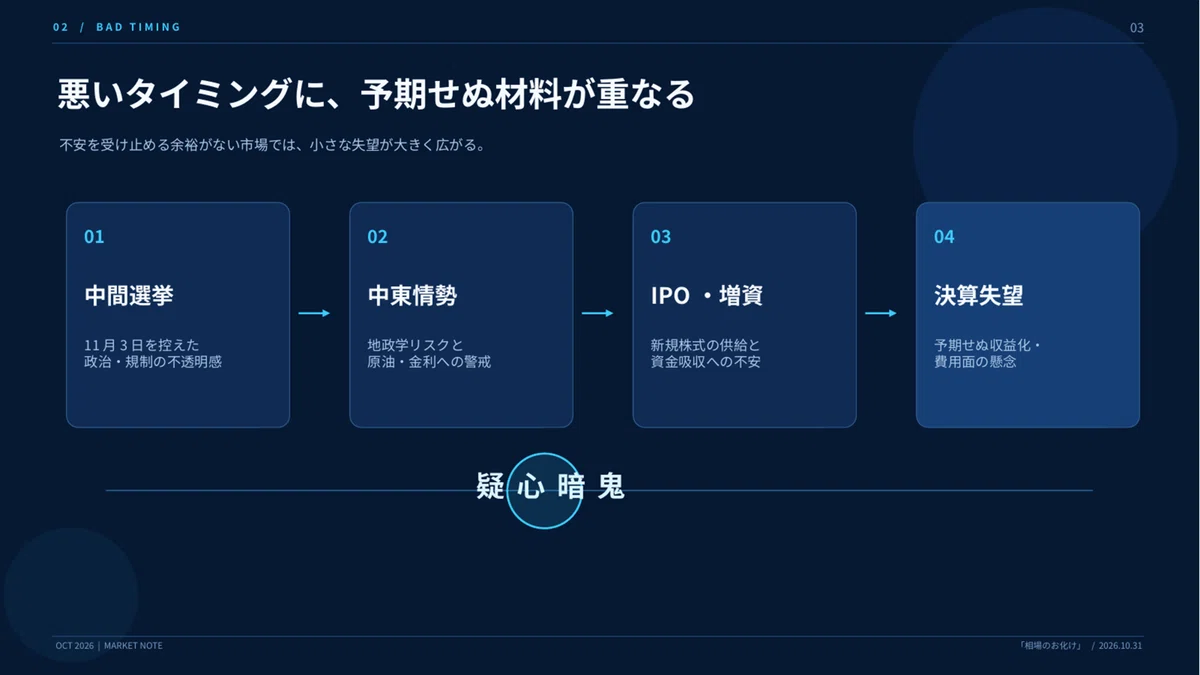
The troublesome part is that each of these concerns does indeed contain facts. However, the fact that individual concerns are correct and the idea that the grand pessimistic theory connecting them is also correct are two completely different things.