
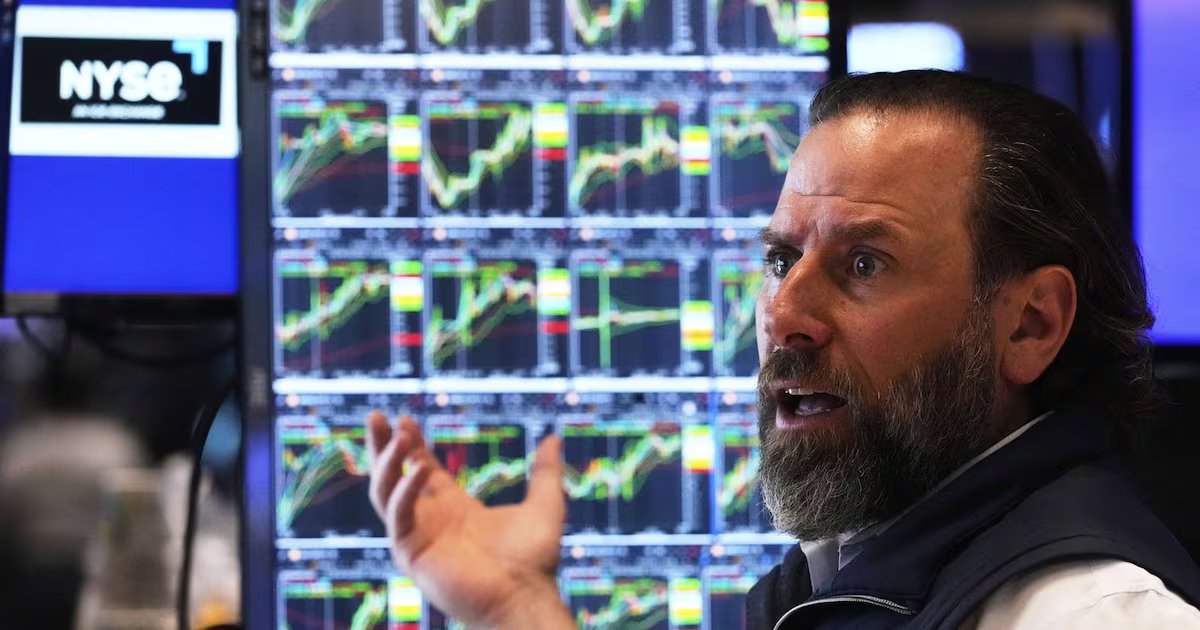
NEW YORK (AP) — U.S. stocks pulled back from their record heights on a shaky Wall Street Thursday following mixed profit reports from Tesla and other big companies. Oil prices, meanwhile, jumped on worries about what will happen next in the war with Iran.
The S&P 500 fell 0.4 per cent and halted a weekslong rally that had erased all its losses because of the war and then carried it to all-time highs. The Dow Jones Industrial Average dipped 179 points, or 0.4 per cent, while the Nasdaq composite dropped 0.9 per cent from its own record.
Tesla helped drag the market lower after sinking 3.6 per cent even though it reported better results for the latest quarter than analysts expected. Investors focused instead on a big jump in Tesla’s forecast for spending this year, as it builds factories to make robots and other products.
“You should expect to see a very significant increase in capital expenditures,” Elon Musk told investors late Wednesday, “but I think well justified for a substantially increased future revenue stream.”
ServiceNow dropped even more, 17.7 per cent, even though its results for the latest quarter matched analysts’ expectations. The company has been under pressure, along with much of the broad software industry, because of worries that rivals powered by artificial-intelligence technology could undercut its business.
In the oil market, prices leaped as uncertainty built about what will happen with the Strait of Hormuz. A ceasefire is still in place between the United States and Iran, but oil tankers in the Persian Gulf aren’t able to get through the narrow waterway off Iran’s coast and deliver crude to customers.
The U.S. military on Thursday seized another tanker associated with the smuggling of Iranian oil, a day after Iran’s paramilitary Revolutionary Guards took control of two vessels in the strait. President Donald Trump also said Thursday he ordered the U.S. military to “shoot and kill” Iranian boats that deploy mines to gum up traffic in the strait.
The price for a barrel of Brent crude to be delivered in June rose 3.1 per cent to settle at US$105.07 and at one point topped US$107. That peak coincided with a sudden drawdown for stocks, and the S&P 500 fell as much as 1.3 per cent before it almost as instantly erased half the loss.
The price for a barrel of Brent to be delivered in July, which is the more popular contract for traders, settled at US$99.35 after getting as high as US$101.
More expensive oil has hurt airlines in particular because of the industry’s big fuel bills, and stocks diverged in the industry following the latest profit reports.
American Airlines Group rose 2.4 per cent after reporting better profit and revenue for the latest quarter than analysts expected. American said demand was strong for flights, and it saw the nine best weeks for revenue intake in its 100-year history.
Southwest Airlines lost 4.1 per cent after reporting weaker quarterly results than analysts expected. It said it would not give an updated forecast for profit this year because of “the ongoing macroeconomic uncertainty.”
Also on the losing end of Wall Street was IBM, which sank 8.3 per cent despite reporting better profit and revenue for the latest quarter than expected. Investors focused on potentially discouraging numbers underneath the surface, including decelerating growth in trends for its software business.
Paramount Skydance fell 4.5 per cent after Warner Bros. Discovery shareholders approved selling the business to Paramount. Warner Bros. Discovery sank 1.6 per cent.
Texas Instruments helped limit Wall Street’s losses after breezing past analysts’ expectations for profit in the latest quarter. CEO Haviv Ilan said the semiconductor company is benefiting from growth led by industrial and data center customers, and its 19.4 per cent leap was the strongest force pushing upward on the S&P 500.
All told, the S&P 500 fell 29.50 points to 7,108.40. The Dow Jones Industrial Average dipped 179.71 to 49,310.32, and the Nasdaq composite sank 219.06 to 24,438.50.
In stock markets abroad, indexes fell across much of Europe and Asia. Hong Kong’s Hang Seng fell 0.9 per cent, and Japan’s Nikkei 225 sank 0.7 per cent for two of the bigger losses.
South Korea’s Kospi climbed 0.9 per cent after the government reported better-than-expected economic growth for the start of the year, boosted by strong exports, particularly of computer chips used in the AI boom. Semiconductor supplier SK Hynix said its revenue for the latest quarter jumped more than analysts expected largely because of AI-related demand.
In the bond market, the yield on the 10-year Treasury erased an early dip and rose to 4.32 per cent from 4.30 per cent late Wednesday as oil prices accelerated.
A report in the morning said slightly more U.S. workers applied for unemployment benefits last week, but the number is still at a historically healthy level. A separate, preliminary report on U.S. business output from S&P Global also suggested growth is improving a bit from its near-stagnation seen in March.
Stan Choe, The Associated Press. AP Business Writers Chan Ho-him and Matt Ott contributed to this report.