
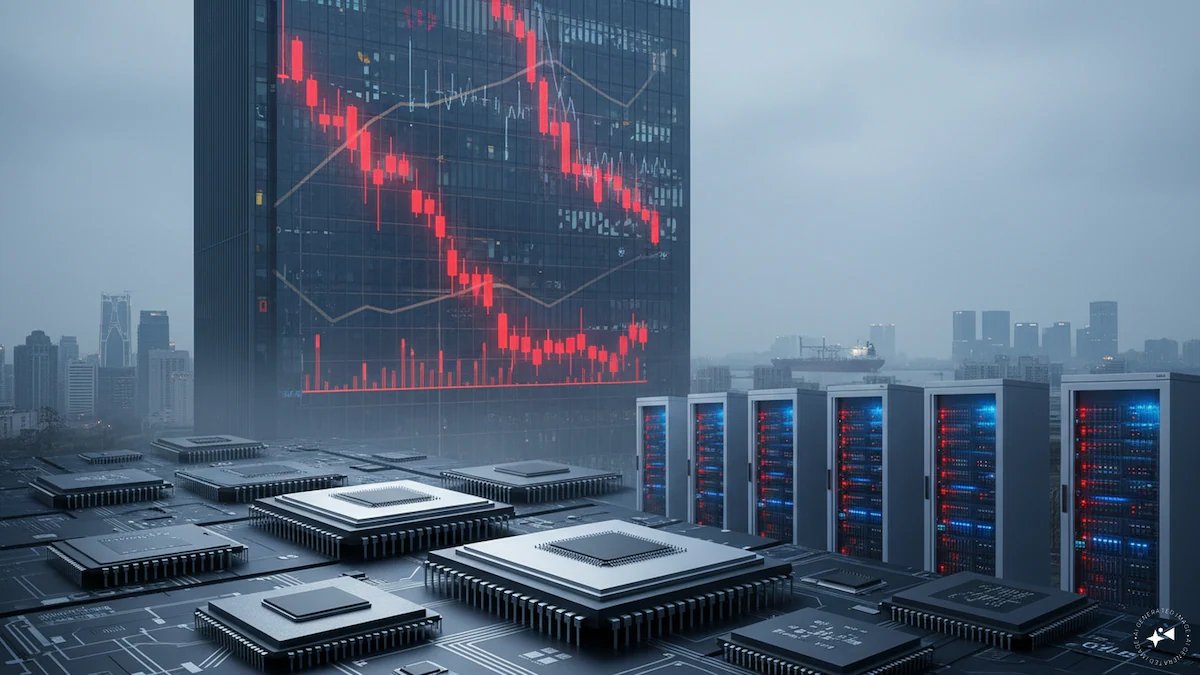
Asian equities fell on Friday October 30, as technology shares slid for a second straight session, and weaker than expected earnings from major US companies seemed to have pushed investors out of the artificial intelligence trade.
South Korea’s Kospi led the losses and closed 3.96% lower. Chip heavyweights Samsung Electronics and SK Hynix both declined, and the index is widely seen as a key barometer of AI-linked bets.
Taiwan’s TAIEX shed 3.19%, while Japan’s Nikkei 225 dropped 1.88% and the broader Topix slipped 0.61%. The MSCI Asia Pacific Index fell 0.3%. Hang Seng futures edged up 0.4%.
In India, the GIFT Nifty which indicates how the country’s stock market could open for the day’s trade predicted a muted start in the red. Indian benchmarks indices had ended Thursday’s session at the day’s high, with the Nifty gaining 238 points, or around 1%, to 22,937.
In currency markets, the yen weakened 0.1% to 157.87 per dollar ahead of the Bank of Japan’s rate decision. The central bank is widely expected to hold its benchmark rate on Friday and to signal that underlying inflation has finally reached its 2% target.
The offshore yuan barely moved at 6.6566 per dollar.
Wall Street offered little comfort as Nasdaq 100 futures fell 1.5% and S&P 500 futures lost 0.6%, which points to further pressure on US equities when trading resumes. The cash markets had already retreated on Thursday after the Nasdaq 100 dropped 1.4% and the S&P 500 lost 0.3%.
The Philadelphia Semiconductor Index fell 1.4%, one of the hardest-hit areas of the market. Alphabet recorded its biggest ever one-day drop in Thursday’s trade after its earnings came in weaker than expectations.
Results released after the US close added to the gloom as Amazon.com tumbled 7.3% in extended trading as its spending surged while growth in its online business slowed.
Intel shares also bore the brunt and plunged 23% after hours after the company’s revenue forecast missed estimates, and weak demand for PC processors and supply-chain problems weighed on the outlook.
Microsoft however, seemd to offer a rare bright spot, drawing heavy demand for its $25 billion debt offering.
The core worry that seems to be unsettling the markets is whether heavy AI spending can deliver returns quickly enough to justify lofty valuations. The damage has stayed largely within technology, though. More than 400 S&P 500 members advanced on Thursday as investors rotated into other sectors.
The tech rout also revived demand for US Treasuries, as traders scaled back their bets on US Federal Reserve rate increases.
Meanwhile, oil prices rose in early Asian trade, as traders weighed signs that the United States may resume military strikes against Iran, a move that could unsettle the region and disrupt energy flows, according to media reports.
Brent crude traded above $115 a barrel in early Asian trading, at $115.44, after swinging by more than $3 in the previous session. The US West Texas Intermediate (WTI) gained 0.8% to $102.84 a barrel.