

For most Americans, the universe of stocks they can invest in is rapidly shrinking. The number of public companies in the U.S. is half of its peak in the late 1990s.That’s not a problem for the rich.
The ultrawealthy are able to buy and sell shares of the buzziest private companies via invite-only transactions long before they list their shares on public stock exchanges.
That’s created a two-tier market. One tier is a private club of sorts, where a privileged group can obtain shares of companies still in their early growth stages. Everyone else is left with older, slower-growing names. The dynamic is exacerbating the wealth disparity in the U.S., as the growth in the net worth of the richest Americans is far outpacing all other income groups.
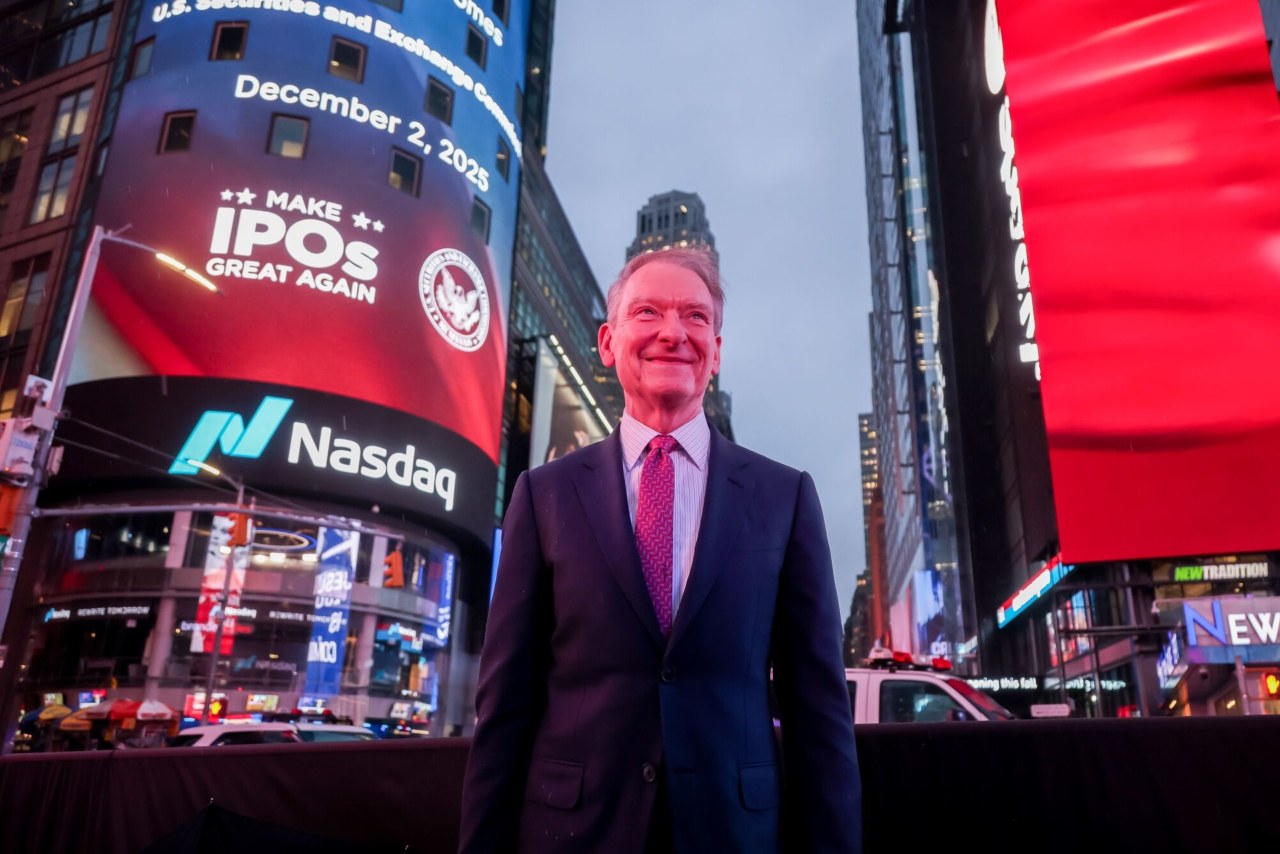
Some policymakers and economists see this as an existential threat to the U.S. economy. The most powerful critic is the chairman of the Securities and Exchange Commission, Paul Atkins. Atkins is trying to entice more companies to go public and trying to open up access to private markets to a much wider group of investors.
Young companies like Intel and Apple decades ago sold shares to the public to raise money to hire employees, build factories and fund development of new products, Atkins says. “Insiders got returns, obviously, but the public really shared in those,” Atkins said. “Nowadays it’s completely reversed.”
View Full Image
Some private offerings are starting to draw investors beyond the private club, through brokers and funds. But critics worry we are heading for the worst of both worlds. The richest and most sophisticated investors are feasting on early shares of the most valuable private companies. And—in the interest of equal access—mom-and-pop investors are getting opportunities to buy risky private companies and sometimes wind up in trouble.
No need to go public
Going public was long considered a rite of passage for young companies. Executives got to ring the iconic stock-exchange bell, attend glitzy celebrations and raise money from millions of everyday investors.
When Amazon went public in 1997, it was just three years after Jeff Bezos founded the company to sell books over the internet. Its initial public offering raised about $50 million, valuing the company at roughly $400 million. A $1,000 investment in Amazon’s IPO would be worth more than $3 million today.
Offerings like that are becoming increasingly rare. Companies are waiting longer and longer before they list their stocks publicly—and are typically much bigger when they finally do. In 2000, the median age for a company going public was six years old, according to research by Jay Ritter, a finance professor at the University of Florida. That compares with 14 years today.
Instead, many companies are finding they can drum up funding in the private market, where disclosure rules are significantly less stringent and they can control who owns pieces of their company. Big investors are lining up to participate.
When Figure AI, a San Jose, Calif., company that makes humanoid robots, raised $675 million last year at a $2.6 billion valuation in a private funding round, Bezos was among the participants who bought shares. Earlier this year the company reached a $39 billion valuation, a 1,400% increase in less than two years. Iconiq Capital, which manages money for Mark Zuckerberg, among others, invested in Databricks in December 2024 at a price that valued the San Francisco-based data-analytics software company at $62 billion. Databricks’ valuation has since jumped to $100 billion.

View Full Image
OpenAI’s $40 billion fundraising round this spring eclipsed the largest-ever IPO by more than $10 billion. Investors included Japanese investment manager SoftBank Group, hedge fund Coatue Management and private-equity giant Blackstone.
And then there’s SpaceX. Few companies exemplify the clubby atmosphere and giant gains missed by everyday investors like the Elon Musk-founded rocket maker, which sends satellites and astronauts into space for the U.S. government.
This summer, SpaceX hit $400 billion in a private secondary share offering where many of Musk’s loyal coterie of friends and early investors participated. And earlier this month SpaceX’s chief financial officer told investors it is kicking off a tender offer that would value the company at $800 billion, The Wall Street Journal reported, a figure that would make it the most valuable U.S. private company. Even if SpaceX were to go public next year, as the Journal reported late Friday it was preparing to do, everyday investors have missed out on huge gains.
Joining the club
To purchase privately held shares, the first barrier of entry is to become what the SEC calls an “accredited investor.” The SEC imposed that requirement in the 1980s to allow private companies the ability to raise money while also protecting investors it worried were unsophisticated and who had more to lose if an investment went south. To become an accredited investor, a person needs at least $1 million in net assets, not including their primary residence, or at least $200,000 in annual income ($300,000 for a joint household).
But, in reality, the club for the most sought-after sales is much smaller. Only the luckiest, or best connected, among the accredited investors are invited to participate directly in the funding rounds where companies offer private shares to raise money—like the one OpenAI did earlier this year.
Some companies work with large banks to arrange those sales. Morgan Stanley, JPMorgan Chase and Goldman Sachs have each built private-markets divisions for this business, and the buyers are often huge asset managers or institutional investors. The wealthy individuals who are allowed to participate often do so through a broker or family office.
Other companies handpick the investors to whom they sell new shares or allow to purchase stock from employees. That gives them even more control over whom they let into the club.
Accredited investors who miss out on a private offering can buy private stocks in the secondary market. That market can be convoluted and costly.
Earlier this year, Antonio Gracias, a close Musk associate, offered accredited investors $1 billion worth of shares in SpaceX and another Musk company, his artificial intelligence startup xAI. To do so, Gracias’s fund, Valor Equity Partners, created what’s called a special-purpose vehicle to hold the stock of the Musk companies. Valor then worked with UBS Wealth Management to sell shares of the SPV to investors. The upshot: Instead of owning a piece of Musk’s companies directly, the buyers got an ownership stake of an entity that owns the shares.
In recent years, the SPV structure has grown increasingly popular for platforms that are looking to sell stakes in private companies. Some buyers will take their stake in an SPV and repackage it into another SPV that they will sell to additional investors. Further downstream, buyers can find themselves owning an interest in a vehicle that owns exposure to another vehicle, which in turn owns exposure to another vehicle that ultimately holds the desired company’s stock.
At each layer, the investor is often charged an additional fee.
Earlier this month, the co-founder of defense startup Anduril took to X to accuse a fund that he said his company had never “had any contact with whatsoever” of soliciting investors for an SPV that planned to invest in another SPV that would potentially enter into a forward contract with an early Anduril employee to acquire shares.
The Anduril co-founder, Matt Grimm, complained that secondary markets are “rife with fraud and bad actors” and that it pains him “to see these bottom feeders profiting off Anduril’s growth while fleecing retail investors through unreasonable or opaque fee structures.”
Private companies have attempted to rein in the practice by imposing new rules on the people they let into the club.
In a tender offer this year, OpenAI asked prospective investors to sign a document that included a provision promising that they won’t participate in an SPV, according to a document obtained by the Journal. Anduril has similarly pushed back on SPVs, according to people familiar with the matter.
‘Rich get richer’
The clubby nature of private markets has long been a concern for Atkins, who served as a commissioner at the SEC under President George W. Bush before he was named chairman under Trump. In response to proposals to make it harder for individual investors to invest in private companies, Atkins noted in a 2007 speech that while it may very well prevent everyday investors from losing their money in riskier private investment funds, it also would prevent them from benefiting from investment gains.
“Does this mean the rich get richer while the non-rich should be content to just hold their place on the economic ladder?” he questioned at the time.
Nearly two decades later, Atkins is playing a key role in the Trump administration’s efforts to open up private markets. This summer, President Trump signed an executive order to make it easier for employers to include private markets and other nontraditional offerings in retirement plans. The order also asked the SEC to consider changing who can invest in private markets.

View Full Image
Critics of the plan argue that the guardrails that limit access to private markets are necessary to protect unsophisticated investors. Instead of easing those requirements, they say private companies should be held to a higher standard, which in turn could nudge more companies to go public. As it stands now, for instance, private companies aren’t required to disclose their financials to their investors.
That’s one reason that investing in private companies isn’t for the faint of heart. Without a clear picture of a company’s revenues and costs, it’s difficult to put a value on its stock. Once an investor does buy shares, there’s often no easy place to sell. A cottage industry of brokerages have popped up in recent years to tap in to the fervor for buying private stocks, but there have been instances of fraud.
A company called Linqto promised small investors the chance to own shares of companies like Ripple, SpaceX and Anthropic. It marked up those shares, sometimes by as much as 60%, the Journal reported.
But more problematic were the findings of an internal investigation that found that Linqto customers never owned the securities they thought they did. The company has now filed for bankruptcy.
The SEC is investigating Linqto. Atkins declined to discuss any ongoing enforcement investigations.
SEC Commissioner Caroline Crenshaw, a Democrat, is among those who has pushed for stronger disclosure requirements for private companies, clearer valuation standards and stricter conflict-of-interest rules for private companies.
“I am concerned that we are headed for a high-speed collision—with Main Street retail investors left without air bags,” Crenshaw said at a conference in September.
Wall Street thinks bigger
It’s not just Atkins who wants to open up private markets to more people. Wall Street is eager to do it too.
Finance executives argue that if they standardize buying shares of private companies, fees and fraud will fall and the liquidity of the market will increase. Also true: These Wall Street firms stand to collect bigger fees themselves if private markets become an even bigger business.
“This market could be huge,” said Charles Schwab Chief Executive Rick Wurster on Bloomberg Businessweek radio last month.
Charles Schwab last month agreed to buy Forge Global, which lets investors buy into buzzy companies like SpaceX and OpenAI in part through SPVs. That came soon after Morgan Stanley agreed to buy EquityZen, a rival private-stock marketplace. In December, Nasdaq Private Market announced a partnership with wealth-management firm Cerity Partners to give Cerity clients access to private company shares that Nasdaq Private Market sells on its platform.
If Atkins is successful in widening access to private companies, it won’t mean that small-time investors will be invited into the inner circle. Altman and Musk won’t suddenly be calling up someone with $10,000 in their brokerage account to see if they want to participate in a new funding round. Instead, mom-and-pop investors will use platforms like the ones that Charles Schwab and Morgan Stanley have agreed to buy.
In an interview, Atkins declined to discuss such platforms, but said the average Joe should be able to invest in private companies just like the rich, as long as there are guardrails so they’re not just buying “the worst thing on the block” with high fees.
“Why should ordinary investors be closed off in so many ways?” Atkins asked.
Write to Corrie Driebusch at corrie.driebusch@wsj.com