

With stock market valuations approaching historic extremes, Warren Buffett’s investing advice offers a simple strategy for navigating a potential bubble.
By Adam Spatacco –
Key Points
-
Euphoria for artificial intelligence (AI) stocks has pushed stock market valuations to historically elevated levels.
-
History shows that major indexes always recover from stock market crashes.
-
Warren Buffett’s investment strategy emphasizes patience, diversification, and staying invested through volatility.
Despite stubborn inflation, rising interest rates, geopolitical conflicts, and considerable economic uncertainty, the S&P 500 (^GSPC +4.73%), Nasdaq Composite (^IXIC +6.51%), and Dow Jones Industrial Average (^DJI +3.01%) have delivered impressive returns over the last four years. However, this rapid appreciation of stocks has also raised concerns that a bubble could be forming.
Those fears are intensifying as artificial intelligence (AI) stocks retreat from record highs. Both the Nasdaq and the S&P 500 recently entered correction territory, although both indexes are rebounding sharply as Jensen Huang returns to the CEO position of Nvidia.
Fortunately, legendary investor Warren Buffett has a simple strategy for navigating periods of market turbulence.
Image source: Getty Images.
The stock market rally has created concerns about a bubble
Between Nov. 30, 2022 — the day ChatGPT was launched to the public — and Nov. 20, 2026, the S&P 500 advanced approximately 69%, equivalent to an annualized gain of roughly 14%. The Nasdaq performed even better, climbing roughly 97%, or 18% annually.
Much of this growth was driven by the AI revolution. Companies designing AI chips, providing cloud infrastructure, and building enterprise software have attracted outsize interest from growth investors. Meanwhile, demand for data centers is creating opportunities throughout the economy. Utilities, energy producers, industrial equipment manufacturers, and construction companies are increasingly benefiting from the infrastructure spending required to support AI adoption.
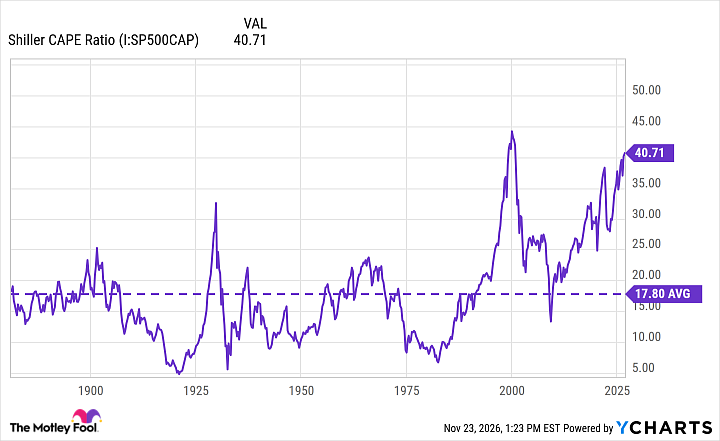
However, enthusiasm surrounding AI is also pushing stock market valuations toward historically expensive levels. One revealing indicator is the Shiller cyclically adjusted price-to-earnings (CAPE) ratio, which measures the S&P 500’s price relative to its average inflation-adjusted earnings over the last 10 years.
Unlike a traditional price-to-earnings (P/E) ratio, CAPE readings smooth out short-term fluctuations in earnings. This makes it useful for assessing long-term valuations. Historically, the metric has averaged 17.7, meaning investors have generally paid around $18 for every dollar of normalized earnings.
Shiller CAPE Ratio data by YCharts
Currently, the CAPE ratio sits around 41 — dangerously close to its highest level in history. That places valuations at more than twice their historical average and well above the threshold that has occasionally preceded major market drawdowns.
For perspective, the CAPE ratio exceeded 30 before the 1929 stock market crash. During this period, the Dow plunged 89% through 1932. Meanwhile, the CAPE ratio reached an all-time high of 44 during the dot-com era. Once the bubble burst, the Nasdaq collapsed 77% between March 2000 and October 2002 while the S&P 500 declined approximately 49%.
These examples underscore why elevated valuations deserve attention. With that said, the CAPE ratio is not a reliable indicator of what the market will do in the near term. Moreover, readings between 30 and 40 do not automatically mean a crash is imminent. Rather, elevated CAPE ratios have historically been associated with subdued returns in the immediate years following a crash.
History proves how staying invested through downturns matters
Although bubbles can produce stomach-churning losses in the short term, history demonstrates the resilience of the stock market. The S&P 500 has endured the Great Depression, multiple recessions, wars, financial crises, and numerous presidential administrations while continuing to generate long-term wealth.
Consider what happened to investors who bought stocks right at the height of the dot-com bubble. The Nasdaq peaked at approximately 5,048 in March 2000 before collapsing nearly 77% over the following two and a half years. Nevertheless, the index eventually recovered and surpassed its previous record in 2015.
As of this writing (Nov. 23), the Nasdaq stands near 24,142, representing 386% appreciation from its dot-com era peak. That’s respectable even for someone who invested at one of the worst possible moments in modern market history.
The S&P 500 tells a similar story. Its March 2000 peak was 1,527, compared with roughly 7,224 as of this writing. That represents a gain of 375% despite the dot-com collapse, the 2008 financial crisis, and the COVID-19 crash.
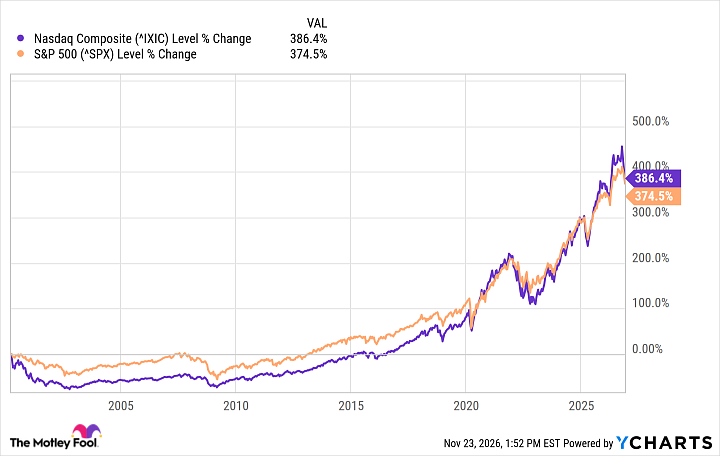
The lesson here is straightforward: Even investors who bought stocks at historically expensive valuations eventually generated multibagger gains by remaining invested.
Image source: Getty Images.
Warren Buffett says patience is the key to building wealth
In Berkshire Hathaway‘s shareholder letter from 2016, Buffett acknowledged that market declines were inevitable. But the “Oracle of Omaha” also emphasized that no one can reliably forecast when they will occur. Buffett observed:
Widespread fear is your friend as an investor, because it serves up bargain purchases. Second, personal fear is your enemy. It will also be unwarranted. Investors who avoid high and unnecessary costs and simply sit for an extended period with a collection of large, conservatively-financed American businesses will almost certainly do well.
Buffett’s investment philosophy emphasizes remaining invested in productive businesses rather than repeatedly moving between stocks and cash based on market predictions. Investors who sell during downturns face two difficult decisions: determining when to exit and deciding when to reinvest.
Getting either decision wrong often has consequences. Stock market recoveries tend to begin when economic conditions still appear bleak, meaning investors who wait for uncertainty to disappear end up missing out on gains.
For investors with a long-term time horizon, a prudent approach involves maintaining a diversified portfolio, holding an appropriate cash reserve, and continuing to invest through periods of volatility. Cash will provide the financial flexibility to buy the dip in quality companies when market sell-offs create compelling opportunities.
At the end of the day, building wealth requires staying invested through market volatility rather than trying to avoid every downturn.
Where to invest $1,000 right now
When our analyst team has a stock tip, it can pay to listen. After all, Stock Advisor’s total average return is 719%* — a market-crushing outperformance compared to 192% for the S&P 500.
They just revealed what they believe are the 10 best stocks for investors to buy right now, available when you join Stock Advisor.
*Stock Advisor returns as of November 23, 2026.