
Sign up for the Slatest to get the most insightful analysis, criticism, and advice out there, delivered to your inbox daily.
Following President Donald Trump’s announcement of global tariffs during his April 2 “Liberation Day” speech, stock markets around the world plunged sharply. The S&P 500 suffered its most significant one-day drop since the COVID-19 pandemic, while the Dow Jones Industrial Average fell 1,500 points on back-to-back days, marking the steepest decline in its 127-year history. Then on Wednesday, Trump partially backtracked, pausing certain tariffs for 90 days (with the notable exception of China’s), and the Dow posted its best one-day jump since 2020. But it’s not a total rebound. At the time of reporting, both U.S. and global markets remain significantly down since “Liberation Day,” with investors grappling with the uncertainty of a U.S.-China trade war and its potential damage to the world economy.
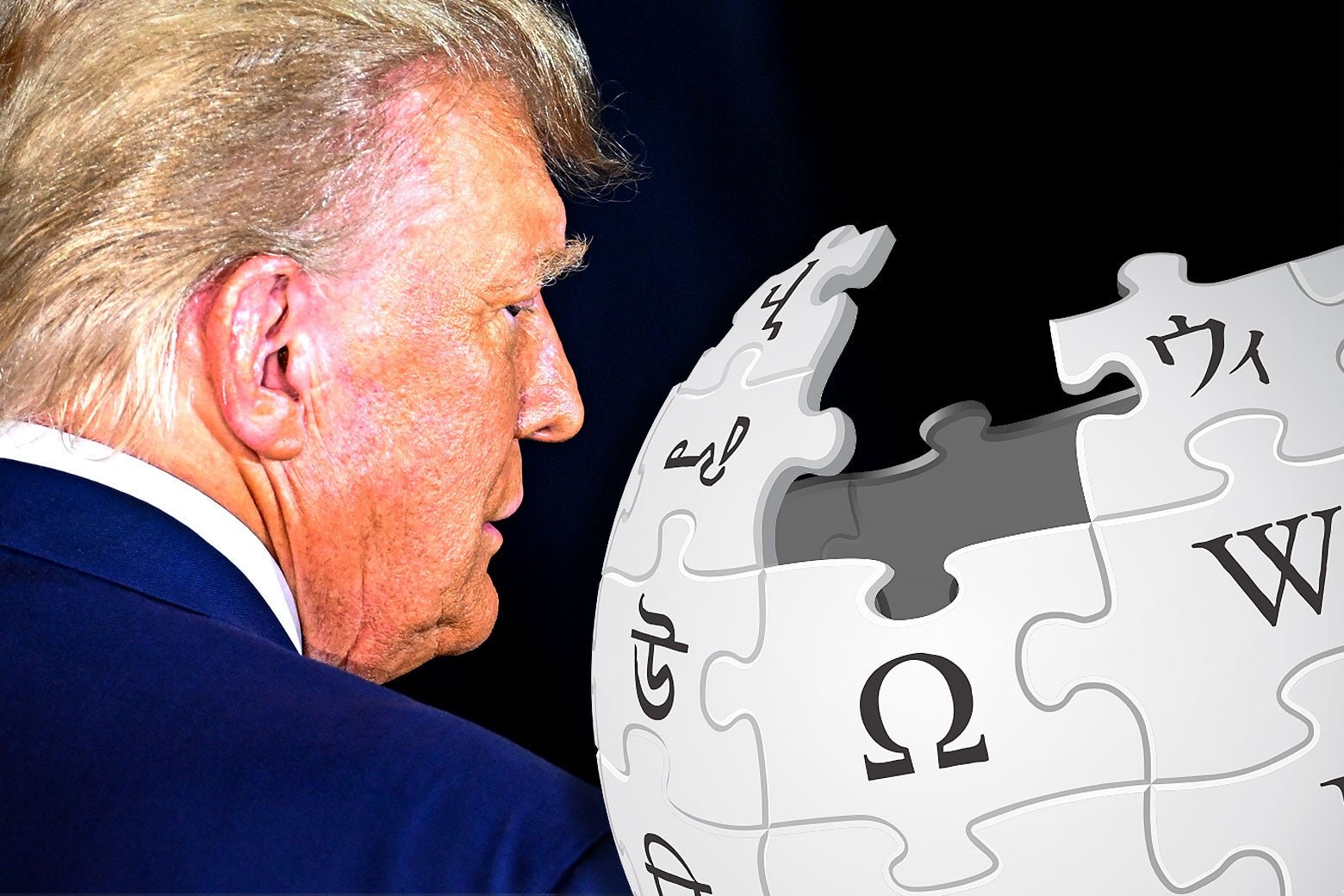
Amid the economic upheaval, Wikipedia’s volunteer editors have been diligently chronicling the turbulence on the open-access encyclopedia. Currently, the main Wikipedia entry is titled “2025 stock market crash”; however, there is a prominent note at the top of the page pointing to an ongoing debate about whether the title should be changed to “2025 stock market decline.” The back-and-forth about calling it a crash versus a decline is taking place on the article’s talk page, a forum for editors to deliberate potential edits. So far, the discussion has mostly been a healthy disagreement about how to properly apply Wikipedia’s policies, like using reliable sources and writing from a neutral point of view. This discussion is not nearly as contentious as previous naming disputes such as “Taiwan” versus “Republic of China,” or whether to call Jan. 6 an “insurrection” or an “attack.” But the crash-versus-decline debate reveals some cracks beneath the surface: Editors have starkly different views of what Wikipedia is and how it best serves readers.
As with other debates on Wikipedia, there are basically two camps: On one side, we have the archivists, editors who believe that Wikipedia’s role is akin to that of traditional encyclopedias, which only included entries that were thought to have a long-term historical significance. The archivists point to the policy that Wikipedia is not a newspaper that should cover all current events, only those that are truly encyclopedic. Wikipedia’s archivists tend to be rather cautious and conservative about framing. It’s not known yet whether the events of April 2025 will linger in the historical memory like Black Thursday (1929), Black Monday (1987), the Flash Crash (2010), and the COVID-19 crash (2020). The archivists argue that until we have a clearer picture, Wikipedia should refrain from calling this a “crash” because it’s too politically contentious.
Standing opposite of the archivists are the updaters, the Wikipedians who believe the site’s articles should reflect the current media and public framing of significant events. They point to Wikipedia’s explicit policy that it’s not a paper encyclopedia like the days of yore, but rather a digital encyclopedia project. There’s no need to delay changes until some distant future print run; the whole point of a wiki is that you can always make an edit. Quick changes are helpful because the reality is that readers are visiting Wikipedia (or accessing the same info via A.I. tools) because they want information about these events in real time. And it doesn’t matter if the term crash is potentially contentious; if that’s the word being used by contemporary sources, then Wikipedia should follow suit.
If it’s not obvious by now, most Wikipedians in the updater camp prefer the word crash, while the archivists lean toward calling it a decline until there’s a broader historical consensus. Reading through the ongoing debate about this nomenclature, it’s striking that what one group takes as totally obvious isn’t necessarily accepted by the other side. Take this exchange from early in the debate: “This is clearly a stock market crash,” wrote one editor, to which another replied, “Says who?”
Wikipedia’s policy states that its articles should reflect and curate the information that’s published by reliable sources on a topic. That’s why many Wikipedia editors have chimed in with links to articles in Bloomberg, Fortune, Business Insider, and other financial news sites that have specifically used the word crash—That’s who says so, they are arguing. On the other hand, some news outlets have stopped short of calling it a full-blown crash. With Trump’s recent decision to hit pause, it isn’t obvious which description is going to stick. Maybe this incident will be forgotten like so many other seemingly newsworthy events from Trump’s first term. Or this tariff whiplash could likely lead to a recession, which JPMorgan’s CEO Jamie Dimon has described as the likely outcome.
Speaking of recessions, the current debate over how to chronicle this month’s market shocks differs from the 2022 recession discourse. Back then, conservative tweets and media coverage falsely claimed that Wikipedia had altered its definition of “recession” in order to intentionally favor the Biden administration. But the truth was relatively ordinary: For decades, the nonprofit National Bureau of Economic Research has been considered the authority for defining recession dates in the U.S. During the Biden administration, the NBER did not declare a recession because indicators like employment and consumer spending were still quite strong. Rather than conspiring to help Democrats, Wikipedia editors were simply reflecting the NBER’s definition of the term.
When it comes to whether this month’s market turbulence should be called a crash or a decline, there’s no widely accepted authority like the NBER to make the call. Yes, there was a sudden and dramatic drop in stock prices—the standard definition of a crash—but how this drop will be remembered over the long term remains to be seen.
Why does this debate matter? Because Wikipedia isn’t just a reference site—it’s a living archive that provides information infrastructure to the broader internet. Consumers, investors, journalists, and A.I. models all rely on its language, whether they realize it or not. Even billionaires who claim to hate Wikipedia care a great deal about its content. A single word—crash or decline—can potentially shape both market sentiment and public memory.
At press time, Wikipedia editors are still deciding what to call the page, and one intriguing detail is the relatively small group of participants. By my tally, there are only about 40 editors involved. Naturally, there’s always a much larger audience that consumes Wikipedia articles than is willing to engage with the editorial debates about them. Still, considering Wikipedia’s role in writing the “first draft of history,” you might assume there’d be a larger crowd.
Then again, the situation could be worse. While a cohort of 40 Wikipedia editors might not seem substantial, at least it’s not a one-man show.

Sign up for Slate’s evening newsletter.