
Key events
UK house prices edge up in July amid interest rate caution

Joanna Partridge
Economic uncertainty dampened UK house price growth in July as prospective house buyers remained cautious about interest rates amid the ongoing US war with Iran in what should be peak housebuying season.
House prices rose by just 0.1% in July from a month earlier, according to lender Nationwide, while annual price growth slowed to 1.8% this month, down from 2.2% in June.
The UK’s biggest building society said the price of an average home edged slightly higher in July to £277,542, up from £277,484 the previous month. However, this is still lower than the average price recorded in May, when it rose above £278,000.
Robert Gardner, chief economist at Nationwide, said:
Market activity and house prices have remained soft in recent months, in part reflecting the uncertain economic backdrop. Geopolitical tensions remain high, with the conflict between Iran and the US again exerting upward pressure on energy prices and market interest rates in recent weeks.
Financial market expectations for the future path of Bank Rate have been volatile, reflecting shifting views about the inflationary implications of events at home and abroad.
British Airways owner’s profits fall as Iran war pushes up fuel costs
The owner of British Airways has reported a steep fall in profits and said it expects no growth in passenger capacity this year as the US-Israeli war in Iran takes its toll.
International Airlines Group (IAG) said it expected demand to stay strong, but added that its “disciplined cost control” could only partly mitigate the impact of “a significant fuel price increase” caused by the attacks on Iran. Iran closed the strait of Hormuz in response to the attacks, a key export route for oil from the Gulf.
The company, which also owns Iberia and Aer Lingus, among others, said that it was a “resilient revenue performance despite lower capacity than planned”.
Revenue increased in the first half of 2026 by 1% to €16bn, while profit after tax fell 21% to €1bn.
Luis Gallego, IAG’s chief executive, said:
With these results IAG has again demonstrated that its excellent fundamentals are supporting continued value creation for our shareholders, despite the impact of the crisis in the Middle East and wider geopolitical events.
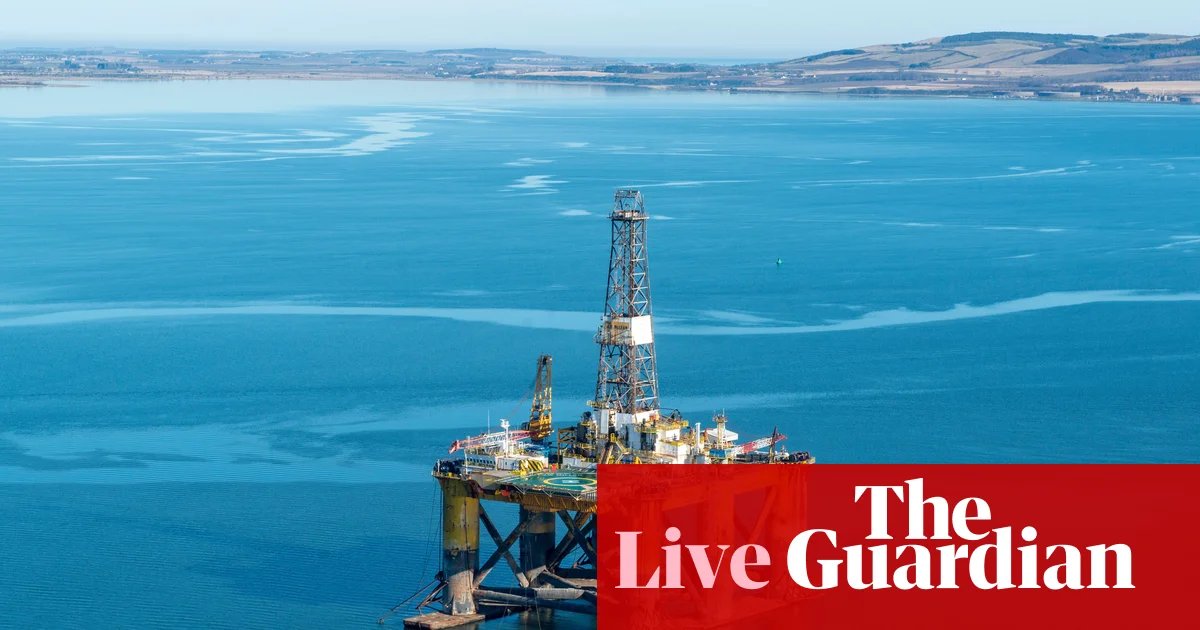
BP to sell North Sea business; Korea’s stock market rises a record 18%
Good morning, and welcome to our live coverage of business, economics and financial markets.
BP has put its North Sea oil business up for sale, saying it will try to find a buyer amid a political dispute over whether the UK government should allow more drilling.
Prime minister Andy Burnham on Thursday signalled that he would be open to more extraction in the North Sea, although he did not make clear if that would mean new licences or allowing expanded use of existing wells.
BP, one of the biggest companies on the FTSE 100, said it was selling the North Sea business as part of an ongoing portfolio review under American chief executive Meg O’Neill. The American was appointed in December with a remit to refocus the company after a tumultuous period of three chief executives in three years.
The company said it wanted to direct the spending required on the North Sea to other places which could offer higher financial returns.
O’Neill said:
The UK has been our home for more than 100 years and will continue to play an important role in our future. We’re proud of the jobs we create, the contribution we make to the UK economy, and the work we do to keep energy flowing every day.
The North Sea remains integral to the UK’s energy system. However, as we focus our portfolio and direct capital to our highest-value opportunities, we believe our North Sea business will be better positioned as part of another company. It has world-class people, resilient assets and a proud heritage, and it is precisely these qualities that can attract an owner ready to back its next chapter. We are seeking an outcome that recognises that value.
The question of whether to allow more North Sea drilling has become politically contentious in recent months. Environmental campaigners are aghast that Labour is considering allowing more drilling for planet-heating fossil fuels, but Burnham appears to have decided it would be more useful to drill at a time of high energy prices.
Donald Trump revealed Burnham’s plans after a first phone call between the US president and the new prime minister. Burnham later told reporters:
I indicated in the phone call that we had, a week last Monday, that I would take a pragmatic approach when it comes to the North Sea, and that is my intention as we go forward from here.
There is a resource there. When people are struggling, we can’t ignore that. Hence, me indicating that to the president.
Record day for Korea’s stock market
South Korea’s stock market has been going through a period of turbulence for the ages thanks to the AI boom – and fears it will bust. It continued on Friday, with the largest single-day increase in the benchmark Kospi index’s history.
Korea’s Kospi is up an astonishing 17.91% today. It fell 11% on Tuesday – just shy of the record 12.06% decline hit in early March in the first days of the Iran war – and 6% on Wednesday.
Global stock markets have been dominated in recent months by artificial intelligence companies. But Korea’s stock market does not have the depth of the US, meaning its AI-exposed chip companies are even more dominant. The share price of chipmaker SK Hynix soared 30% on Friday, while Samsung Electronics was up 28%.
Over the last 12 months the index is up 104%, but over the last one month it is down 20%. In this wild week it has dropped a mere 1.1% – all that sound and fury, signifying nearly nothing. These are not normal moves.
Sergi Lanau, director of emerging markets strategy at Oxford Economics, said that “We believe sentiment is still frothy in Korea”, citing the size of assets in leveraged exchange-traded funds (ETFs), which use debt to pump up returns. He said:
Although we believe the AI buildout still has legs, we expect burned leveraged traders in Korea to continue to exit the market, keeping it under pressure. That’s sufficient reason to lower our weight on the broader emerging market complex to neutral.
Korea’s authorities have this week sought to tighten restrictions on leveraged ETFs, although given the wild swings some investors will already be ruing the day they bought them.