
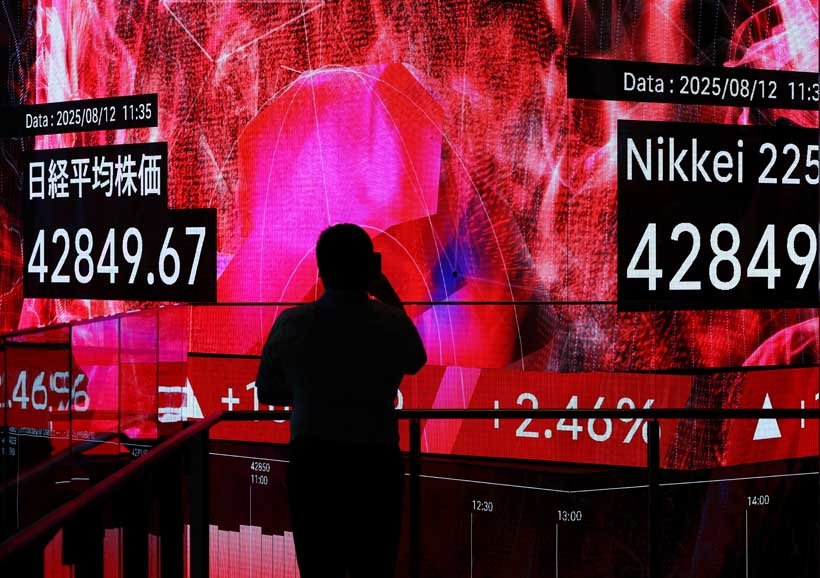
Asian stock markets declined on Thursday as renewed fighting between the United States and Iran unsettled investors and triggered a broader shift toward safer assets. Although oil prices eased from recent highs following a ceasefire agreement between Israel and Lebanon, concerns about escalating regional tensions continued to weigh on global market sentiment.
Investors largely ignored stronger than expected US economic data, focusing instead on the potential impact of renewed hostilities in the Middle East on global growth, energy markets and financial stability.
Asian Markets Extend Losses
MSCI’s broad index of Asia Pacific shares outside Japan fell 1.6 percent, reflecting widespread investor caution across the region.
Japan’s Nikkei 225 dropped 1.4 percent, while South Korean stocks reopened after a public holiday and fell as much as 2.6 percent. US stock futures also pointed lower, with S&P 500 futures declining 0.4 percent.
Stay ahead of the geopolitical week.
MD Briefing delivers expert analysis across five global fronts — the Indo-Pacific, energy, geoeconomics, European security, and the Middle East — every Monday morning. Free.
Market analysts said investors shifted back into a risk off mode as military tensions between Washington and Tehran intensified once again.
Wall Street Retreats Despite Strong Economic Data
US stocks closed lower overnight as concerns over geopolitical risks overshadowed positive economic indicators.
The S&P 500 fell 0.7 percent even after data showed the US services sector expanded faster than expected in May. The improvement was partly driven by businesses increasing orders and rebuilding inventories amid fears of supply disruptions and rising costs linked to the Iran conflict.
Investors appeared more focused on the possibility of prolonged instability in the Middle East than on encouraging economic signals.
Oil Prices Ease After Israel Lebanon Ceasefire
Oil prices pulled back from recent gains after Israel and Lebanon agreed to implement a ceasefire arrangement aimed at reducing hostilities along their border.
Brent crude futures slipped 0.7 percent to $97.14 per barrel during Asian trading. The agreement is contingent upon a complete cessation of fire by Hezbollah forces and the evacuation of operatives from southern Lebanon.
Although the ceasefire helped calm immediate concerns about regional supply disruptions, traders remained cautious given the fragile security environment and ongoing tensions involving Iran.
US Political Debate Over Iran Conflict Intensifies
Political developments in Washington added another dimension to market uncertainty.
The Republican controlled US House of Representatives approved a war powers resolution intended to limit President Donald Trump’s ability to continue military operations against Iran. However, the measure faces significant obstacles in the Senate and would likely encounter a presidential veto if it advances further.
The debate reflects growing political divisions over US involvement in the conflict and its potential consequences for global stability.
Technology stocks faced additional pressure after semiconductor company Broadcom reported quarterly revenue that fell short of Wall Street expectations.
Broadcom shares plunged more than 13 percent in extended trading, raising concerns about the pace of growth in the artificial intelligence sector.
Investors were also disappointed that company executives maintained their previous 2027 sales forecast rather than raising expectations, prompting questions about whether demand growth in AI related markets may be slowing.
Yen Gains as Bank of Japan Signals Potential Rate Hike
Currency markets were influenced by growing expectations that the Bank of Japan could raise interest rates in the near future.
The Japanese yen strengthened slightly against the US dollar, trading near levels that many investors consider important for potential government intervention.
Comments from Japanese officials reinforced expectations that policymakers are increasingly concerned about inflation risks and may be preparing for tighter monetary policy.
Australian Dollar Supported by Trade Data
The Australian dollar initially gained support after government data showed the country’s trade balance returned to surplus in April.
A recovery in resource exports helped offset higher fuel imports, improving Australia’s external trade position. However, the currency later surrendered most of its gains as broader market caution limited investor appetite for risk sensitive assets.
Gold Attracts Safe Haven Demand
Gold prices rose 0.9 percent as investors sought protection from market volatility and geopolitical uncertainty.
The precious metal remained firmly within its recent trading range, benefiting from increased demand for safe haven assets amid concerns about the Middle East conflict and broader economic risks.
Government bond markets were relatively stable, with the yield on the benchmark US 10 year Treasury remaining near 4.49 percent.
Bitcoin Remains Under Pressure
Cryptocurrency markets continued to struggle as investors moved away from riskier assets.
Bitcoin fell 1.2 percent to around $64,118 after recently touching a four month low. The digital currency has lost as much as 17 percent over five consecutive days of declines.
Analysts attributed the weakness to a combination of a stronger US dollar, rising bond yields and deteriorating investor confidence caused by growing geopolitical tensions.
Ethereum managed to post modest gains but remained vulnerable to broader market sentiment.
Background
Global financial markets have faced heightened volatility throughout 2026 due to escalating geopolitical tensions in the Middle East. The conflict involving the United States and Iran has raised concerns about potential disruptions to global energy supplies, international trade routes and economic growth.
Historically, periods of geopolitical instability have pushed investors toward safer assets such as gold, government bonds and stable currencies while reducing exposure to stocks and cryptocurrencies.
At the same time, investors continue to monitor central bank policies, inflation trends and corporate earnings for signs of how the global economy is responding to ongoing uncertainty.
Analysis: Geopolitics Overshadows Economic Fundamentals
The latest market reaction demonstrates how geopolitical developments can quickly outweigh positive economic data.
Despite stronger than expected growth in the US services sector, investors focused primarily on the risks associated with renewed fighting between the United States and Iran. This shift in sentiment triggered broad selling across equity markets while boosting demand for traditional safe haven assets.
Oil’s retreat from recent highs suggests markets believe the Israel Lebanon ceasefire could help prevent a wider regional conflict. However, the relatively modest decline indicates that traders remain concerned about the possibility of further escalation involving Iran.
The selloff in technology stocks following Broadcom’s disappointing results also highlights growing investor sensitivity to earnings performance after months of strong enthusiasm surrounding artificial intelligence related companies.
Meanwhile, expectations of a possible Bank of Japan rate hike add another source of uncertainty for global investors. Changes in Japanese monetary policy could influence currency markets, capital flows and borrowing costs worldwide.
Unless diplomatic efforts succeed in reducing tensions between Washington and Tehran, market volatility is likely to remain elevated. Investors will continue to closely monitor developments in the Middle East, energy markets and central bank policies as they assess risks to the global economic outlook.
Conclusion
Asian stocks fell sharply as renewed US Iran hostilities fueled concerns about global stability and economic growth. While oil prices eased following a ceasefire agreement between Israel and Lebanon, investors remained cautious amid ongoing geopolitical uncertainty. With pressure on equities, cryptocurrencies and technology stocks, market participants are increasingly turning to safe haven assets while awaiting clearer signals on the future direction of the conflict and the global economy.
With information from Reuters.